The Cut Melon (1760), acquired last year, is now on view again after conservation
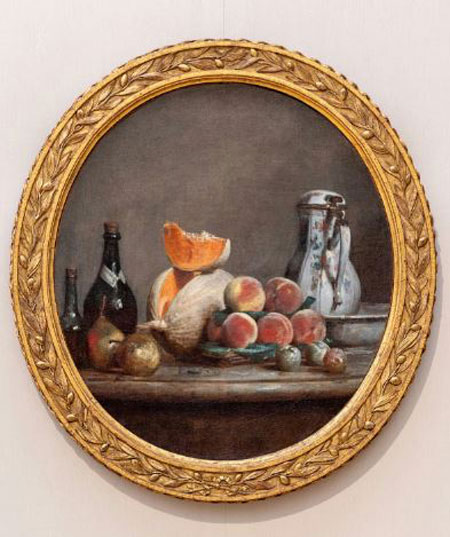
The Kimbell Art Museum announced that Jean Siméon Chardin's The Cut Melon (1760) is back on view following conservation treatment of both the painting and its original frame. Chardin is considered one of the greatest painters of still lifes in the history of art, and The Cut Melon one of his most remarkable works. In its original frame, a rarity for Old Master paintings, the masterpiece can now be seen as it appeared when it was first exhibited, at the Paris Salon in 1761.
The Cut Melon
Acquired last year, the painting arrived at the Kimbell after being preserved in distinguished private collections since the eighteenth century. Prior to cleaning, decades of benign neglect and discolored varnish had veiled the work in warm tones. The conservation treatment allowed for the return of Chardin's cooler tonality, particularly in the depiction of the marble tabletop, the pitcher, and the melon's rind. Now revealed to its fullest is the freely brushed surface that Chardin intended for the painting. This is seen, for example, in the leaves on which the peaches rest, where Chardin's freshly revealed dry brushwork projects a tactile quality, while the cool-toned, textured cantaloupe rind contrasts with the soft, bright orange flesh.
Its frame
At the annual Paris Salon in 1761 the painting was paired with The Jar of Apricots (1758, The Art Gallery of Ontario, Toronto). The Salon catalogue lists "Two paintings in oval format belonging to M. Roëttiers, goldsmith to the King." Their precise identity is confirmed by the artist Gabriel de Saint-Aubin's thumbnail sketches of the framed oval paintings in his copy of the printed catalogue (Bibliothèque nationale de France, Paris). Notably, Saint-Aubin wrote that the pictures were "encircled by a branch and a golden chain" ("environé d'un Rameau et d'une chaîne d'or"). His interest must have been piqued by its simple neoclassical design derived from ancient Greek and Roman architecture, a style that had begun to replace the elaborately carved, exuberant curves of Rococo picture frames and other decorative arts at this time. Olive leaf branches (crossed and tied with a ribbon at the bottom) have been carved in low relief between two narrow flat bands of the gilded frame. Showcasing the expert craftsmanship of the frame maker are the twisted, interlocking links of the curb chain that has been intricately carved along the side of the oval frame. Such a type of chain, an unusual motif to ornament a frame, would have been familiar to the goldsmith and might have even been used to hang a picture or medallion. The recent restoration highlights the frame's virtuoso craftsmanship, though the identities of the designer and frame maker remain unknown.
Their history
The earliest owner of The Cut Melon and its frame–Jacques Roëttiers, goldsmith to King Louis XV and a member of the illustrious family of medalists and goldsmiths–probably commissioned the painting and its pendant from Chardin. As esteemed artists in their respective professions, they must have shared mutual respect and known each other well, for both had been granted artists' lodgings in the Louvre by the king. The Cut Melon was bought in the early nineteenth century by the painter François Marcille, who assembled a renowned collection of eighteenth-century French paintings, contributing to the revival of interest in Chardin and other artists. From his son Camille, the painting was purchased in 1876 by Baroness Charlotte de Rothschild, an arts patron and gifted watercolorist, in whose family it remained until acquired by the Kimbell Art Foundation.
ABOUT JEAN SIMÉON CHARDIN
Jean Siméon Chardin (1699–1779), whom Denis Diderot famously acclaimed as "the great magician" in tribute to the artist's seemingly effortless compositions that invite poetic reveries for their humble subjects, was the leading exponent of both still-life and genre painting in eighteenth-century France.
Chardin elevated the stature of these "lesser" categories of painting in the Académie Royale de Peinture et de Sculpture in Paris, to which he was accepted in 1728 as "skilled in animals and fruit." Earning esteem for his still lifes of game and kitchen scenes, he expanded his repertoire to figural genre scenes, often featuring maidservants and children. Elected Academy treasurer in 1755, he was also in charge of hanging the pictures in the annual Salons, where his own innovative works received great acclaim.
By the 1750s and 1760s, Chardin returned to painting still life. Chardin expert Pierre Rosenberg, former director of the Musée du Louvre, has observed that it is "the voluptuousness, tenderness, and the gravity which set Chardin apart and place him in the ranks of the great painters." Rosenberg has called The Cut Melon and its pendant "among the finest of this period of Chardin's career."
After his death in 1779, Chardin fell into relative obscurity, but by the mid-nineteenth century was "rediscovered" by connoisseurs and collectors—and especially artists—who were sensitive to his exceptional skills in manipulating light, color, and composition. Among the legions of later artists Chardin's work inspired were Édouard Manet, Paul Cézanne, and, more recently, Lucien Freud. Writers have been equally inspired by Chardin, including Marcel Proust who references the painter numerous times in his groundbreaking masterpiece In Search of Lost Time.
VISITOR INFORMATION
Admission to the museum's permanent collection is always free. Special exhibition tickets are $18 for adults, $16 for seniors and students, $14 for children ages 6–11, and free for children under age 6. Audio guides are available for $4. Admission is half-price all day on Tuesday and after 5 p.m. on Friday. Additional discounts are available on-site for K–12 teachers, active-duty military, and SNAP program recipients. Museum members receive unlimited, free access to all special exhibitions and free audio guides.
The Kimbell Art Museum is open Tuesday through Thursday and Saturday, 10 a.m.–5 p.m.; Friday, noon–8 p.m.; and Sunday, noon–5 p.m.; last exhibition entry 30 minutes before closing. It is closed Monday, New Year's Day, Juneteenth, July 4, Thanksgiving, and Christmas. For general information, call 817-332-8451.
ABOUT THE KIMBELL ART MUSEUM
The Kimbell Art Museum, owned and operated by the Kimbell Art Foundation, is internationally renowned for both its collections and its architecture. The Kimbell's collections range in period from antiquity to the twentieth century and include European paintings and sculptures by artists such as Michelangelo, Caravaggio, Artemisia Gentileschi, Bernini, Velázquez, Gainsborough, Monet, Cézanne, Picasso, and Matisse, as well as important examples of Egyptian and classical antiquities. Also included are significant works of Asian art from China, Japan, the Himalayas, and South and Southeast Asia; notable African sculptures primarily from West and Central Africa; and a wide range of ancient American art representing cultures across Mexico and Central and South America.
The museum's 1972 building, designed by the American architect Louis I. Kahn, is widely regarded as one of the outstanding architectural achievements of the modern era. A second building, designed by Italian architect Renzo Piano, opened in 2013 and now provides space for special exhibitions, dedicated classrooms, and a 289-seat auditorium with excellent acoustics for music. For more information, visit kimbellart.org.