I remember well the first time I fished with guide Tony Parker. It was a cold winter’s day back in the early nineties at Lake Tawakoni.
Tony was just getting established as a fishing guide and back then he did a good bit of largemouth bass fishing. On the phone the evening before our trip, we discussed the game plan for fishing the next morning. As I remember our conversation went something like this: “Luke we will fish a bluebird day tomorrow and conditions are definitely not ideal. We’ll fish water about 6-feet deep with Texas-rigged worms and I think we’ll do pretty well. These bass have been on a steady shallow-water pattern and I think it will hold.”
I joined Tony around nine the next morning, after the sun warmed things up a bit. It was still cold with a chilling north breeze. We fished the breakwater that was protected by a marina and caught a respectable number of chunky pre-spawn bass.
Since that first time to fish together years ago, I’ve continued to fish with Tony and followed his career. I have a feeling he could still hold his own as a bass catcher, but his bread-and-butter species are hybrid stripers and white bass.
He began guiding for these open water schooling species at Tawakoni but then when Lake Jim Chapman (called Lake Cooper by many) opened, Tony was one of the first, probably the first, fishing guide to move his operation to these fertile waters fed by the Sulphur River. Tony was very instrumental in putting Cooper on the map as a destination for anglers to come and enjoy some fast pace catching for hybrids and white bass.
For many years, Tony invited just about every outdoor writer in the state to come fish with him and enjoy some red-hot catching of white bass and later hybrid stripers. For reasons unknown to Tony, or anyone else for that matter, the best bite for hybrids and white bass on Cooper has always been midday.
Right now, midday fishing often equates to getting parched by a relentless sun and fishing the 100-degree-plus temperatures. Until the weather cools a bit, Tony will be running very early morning trips to Tawakoni where the bite has always been very dependable.
Fast forward to last week
My good friend Jeff Rice and I pulled into the parking lot constructed by the Sabine River Authority situated near the south end of the dam just as the sun was beginning to peek over the horizon. For many years the old Holiday Marina occupied this spot and my mind backtracked, thinking of all the great fishing trips that I’ve enjoyed that began at the old marina. The marina site is now covered with several acres of concrete parking, a nice bathroom facility and one of the best boat launching ramps I’ve seen anywhere.
Tony was sitting in his new guide boat, rigging rods with 1.5 ounce white and chartreuse lead slabs. We reminisced a bit about the old marina, but our conversation soon turned to the task at hand, catching some hard fighting and good eating hybrid stripers and jumbo-sized white bass.
A little pre-fishing was in order.
“I’ve been fishing some big schools this week that are dependable early morning bite,” says Tony. “The fish are moving out of deep water onto a big flat that averages about 13 feet deep. Some mornings they are chasing shad to the surface and we can spot the school by the topwater splashes but watching the side imaging sonar is the ticket to staying in the action. Trolling with a big deep-diving plug with smaller trailer spoons is a good way to catch a quick limit but we’re going to actually fish for them. It’s a lot more fun and I know you old veteran slab chunkers are up to the challenge.”
Jeff and I definitely were!
Trolling can be a sure-fire method of putting fish in the boat but casting artificial baits and tricking the fish into biting is much more fun. The technique we were using was definitely nothing new to any of us. Make a long cast, hold the rod tip high, contact bottom and crank fast five or six cranks and then let the slab fall to the bottom and repeat the process.
A big school of fish plotted on the right side of the boat, and we quickly boated a couple of chunky hybrid stripers using the tried and proven cast, reel and drop technique. And then Tony pointed to the north and, at the same time, cranked the big motor up.
“There is a big school breaking the surface a couple of hundred yards out to the north," he explained. "Let’s motor that direction and then approach with the trolling motor so we won’t spook them.”
At first, I couldn’t spot the surface action and then I caught the rising sun lighting up some of the splashes. This appeared to be a big school and some of the splashes looked as though someone had dropped a bowling ball from an airplane into the water — some big fish were herding shad to the surface and there was no place for the baitfish to go but up in their frantic effort to escape.
The bite was red hot for about 15 minutes and then the school sounded and moved on in pursuit of the baitfish. So went the next couple of hours when we would mark big schools of hybrids and white bass on sonar, enjoy a few minutes of fast catching and then move on to the next concentration of fish.
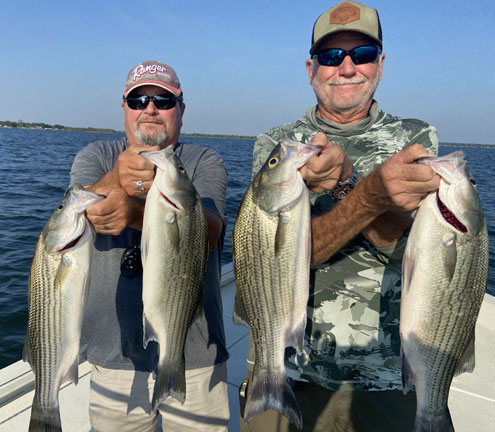
Tony plans to continue these early morning trips to Tawakoni for a bit longer, until the heat wave subsides and mid-day fishing is once again comfortable on Lake Cooper. He’s looking forward to fall and the great fishing it will provide but until then, he’ll continue to chase schooling fish at good old Tawakoni during the cool part of the day. Jeff and I were on our way home with a big cooler of good eating fillets by mid-morning. Who says it’s too hot to fish this time of year?
Guide Tony Parker can be reached at 903-348-1619. Our fishing trip will be featured this week on our outdoor show, “A Sportsman’s Life” hosted on Carbon TV at www.carbontv.com and YouTube.
Catch Luke’s weekly podcast “Catfish Radio with Luke Clayton and Friends” just about wherever podcasts are hosted. Email Luke through his website at www.catfishradio.org.