

It wasn't supposed to be like this.
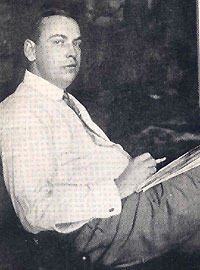
Now, all those old chums were busy replicating the species and duplicating success after success in business. On the other hand, Bedichek was on a train headed down south from Montreal to Texas to start over for the umpteenth time and Steger would soon stagger from rejection to rejection as publishers all across New York City collectively turned their back.
This wasn't the 'different' they had in mind.
Harry Peyton Steger was 25, alone in New York City, unemployed and the only thing he was really sure of--the ability to live off his writing--he was dead wrong about.
For those of us vaguely familiar with the life of Harry Peyton Steger, this wasn't how we envisioned our Rhodes Scholar entering New York City. Don't you just know Mr. and Mrs. Thomas P. Steger had a very different vision of how this was supposed to turn out, too?
You have to wonder about the conversation Harry's parents had when they opened the letter that announced he was back stateside and, in an understatement of dramatic proportions, stated simply, "You may be curious to know what I am going to do in New York. I shall probably pick up something in the journalistic line."
Curious might not be the right word. Furious would be a better description how most parents would feel to learn their son had resigned the most prestigious scholarship on the planet, bummed around Europe for a couple of months and then scraped together just enough to secure steerage (the most modest, inferior accommodations--likely a tiny room in the bowels of the ship near the boiler room) to New York where he knew no one, but kinda thought he might "probably pick up something in the journalistic line."
The Steger clan can trace their ancestry back to John Jefferson, brother of none other than Thomas Jefferson, but if one were to go back far enough, surely Thomas Steger and Alice Scales Steger were direct descendants of Job; both were pillars of patience. At the very least, both were hewn from good timber.
Still, you have to wonder what Harry Peyton Steger's mother, or "mither" as he had taken to calling her, thought about all this. After all, it was Mrs. Steger's female intuition about a newspaper article regarding two new Rhodes Scholars from Texas that flushed the news out of Harry that he had flushed his scholarship.
Alice Scales was the only daughter of Dr. and Mrs. Pleasant Scales of Massachusetts. Alice wed Thomas Steger on New Year's Day 1873 in Baldwyn, Massachusetts. The Steger family was centered around Moscow, Tennessee in those days. Thomas and Alice presented the world with their first child, a son named Harry Peyton Steger, on March 2, 1882. Harry liked to say that he fed squirrels in Moscow's Court Square for seven years and then moved to Bonham.
And what did Harry's father, a prominent and seemingly pragmatic lawyer, think of a son born to chase butterflies? What did this family that truly excelled at making money think of our boy, Harry?
Several Steger brothers had joined the exodus from Tennessee to Texas in the 1880s.
Ed Steger was one of the driving forces behind the formation of the Denison, Bonham and New Orleans Railroad and he is also credited with creating a thriving horse market in Bonham.
Ed later became a lawyer and mule trader; although the two occupations seem to make a rather strange combination, he would later draw upon his training in law to deal with a rather unpleasant situation that arose from a contractual dispute with a business partner over supplying mules to the U.S. Army. And, if a letter Harry Peyton Steger wrote in 1907 is correct, Ed also opened a bank in St. Louis.
William Steger died soon after coming to Bonham. Verge Steger became a merchant and opened an opera house.
By 1890, the Steger Opera House was attracting touring companies of everything from opera to vaudeville to whet the excitement of the folks around Fannin County. The Steger Mill opened the same year.
Gus Steger operated the Steger Mill. Another brother, Robert Steger, also went to work at the mill. If you recall, this was the mill that Harry expected to run one summer, however it was explained to him in no uncertain terms at his interview that, unlike an institution of higher learning, Latin and Greek weren't exactly prerequisites for a management position in the mill business. Needless to say, Harry didn't get a callback.
"He thought some rather unflattering remarks and thunk some of them out loud," Harry had written to Bedichek about the unsuccessful job interview.
Thomas P. Steger was a lawyer and a member of the board of directors for the Steger Lumber Company that was operated by a nephew, John Steger. In five short years, Thomas would be burying his only son and still stoically continuing to manage Sam Rayburn’s successful congressional campaign in 1912.
These were Bonham's boom years. The historical Fannin County Courthouse was completed in 1888. The opera house, grain mill and public schools opened two years later. Two railroads transported a variety of commerce--bois d'arc products, cottontail rabbits and chickens, along with crops such as king cotton. Bonham Cotton Mill, supposedly the largest cotton mill west of the Mississippi River, opened in 1900. Simon Bolivar Allen threw open the doors of Allen Memorial Hospital in 1903.
Everyone in town seemed to be making money hand over fist and the Steger boys were certainly no exception. But while the rest of the family seemed to be amassing their life's fortune, Thomas was often wiring cash to bail his son out of another tight spot, for instance, the money he hurriedly sent to Quebec to help Harry and Bedi out of a jam. The Western Union staff in Bonham was on strike at the time, so Thomas instructed a Dallas bank to wire $50 to his son stranded in Canada and also wired them to waive identification. Before the money got there, unfortunately, Harry and Bedi had been forced to bid a hasty adieu to our neighbors to the north.
"When I last heard from my father," Harry wrote Bedi on September 8, 1907, "he had not secured the money, and, in his characteristic flightiness, God bless him, swears that a tramp, calling himself Harry Peyton Steger, has long since got the money and that in his old age all troubles are trebled."
previous Steger articles
http://www.ntxe-news.com/artman/publish/article_46777.shtml
http://www.ntxe-news.com/artman/publish/article_46482.shtml
http://www.ntxe-news.com/artman/publish/article_45951.shtml
http://www.ntxe-news.com/artman/publish/article_45924.shtml
http://www.ntxe-news.com/artman/publish/article_45800.shtml
http://www.ntxe-news.com/artman/publish/article_45392.shtml
http://www.ntxe-news.com/artman/publish/article_45371.shtml
http://www.ntxe-news.com/artman/publish/article_44597.shtml
http://www.ntxe-news.com/artman/publish/article_45014.shtml
http://www.ntxe-news.com/artman/publish/article_44642.shtml
http://www.ntxe-news.com/artman/publish/article_44471.shtml
http://www.ntxe-news.com/artman/publish/article_43963.shtml
http://www.ntxe-news.com/artman/publish/article_43514.shtml
http://www.ntxe-news.com/artman/publish/article_42785.shtml
http://www.ntxe-news.com/artman/publish/article_42657.shtml
http://www.ntxe-news.com/artman/publish/article_42669.shtml
http://www.ntxe-news.com/artman/publish/article_42541.shtml
http://www.ntxe-news.com/artman/publish/article_41825.shtml
http://www.ntxe-news.com/artman/publish/article_42012.shtml
http://www.ntxe-news.com/artman/publish/article_41543.shtml