

In the late1830s, the French thought that the Gabon estuary was the outlet to the Congo River with possible links to the headwaters of the Nile. Gabon became their headquarters for “French Equatorial Africa” while Senegal remained their central post for “French West Africa.” When new explorations proved that neither the Ogowe River nor the Gabon estuary were key to penetrating the interior, the French refocused their efforts and called Gabon “the Cinderella of Equatorial Africa.” Their colonial headquarters was moved to the banks of the Congo river and called ‘Brazzaville.’ Across the river from ‘Brazzaville’ was ‘Leopoldville’- the capitol of the then Belgian Congo.
With the coming of political independence from European colonialism in the 1960s, and with more global emphasis on ecology and saving the planet from ecocide, the role of Gabon has dramatically changed from ‘Cinderella’ to a model that more nations want to follow. Ten percent of Gabon** has been officially designated as protected areas where the rainforests inhale more carbon dioxide per acre than any other country worldwide. General Colin Powell*** was involved in supporting Gabon’s plans when he met with the president of Gabon, Omar Bongo, in 2002.
The key figure in President Bongo’s cabinet today is Lee James Taylor White. Born in Britain, he became a dual citizen(British-Gabonese) and is now serving as Gabon’s Minister of Water, the Forest, the Sea, and Environment. Lee White also feels that Gabon is a world leader in conservation, and he believes that many other countries will want to learn from Gabon’s example.
Today the Schweitzer hospital in Lambarene continues to serve as a more specialized medical care facility. Several nations have organizations to keep the spirit of Schweitzer alive. In Texas we have an ‘Albert Schweitzer Fellowship—Consortium Schools’ which seeks membership primarily from pre-medical college students.
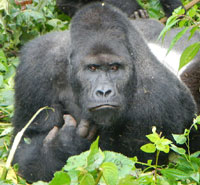
Gorillas, other animals, and a wide variety of plants are protected and flourishing as Gabon becomes a model for avoiding ecocide and for encouraging eco-tourism.
*The DNA of gorillas exceeds 90 per cent similarity to humans. Only chimpanzees (and bonobos) are closer to humans in DNA. Western gorillas in Africa number more than 300,000—about 5,000 are in east Africa.
**Gabon is the size of New York, Pennsylvania, and New Jersey combined with a population of two million—about the total number of people incarcerated in U.S. prisons!
***General Powell spoke recently as a guest lecturer in Austin College’s program of special convocations.
Thanks go to Wikipedia for some of the data used in this op-ed.