The 14th in a series of articles
for the 175th Anniversary of Bonham
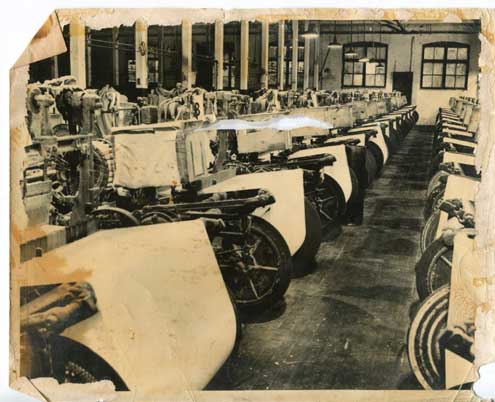
Bonham, Texas -- The Bonham Cotton Mill was organized in 1900 by nine Bonham directors acting for 192 local stockholders. “Bonham’s people invested in the mill, Bonham people operated it, and Bonham people were employed by it.” Its payroll touched almost every business in Bonham for 70 years.
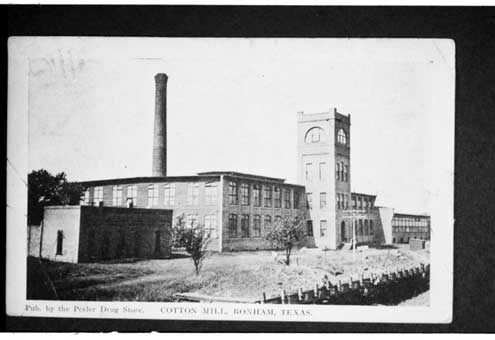
The facility was located where the Powder Creek Park is today.
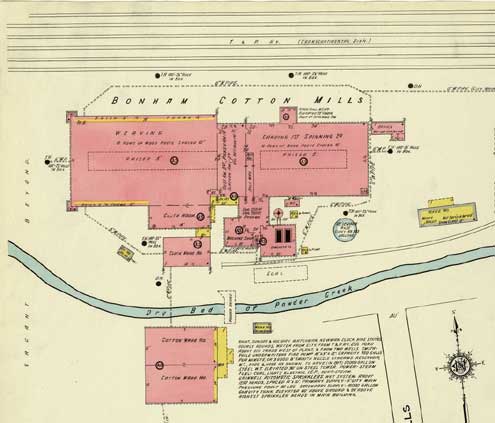
The high smokestack vented the smoke from coal until 1912, when electricity came. Water came from Powder Creek to create steam, necessary to maintain high humidity required for the textile operations.
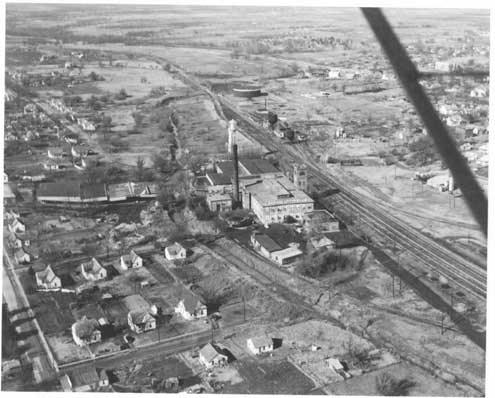
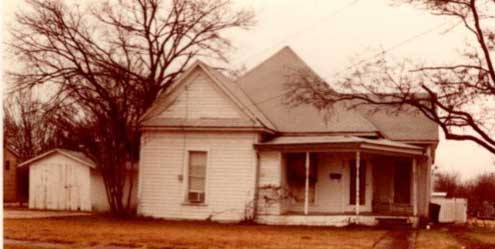
An important piece of the history of the Cotton Mill is that 50 tenant houses for workers were built along South Fifth and South Sixth streets and the cross streets in between. Some were ready by 1901. The photograph below shows many of these homes.
The photo below is one of the houses. At some point the Mill allowed the workers to purchase the homes.
The 1910 census lists 196 residents working at the Cotton Mill. This figure remained stable for 30 years.
Bonham Cotton Mills was re-chartered as a Texas corporation in 1931. Financing from local people and a Dallas trust allowed the mill to reopen. “Nearly 200 People Will Be Put Back to Work with a $10,000 Monthly Payroll.” Employees would return to work full-time, five and one-half days a week. The plant would require 10,000 bales of cotton to be purchased annually. The Bonham Daily Favorite described the mill as “the only plant in Texas or west of the Mississippi River that manufactures light sheeting . . . It is also the largest textile plant in Texas.” “It is no small matter to secure a plant that will give employment to two hundred people and spend ten thousand dollars a month in salaries alone.”
The photos below show Cotton Mill employees in 1938.
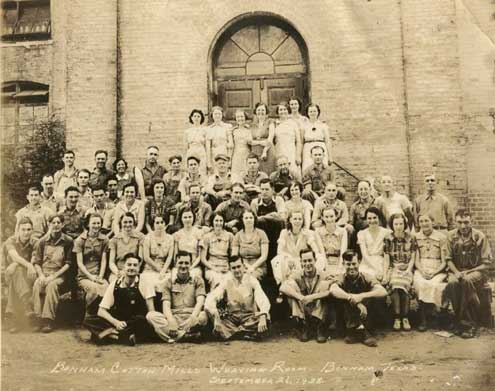
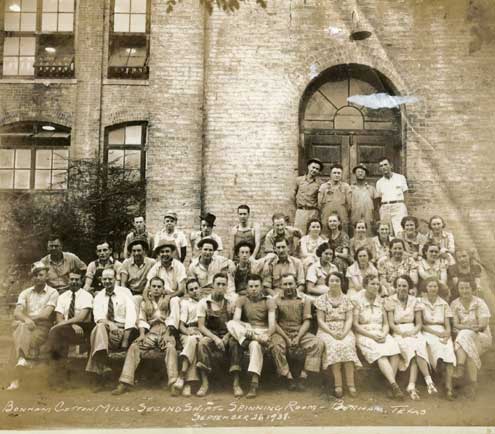
By 1950 it was the largest light sheeting mill west of the Mississippi River, with 350 employees. There were three shifts daily for continuous 24 hour running time. It was for decades the major employer in Bonham.
The community and the mill operated a free kindergarten for fifty years. It was begun in 1907 by Mrs. E. F. White and Mrs. P. B. Weaks, members of the First Methodist Church in a private residence. Later the mill supervised the construction of a permanent facility. Children from the entire town were accepted, and tuition was charged to those who could afford it. When it closed in 1957 it was estimated that 2,000 children had attended. In 1950 it was reported that the Bonham Cotton Mill used as much as 43% of all electrical power sold in Bonham and was the largest user of water and natural gas. During the summer months more Cokes were sold at its commissary than at any other place in Bonham. [Note: This article is primarily derived from the work of Beverly Christian and especially her article in the East Texas Historical Journal. Photos are from the Fannin County Museum of History. The Museum has much information and many photographs about the Cotton Mill in its Photo Database which can be accessed at www.fannincountymuseum.org.