The 7th in a series of articles
for the 175th Anniversary of Bonham
Note: This article is in large part from a previous more lengthy article in the North Texas e-News by Tim Davis.
Bonham, Texas -- As discussed in the previous article on the S. B. Allen Memorial Hospital, the white citizens of Bonham and Fannin County had a hospital as of 1903.
However, there was no hospital for the colored citizens. This article gives some of the history of the Fannin County Colored Hospital.
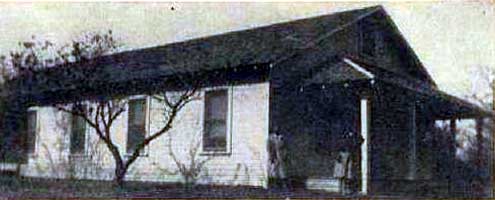
In 1935 Rev. J. D. Johnson (Dave Johnson), one of the leading Negro citizens, decided it was time for Bonham and Fannin County to have a hospital for its black citizens. He immediately set about promoting and raising funds for the idea. Noting his enthusiasm, the November 18 Daily Favorite stated: “Dave usually gets what he goes after.”
The same article also noted that the directors of the Allen Memorial Hospital “agreed to assume the responsibility of directing the affairs of the new” colored hospital, and that a prominent Bonham physician, Dr. A. B. Kennedy, had donated land near Allen Memorial for the project.
What became known as the Fannin County Colored Hospital (hereafter FCCH) did not happen overnight. Planning and funding crawled along at a snail’s pace. However, by mid-1939 the FCCH project was quickly gaining steam. On June 12 the Bonham City Council voted to “locate contemplated hospital for negroes on portion of ground now occupied by S. B. Allen Memorial Hospital.”
The June 14 Bonham Daily Favorite reported that building of the FCCH would begin soon and that the total cost would be roughly $3,000. The county was to give $1,000, the city $750, and the rest was to come from private contributors.
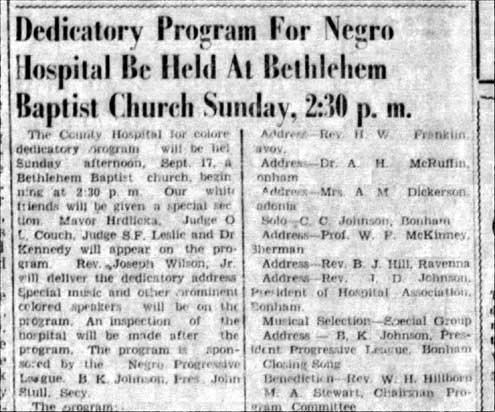
By late summer 1939 the Daily Favorite reported that the FCCH would soon be ready for patients. The September 14, 1939 Bonham Daily Favorite carried a big announcement noting that a dedication ceremony for the new hospital would be held at Bethlehem Baptist Church on Sunday, September 17. Among many local dignitaries on the speaker’s list were Rev. J. D. Johnson, Dr. A. B. Kennedy and Congressman Sam Rayburn. Afterwards, the crowd was to make the short walk to the new facility for an open house tour.
FCCH lacked an emergency room, operating rooms and the other trappings of a standard hospital. It provided a recovery facility for black patients who, under state law, had to receive surgical, medical or obstetric services at Allen Memorial.
Just six years after the FCCH’s opening, it lost its biggest supporter. Late in 1945 Rev. Dave Johnson came down with pneumonia and was given a private room in his cherished institution. He passed away on December 14. The physician in attendance was Dr. A. B. Kennedy.
In the following years the FCCH rolled along thanks mainly to private contributions and regular funding from the county and city. However, by 1955 the facility was in bad shape. The October 12 Bonham Daily Favorite carried a front page article reporting that the board of the FCCH and its chairman, Mr. LeRoy E. McIntyre, was making “an appeal for materials and funds with which to renovate the interior of the present structure.” There was a need for the most basic of items: shades, curtains, paint, wallpaper, towels, dishes, and, of course, cash.
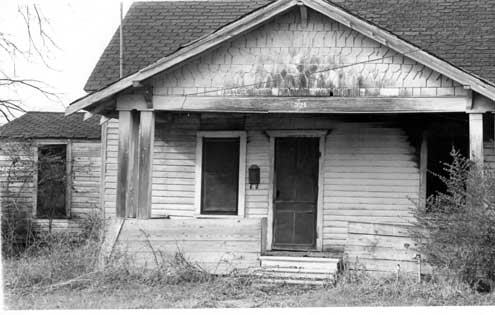
In 1961 two new doctors arrived in Bonham and re-opened S.B. Allen, which had been closed due to financial problems. Although it was not announced, it is assumed that in 1961 African American patients were admitted to S.B. Allen and stayed in newly renovated rooms in basement.
Although Rev. Johnson’s hospital was closed for good, its very presence had an impact. The small wooden building no doubt influenced Allen Memorial’s new directors to begin admitting patients of color to the main hospital. And it’s just as well that they did, for society was slowly moving in that direction. Bonham’s new VA hospital was already admitting veterans of color on an equal basis, and the 1964 Civil Rights Act would outlaw discrimination in all public accommodations – hospitals included. It could easily be said that Dave Johnson played at least a small role in the larger process.
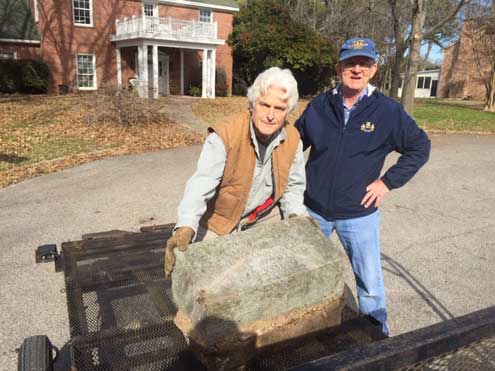
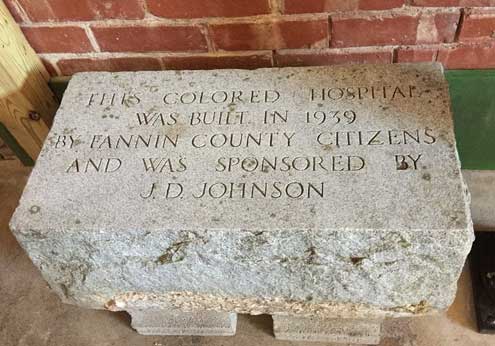
Although the hospital was built in 1939, the cornerstone was not installed until 1947, two years after the death of J. D. Johnson. An article in the Bonham Daily Favorite, September 19, 1947, says that the cornerstone was to be laid “in honor of Dave Johnson.” Rep. Sam Rayburn was the principal speaker on the program.
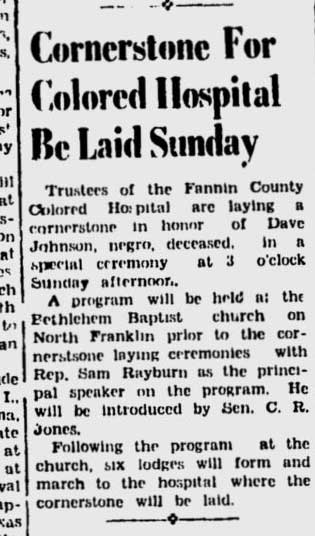
J. D. Johnson was one of the most noted leaders of the black community in Fannin County for decades. Articles in the local newspapers document his involvement to raise funds for the Red Cross and to buy Liberty Bonds in 1918. In 1933 he was President of the Welfare League. In 1934 he served on the Grand Jury. He was likely involved in many more activities that were not reported in the newspapers.
After the closing of S. B. Allen Memorial and the Colored Hospital, Dr. James Froelich and his wife Deidra acquired the property and thus the cornerstone of the Colored Hospital. Dr. Froelich had been in discussions with Larry Standlee about moving the cornerstone to the Fannin County Museum of History, where it rests today.