

Grayson County -- When I was young, and the earth was cooling, Stephen Stills wrote “Love the One You’re With,” and Crosby, Stills, Nash and Young recorded it. The song was about getting dumped by your love and choosing to love another, who was present, and available. That’s how vegetable gardening is in Texas.
It’s late August here so my first loves, succulent cucumbers and sweet green beans, are gone. They have dumped me. On the other hand, the Red Malabar Spinach over there, looks quite alluring. Its heart shaped, emerald green leaves, deep maroon vines, white flowers, and purplish black berries have caught my eye.
About three years ago I planted 20 Red Malabar Spinach seeds in my raised bed. All 20 sprouted happily and the luxurious vines climbed triumphantly up the small trellis I had attached to the fence. When the vines ran out of trellis, they cascaded down the back of the fence where neighbors admired them.
Since then, the purplish black berries from the original vines have migrated throughout my yard, coming up in their original location, under the long bean cattle panel, next to the Knockout Roses, and in the river rock beds behind my garage. The ability to pick up and move to an entirely different area, without any apparent human intervention, is one of its most enduring qualities.
Malabar Spinach is also drought and heat tolerant. As a result, it is reliably available for harvest all summer long, even this year when temperatures in North Texas climbed above 100, stayed there for days, and rain ran off to Oklahoma.
We pluck the heart shaped leaves and add them in handfuls to stir fry recipes. Malabar Spinach contains three times more Vitamin C than spinach, so it is a healthy addition to your summer plate. In fresh salads the leaves are tender and crispy, and slightly slippery on the tongue. The berries, also edible, have a slight lemon flavor and enticing texture.
When the vines winked at me from the river rock beds near the garage, I felt a deep affection for them because they were still there. So I decided to reward the half a dozen vines with a trellis. A week later, the vines had climbed the trellis and were coiling around it in a counter-clockwise fashion.
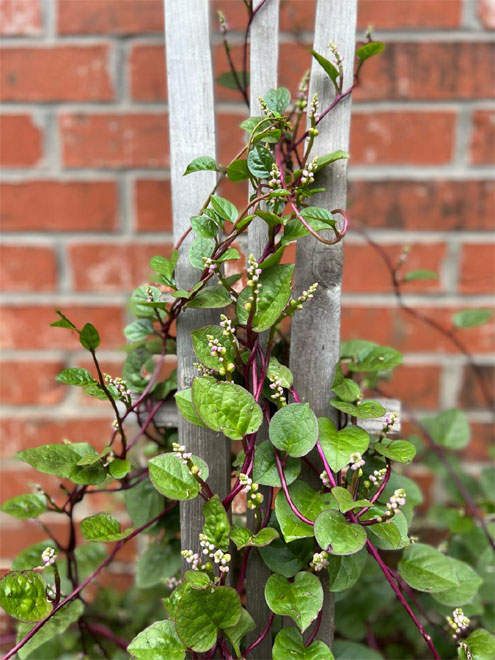
Vine growth and coiling is known as thigmotropism, from the Greek words for touch (thigmo) and tropism (to move). The direction that they coil is controlled by genetics. When the growing tip of the vine touches an obstacle, such as a trellis, plant hormones are produced that prompt the cells on the side opposite the trellis to grow faster than those touching the trellis. This outpacing of the inner cells pushes the vines around the trellis. Approximately 90% of vines curl counterclockwise as they grow. Check out the vines in your yard to see if that rings true for your plants.
If you find that the ones you love have departed, try growing Malabar Spinach next year. You may find that it is the one you have been waiting for your whole life. You can save the seeds and plant them in a precise location and then try to guess where it will show up next year. Happy gardening!