

I remember my first couple years guiding for elk and bear in the Rocky Mountains of Colorado. I was all about having everything on my back that could possibly be needed for the hunt. I bought one of those gigantic guide backpacks and stuffed it full of everything I ‘thought’ I might need and, looking back, a lot of things that I would never have needed. After a season of lugging all that weight around, I decided to go light and eliminate everything but the bare essentials. I purchased a very light pack and stocked it with items that would be needed for a day hunt in the mountains or…a hunt here in Texas.
As a younger hunter, I often found myself with a harvested deer or hog wishing I had thought to bring and extra item or two that would have made the field dressing and retrieval of the meat from the field a bit easier. It’s one thing to park one’s truck or four wheeler a hundred yards from a hunting stand and drive to the site to load up downed game but quite more challenging when the game is harvested in an area that is not vehicle accessible. A bit of forethought before the hunt will save much work after the game is on the ground.
For many years, I hunted a lease that had a connected series of gravel pit ponds that lead from the front road where I left my truck to the very back where I did most of my hunting. In the beginning, I actually quartered whitetail deer and hogs, just like when hunting in remote mountain states, and packed the meat back to the truck. Then I got smart; why not use my little boat to retrieve the meat! I remember feeling like a Rocky mountain fur trapper of the early eighteen hundreds when I loaded a buck in the front of that little craft and paddled back through the series of gravel pits to my truck! I later began accessing the remote area by water. For over ten years, I was the only human that visited that remote spot and I enjoyed many successful hunts there.
Regardless how I made my way to this remote spot, I still needed to have certain necessary items in my hunting pack. If you’re a hunter, stop and give some thought to the ‘must have’ items you carry. Of course, you will need a hunting knife. I know a couple of guys that pack only a skinning knife on their hunts. Granted, a good knife can definitely get the job done but a handful of additional items make the task much easier.
In my pack, I carry two knives. A quality knife will suffice for one animal but it’s nice to have and additional sharp knife to complete the job. I also carry a small diamond sharpening stone. A sharp knife is obviously my primary item. I’ve found a small package of baby ‘wipes’ is also very handy for clean up after field dressing game. It takes up very little space in the pack and weighs next to nothing. A few feet of nylon cord has many uses and I always include it in my pack. It can be used to hoist a rifle or bow up into a tree stand or to position a downed animal for field dressing. I always have my compass handy, even when hunting areas I am totally familiar with. Things look a lot different at night in the woods in case I have to trail an animal I have shot during the waning hours of daylight.
A roll of fluorescent orange surveyors tape is a must, especially at night, for marking the trail of a wounded animal. One item that is a bit bulky but very useful is a quality spotlight, I keep the batteries fully charged but I never trust one light. I pack a small light that I use for walking after dark as well as one of the automotive ‘bar’ lights that I’ve found essential for field dressing game at night. These little lights are very inexpensive; mine is only about 8 inches long and has a series of LED lights that provide plenty of light, even on the darkest night.
I carry about 20 feet of half-inch stout rope in case I decide to hoist an animal above ground under a low hanging tree branch while I pack the quarters out of the woods.
Coyotes are always a problem to consider when leaving field dressed animals in the woods and this might sound a bit odd but I carry a little after shave lotion in a zip lock bag and place it around the carcass, along with a hat or some garment with human scent. I’ve never had a coyote disturb harvest animals left in the woods a few hours when using this method. Early in my hunting career, I had a roving pack of coyotes find a buck I had left in the woods a few hours. Coyotes can do a lot of damage to game meat in a very short time. If you have some useful items for a hunting pack, please email me. I might need to add them to my ‘basics’!
Camp bread
Here’s a recipe I have used for camp bread that is fast and easy. You will need either a Dutch kettle or cast iron skillet with lid. Mix a teaspoon salt, sugar to your liking, quarter cup of cooking oil, butter or bacon grease, with 2 cups flour and a half cup milk. Knead well and form into a ball. Flatten the ball to a thickness of about 1.5 inches and cut into quarters.
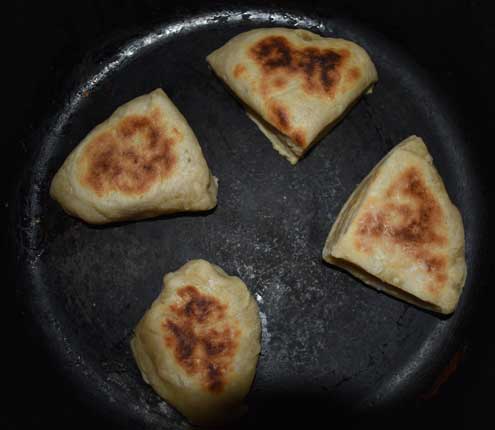
Place into a heated cast iron skillet or kettle, place lid and allow to ‘bake’ over low heat over a camp stove (not oven) for about 6 or 7 minutes. Turn and cook on the other side 6 minutes. Check to insure the bread is done in the middle. If not, allow a couple more minutes cooking time. If you desire ‘fry bread’ fry the dough in cooking oil.
Contact outdoors writer Luke Clayton at www.catfishradio.org