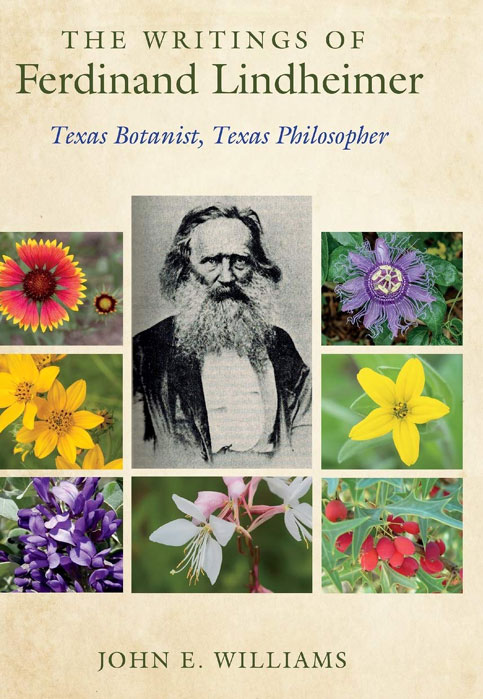
Texas A&M University Press has made an important contribution to the study of science in 19th century Texas by publishing “The Writings of Ferdinand Lindheimer: Texas Botanist, Texas Philosopher,” the first English translation of this German Texan’s collected essays, edited and annotated by John E. Williams. This is the latest book added to the Gideon Lincecum Nature and the Environment series.
Born in 1801 in Germany, Lindheimer was well educated and became a teacher at the Bunsen Institute in Frankfurt, where he was a proponent of governmental reform. His political activism forced him to leave Germany in 1834, and after arriving in Illinois he traveled by boat to New Orleans. From there he began traveling to Texas but was diverted to Mexico, where he lived and worked for more than a year. Late in 1835 he departed Mexico as the Texas Revolution was beginning and eventually arrived at the San Jacinto battlefield the day after the final battle of the Texas Revolution.
Lindheimer was a founding settler of New Braunfels, raising his family on the banks of the Comal River. He was “elected” as the first editor of the Neu-Braunfelser Zeitung (still published today as the Herald-Zeitung), and served from 1852 to 1872. He wrote a number of articles for the Zeitung on topics ranging from plants, climate, and agriculture to Texas Indian affairs, optimism, and teaching schoolchildren.
In partnership with Asa Gray of Harvard University, Lindheimer spent eight years collecting Texas plants to distribute to a list of paying subscribers—including places like the British Museum, the Royal Botanic Gardens at Kew, and the Smithsonian Institution. Today, no fewer than 373 plant names are based, at least in part, on Lindheimer collections, and 65 plants have been named in his honor. Over a period of thirteen years, he collected fifteen hundred species in the south Texas area.
Accordingly, Lindheimer is now known as the “father of Texas botany.” While he was not the first botanist to collect plants for scientific examination in Texas, his collections are credited with helping botanists around the world to understand the nature, extent, and significance of the diversity of plants in the state. In 1936, Recorded Texas Historic Landmark number 1590 was placed on Lindheimer's grave.
In the last year of Lindheimer’s life, one of his students worked with him to collect an assortment of his essays and articles from the Zeitung. In 1879, the collection was published in Germany as Aufsätze und Abhandlungen von Ferdinand Lindheimer in Texas (Essays and Articles of Ferdinand Lindheimer in Texas). John E. Williams now offers the first English translation of these essays, which provide valuable insight into the natural and cultural history of Texas.
For example, reflecting the breadth of his knowledge and interests, Lindheimer’s essay on Texas climate combines a scientific perspective with historical and even mythical accounts: “Texas sometimes suffers from lack of rain for months, such as in 1846 and 1848. . . . There was once a great drought in Texas more than a hundred years ago, when the Mexican residents in the west of the country could no longer find water for their herds. At the same time as that drought a legend of the Indians is at least as interesting: the earth had been torn into fissures so huge that a man and his horse could have fallen in.”
Lindheimer died in 1879. Today the Lindheimer House in New Braunfels is preserved as a public museum and operated by the New Braunfels Conservation Society. The house was added to the National Register of Historic Places in 1970.