

The short story of Harry Peyton Steger...
This is the story of a lifelong friendship between Harry Peyton Steger, John Lomax and Roy Bedichek, as well as Steger's assignment to edit and support a disheveled O. Henry in the legendary short-story writer's final days.
Lomax was a pioneering musicologist who discovered the legendary twelve-string guitarist Lead Belly in a Louisiana prison. Bedichek spent decades shaping the UIL and later authored Adventures with a Texas Naturalist. Steger would befriend a mysterious writer the world knew only as O. Henry.
But, long before carving out reputations in folklore, education and publishing, Lomax, Bedichek and Steger comprised the staff in the registrar's office at University of Texas in Austin.
Fortunately, the distinguished careers of Lomax and Bedichek have been documented for posterity. Steger's saga almost slipped through the cracks.
Introduction
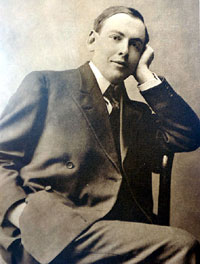
But 120 years ago you would have found young Steger sitting at his desk in Duncan School on the west side of Bonham, a thriving rural northeast Texas community of 3,500 residents located twelve miles south of Red River and Indian Territory.
It seems fortuitous that in 1897 school officials handed fifteen-year-old Steger his diploma and wished him well. As it turned out, Harry had much to accomplish and precious little time. He would be back, though.
In a life that lasted less than thirty-one years, Steger went from being a rapidly rising star at the University of Texas to become one of the brightest young editors on the East Coast. He edited O. Henry's final book, worked with Pulitzer Prize-winning writer Booth Tarkington, and married an actress, but Steger also came back to Bonham High School to teach Latin before launching his career.
The world was Harry Peyton's oyster and he had everything he needed to throw it wide open.
Somehow it all seems so symbolic that Steger's last days as an editor at Doubleday Page & Company in New York City revolved around the art of creating short stories, a skill only a select group of authors possess because it requires capturing so much emotion in relatively little space. Harry Peyton Steger's life was a brilliantly crafted short story. Unfortunately it wasn't graced with an ending like the ones written by his confederate and confidant, O. Henry.
So just who was this small-town Texas boy turned East Coast literary figure? As is the case with so many North Texas residents, the Steger story begins in Tennessee.
Harry Peyton Steger was born in Moscow, Tennessee, not far from Memphis, on March 2, 1882. Harry’s father, Thomas Steger, moved the family to Bonham where young Harry began school as an inquisitive six-year-old. Actually, it seems five Steger brothers relocated to Bonham about the same time and quickly became an integral part of the local business scene.
There was the Steger Opera House, Steger Mill, Steger Lumber, and Thomas Steger was a lawyer credited with managing future U.S. Congressman Sam Rayburn’s congressional campaign in 1914. So, Harry Peyton Steger was hewn from solid timber and the family's intellectual attributes can be traced all the way back to Harry’s great-great grandfather, John Jefferson, brother of one of America’s truly great thinkers, Thomas Jefferson.
In the 1890s, Harry’s affluent world in Bonham was centered on education and culture. By special permission of the Regents, he was allowed admittance to the University of Texas in 1897 as a mere fifteen-year-old.
At UT, Steger blossomed. He became editor of the campus newspaper, The Daily Texan, as well as the campus yearbook. Steger’s roommate at UT was Roy Bedichek and another close friend was John A. Lomax. Bedichek became a noted naturalist and Lomax went on to be a celebrated folklorist.
Harry and “Bedi” shared a love for the classics as well as an interest in campus politics. According to the Texas Library Journal, it may have been Steger’s political activism and his role as newspaper editor that prevented the Bonham High School graduate from being tapped as the first Rhodes Scholar from UT.
According to Steger, he was a “naughty boy” during his time as editor, but his friends evidently strongly opposed the punishment. Again, according to the Texas Library Journal, a protest over the scholarship debacle resulted in the first official rift between students and administrators at the University of Texas.
Steger returned to Bonham briefly where he taught Latin and Greek before enrolling at Johns Hopkins University to study Sanskrit. It was at Johns Hopkins, a year after the “naughty boy” incident, that Steger was selected to be a Rhodes Scholar, becoming the second UT grad to share that honor.
The Letters of Harry Peyton Steger 1899-1912, offer an enlightened glimpse of a Fannin County, Texas, boy at home, abroad and eventually rising through the ranks of the East Coast publishing world.
September 29, 1905
Mr. John A. Lomax, College Station, Texas
My dear Lomax:
I leave to-morrow for London, via Cologne, Vlissingen and Queensboro. The three months of Germany, spent in the midst of a German family, have been constantly delightful. Never was I more energetic, more cheerful, more ambitious; and, to fill my sweet cup, I can truthfully say that I can speak German. For two months now no word of English has passed the fence of my teeth. (Thanks, Homer, for that phrase!)
November 25, 1905
My dear Folks:
Last night I attended the annual Rhodes Dinner. Cecil Rhodes, as you may know, left a fund for this function and this year $1,500,000 were expended. There were nearly 200 present. The hall was a gorgeous sight. Nothing but evening clothes was to be seen. Rudyard Kipling was one of the guests. He wrote his name for me, as well as the other Rhodians; and I have preserved it in my toast-list. Lord Milne, Sir Lewis Mitchell and numerous other nabobs and potentates were also in evidence.
January 9, 1906
Dear Folks:
Lady Monkswell (one of the swellest of the English nobility) has invited all of the Rhodes Scholars to a reception at her town-house (in London) on the 18th inst. My curiosity bids me go, but my wardrobe, with more force, bids me stay. You see, to be observed, in London, on the streets, in the afternoon, or even in a home, without a frock coat and a high silk hat, or else a Prince Albert, would be as rude as appearing in pajamas. I tell you this because I think it will amuse you. There is never a place in the world where formality in dress counts for so much as it does in London. Of course, it is all silly rot.
previous Steger chapters
http://www.ntxe-news.com/artman/publish/article_117962.shtml