

Fannin County, Texas -- Lanny Joe Burnett grew up on a farm south of Bonham in the Fannin County community of Bartley Woods, and went to school in Gober, mastering, one supposes, the famous Gober Plowboy “off the ear” set shot that was the wonderment of the basketball world. “I went to college at East Texas State (TAMU Commerce for those with limited memories) and crammed a four-year course in to five and a half short years with special tutoring. I got a degree in agriculture and immediately begin teaching science.”
He taught junior high science in Richardson for a few years and then, ever driven by his early desire to be a cowboy, went into the skiing business—the snow skiing business. “We were on Easter vacation one year and a couple of my school teacher buddies and I drove to Red River, New Mexico and went skiing. Soon as I got back to Dallas I got a job in a ski shop. I didn’t figure that if you worked in a ski shop, you did not get to do all that much skiing. But I loved the romance of it I guess.” Swoosh!
Burnett quit teaching school and took up the snow business full time. Eventually he lived in Aspen and Vail, Colorado, and El Paso and a number of other locations where the Midland-based company he worked for had stores. “I really wanted to be a ski bum, but to do that properly you had to have long hair. Unfortunately you couldn’t wear long hair in the store, so we all had wigs that we put on when we went to work. And they were really nice looking, as you can imagine.
“One time I was skiing on a real cold day and hair was on my shoulder and my skis were on my shoulder and the metal edge on the skis got frozen to the hair. When I re-moved them [the skis] from my shoulder, I removed about six inches of hair. But you have the setbacks.”
After ten years on the slopes, but no closer to being a cowboy, Burnett was ready for something else, or rather a combination of things. The new owner of the ski shops went bust and closed the operations and Burnett found himself “at liberty,” as vaudevillians used to say. “I moved to Ruidoso, New Mexico, leased a bar and taught skiing during the day.”
But the lure of the Lone Star called, and Burnett moved back to Texas, settling in Dallas and, having found the bar business to his liking, opened a place on famed Greenville Avenue in Big D across from SMU. “We had a place called the “Water Hole.” When you came in you got a piece of chalk and were allowed to write your name anywhere you wanted to.
“I had to make so much money a day to pay my rent, and the juke box and the shuffle board and pong machine and pool table just wouldn’t quite do it. So we sponsored athletic teams in the city leagues and each one had a certain night when they would come in. We sponsored a fast pitch softball team that played over 400 games a year. We also sponsored a rugby team, and that could have been our undoing. After they came in, it took several days to recover.”
Fine and dandy, but not much progress toward being a cowboy. Enter the Tin Man. Burnett got out of the bar business in 1976 or 1977, the actual date is lost in the legend of the thing, and became a Tin Man. “I began to sell aluminum and steel siding and re-placement windows. Had a great time and in a way I was still in the bar business, but on the other side of the counter. We’d meet every night and brag about all the stuff we’d sold that day.”
Nine years later, Burnett was running a home improvement office in Memphis, Tennessee (Yes, Virginia, there are people standing out in front of Graceland 24 hours a day.) when he decided it was time to go back to Texas. “I moved back to the Dallas area and stayed in sales, working for a printing company and all that led to my moving back to Fannin County in 1993.
“Having no skills applicable to Fannin County, I got a lawn mower and started in the landscaping business,” said Burnett, who now is the chief shovel man at his own dirt-shuffling outfit. “I did a few other things, but I don’t talk about them,” he said with laugh. “The statutes of limitations haven’t run out yet.”
Twenty-seven years later Burnett is still taking care of grass. “It’s mainly the lawn-care business,” Burnett said, “two guys and a goat.” But while that operation has chugged along, a lot more has been going on during that quarter of a century plus.
First, and perhaps most important were changes on the domestic scene. After all, what’s a cowboy with out a cowgirl? Burnett’s cowgirl turned out be Cindy Currin Baker who first caught the cowboy’s eye while she was a cheerleader at Bonham High School and Burnett was traveling up to the big city scouting for a date. “There were only three girls in Gober High School, and five boys, so the pickin’s were slim,” he recalled.
“We had several dates; I took her to a drag race at Commerce one time—a lot small towns had drag strips back them. I won first place and got a big trophy, but I couldn’t take it home because my parents didn’t know what I was doing. She kept it for a long time, and after she married, I think her husband broke it or threw it away.” After those few dates, the cowboy and the cowgirl parted ways, and it would be three decades, more or less, before their trails crossed again.
When Burnett came back to Bonham in 1993, they picked up where they had left off, minus the drag racing trophy, almost immediately. By then Cindy was a single mom raising three children and taking care of Bonham on the side. But that’s another story.
“I don’t remember exactly how we encountered each other the second time, but we were both interested in each other and what was going one in each other’s lives. We probably started seeing each other on a regular basis in ‘95. Her parents were elderly, my mother was elderly and jokingly we would say we say we would wait until they passed on and then we would get married.”
“All of a sudden, I looked up and my mother was 101 and I said ‘Cindy, we need to go ahead and get married, and she said no. I could not believe it; what a terrible thing to say. A couple of days later I saw her, and she said, ‘I found out that we can get married in Colorado without a preacher. You can perform your own ceremony.’”
Not long after that, in 2009, the cowboy and the cowgirl joined their brands at her brother’s place in Colorado. “It was during an elk migration and there were elk everywhere and the snow was starting to fall, and Tech was beating the pants off Nebraska (Cindy’s family were Red Raider fanatics from generations back.) so we didn’t turn the TV off. We each selected a scripture that we liked and that was pretty much what it was based around.”
With a wife, Burnett inherited three grown kids and seven grandchildren. “I called my mother and told her she was a grandmother and great-grandmother. She liked that.” The newly minted great-grandmother died shortly before she would have turned 102.
With an instant family, Burnett also got a ticket to fly. Among other things, Cindy had a very successful career as a customer service representative with American Airlines, and when she retired, she got free travel to anywhere American touched down in the USA and almost free travel in the rest of their markets. The Burnett’s have taken advantage of that perk to see places the lonesome cowboys of the West never even heard about.
“We’ve been to Ireland, England, Scotland, Germany, Italy, Hungary, Poland, the Czech Republic, and Slovenia. We’ve never been to Asia, although I went to Kyrgyzstan once on a church mission. (Burnett has been a Sunday School teacher since he was in grade school, and Cindy is a commissioned minister.) If the Burnett’s travel adventures seem fodder for a great line of stories, they are, but we seem to be drifting farther and father away from the cowboy business, which is the point of this exercise.
The landscaping business is closer to the soil, but it’s not quite the same thing as being a cowboy after all, so let’s keep digging. “I grew up on a farm, and had a horse and cowboys were always somebody I wanted to be just like. I guess it’s got a lot to do with the heritage and tradition we have in this area.
“And of course, I grew up with Roy and Gene, and they were the good guys. They were well mannered and honest and always tried to do the right thing, and we wanted to do just like they did. We never quite mastered the art of looking as good as they did, but we tried to be like them.
“Twenty or so years ago I attended the Red Steagall cowboy gathering in Fort Worth and I heard Larry McWorter do a poem that he’d written about a horse. It made me cry. And I decided right then that I wanted to try doing something like that.”
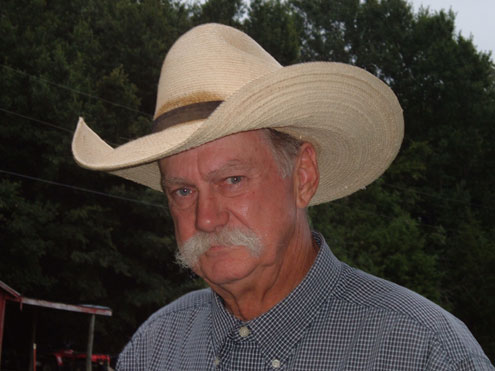
All right, looks like we have made it to the cowboy part as Burnett began to write and perform his own cowboy poetry. “I did this at schools, churches, cowboy gatherings, just about anywhere I could get somebody to listen to me.
“I would go to Duncan, Oklahoma frequently and to Anadarko a few times. I’d go to Apache, Oklahoma once a year and be the artist in residence at Apache High School. I’d be there for a week working on performing and writing. I’d go up on Sunday and usually they’d have some special event on Saturday.”
On a somewhat larger venue, Burnett was part of the very first Youth Poetry Gathering at Cal Farley’s Boys Ranch near Amarillo. He has performed regularly at the Cowboy Symposium in Lubbock and the big George West Storyfest near Beeville. “On Thursday nights they have Dobie Dichos named for J. Frank Dobie and the Spanish word for stories. I got picked for that several times.
“I was in Kanab, Utah once for the World’s Largest Cowboy Poetry Rodeo. You could enter as many events as you wanted to. They were all poetry events, but they all had rodeo names. I entered the event for Rising Stars; it was for people who had never won anything before. There were more than 130 entrants, a by gosh I won that thing. I got a giant belt buckle and $1,500. Course it cost me $1,200 to fix my truck when I got back. It’s a long drive to Kanab, but it was worth it. It was a beautiful place.”
In Lubbock, one of the more unusual performances was called Papers. It involved reading a historical paper about a Western subject. Burnett and Cindy joined forces to write a one-act play about Charles and Mary Goodnight, and acted it out instead of reading. “The people who put on the Doan’s Picnic every year near the Doan’s store crossing of the Red River north of Vernon (where the Great Western Trail crossed the river on the way to Dodge City) heard about it, asked if we do one about the Doans, so we did one for the museum in Vernon.”
In 2001, Burnett, Wynetta Ausmus, her husband, Marvin Brown, and Edward Southland started the first storytelling group in Texoma, the Red River Storytelling Outfit, and for several years performed monthly programs in Denison and other locations in the area. “Wynetta and Marvin got to work and built a storytelling outfit anybody would have been proud of.” Burnett also did stints at the State Fair of Texas, the Fort Worth Fat Stock Show, Red Steagall’s Cowboy Event at the Fort Worth Stockyards, the Cowtown Opry, also in Fort Worth, and the Tejas State Storytelling Convention in Denton. And if that sounds busy, he was.
At one time Burnett was doing 140 or more performances a year. He has cut back considerably of late, but is still riding for the poetry brand. “It is so much fun. There’s a lot of satisfaction to being able to get up in front of an audience and touch their hearts. Being able to share your thoughts with someone else in such a manner that they enjoy it. There’s a lot of entertainment and a lot of showmanship involved, but when you come down to it, you’ve got to say the right words in order to reach someone.”
He usually performs his own work and has more than 50 original poems in his repertoire, Burnett writes about things he has experienced, or wanted to experience. He reaches out to the history and legend of the West to tell the story of the ordinary cowboy on the long drives from Texas, through the Nations, to the railheads in Kansas.
Most of the works, especially the personal pieces, are leavened with humor, often at the poet’s expense. This is a common thread in cowboy poetry, with the author accepting his lot with humility and good grace and putting things is a perspective that reaches beyond himself and his personal experiences.
“The cowboy life was a hard life, and not a financially rewarding life, but it drew people to it who wanted to keep on as long as they could. I read a quote once from an old cowboy who said, ‘We loved the life so much, we used to sit around at night, crying for daylight.’ The cowboy considered himself the aristocrat of the working class. If you don’t understand how he could feel that way, you just need to be sitting on the back of a horse, watching the sun come up.”
So we finally made it to the cowboy stuff. Has Lanny Joe Burnett fulfilled is boyhood dream of being a cowboy? Well, he certain looks like a cowboy; and he sounds like a cowboy; and with out question he has the soul of a cowboy. And since being a cowboy is really more a matter of attitude and values than hats and boots and bravado, he scores pretty well on that scale too.