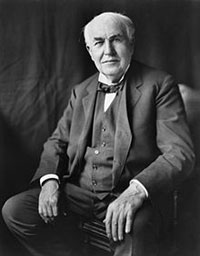
Edison refused to call himself a genius: “You know well enough I am nothing of the sort,” he said, “unless we accept the theory that genius is merely prolonged patience. I’m patient enough, to be sure.” It was Edison’s inexhaustible energy and refusal to admit defeat—his persistence—that enabled him to test 6,000 substances before finding the right filament to make the incandescent light bulb work.
When he was informed in August 1880 that a Japanese strain of bamboo had burned inside its airless pear-shaped bulb for 1,589 hours, the wizard of Menlo Park led a celebratory dance around his laboratory. This was Edison’s Eureka moment.
Fifty years later, Edison joined President Herbert Hoover, Madame Curie, Orville Wright and 500 others to celebrate the golden anniversary of his great breakthrough. By then the “Father of Light” was already imagining an energy-efficient future in which solar rays replaced fossil fuels.
Like many devices attributed to Edison, the incandescent light bulb was less “invented” than refined. Carbon-arc lamps, their harsh glow too strong for home use, had already illuminated several cities in post-Civil War America. Other inventors on both sides of the Atlantic had produced light bulbs with too short a life span or too steep a price tag to be viable. Edison’s strong suit was taking an existing idea and moving it closer to practical usefulness.
It was Edison’s carbon-button transmitter that made Alexander Graham Bell’s telephone an instrument of long-distance communication, and he introduced the greeting “hello” to telephone conversation in place of Bell’s preferred “Ahoy!” Edison also gave us the modern industrial research lab.
Morris’s biography traces Edison’s eccentricities to their source. The youngest of seven children, “Al” Edison was born in the lake port of Milan, Ohio, in 1847. His father was a Southern-sympathizing iconoclast and he was disappointed because the boy was more interested in steam engines than school lessons. A local teacher’s judgment of young Edison as “addled” seemed accurate after Al burned down his father’s barn just to see what would happen (in this case, a public whipping).
“My mother was the making of me,” the adult Edison acknowledged. As a former schoolteacher, Nancy Edison imparted to her son fierce ambition and a passion for reading. Together they read Hume’s History of England and Gibbon’s Decline and Fall of the Roman Empire.
The fame of Thomas Edison didn’t end with his death in 1931. At Henry Ford’s insistence, the inventor’s dying breath was captured in a test tube for display in a museum. A pair of hero-worshiping MGM documentary films soon appeared. Edison’s name was affixed to a U.S. nuclear-powered submarine and an asteroid. In 1997, Life magazine named him the Man of the Millennium.
But the extravagance with which he was acclaimed in life all but ensured a posthumous backlash against the “Wizard of Menlo Park” (a title Edison disliked for its hint of sorcery). “An odd sort of hero,” Time called him in 1979. “A millionaire who often lived like a bum.” The ultimate lab rat was depicted as a negligent husband and disastrous parent.
Not all of Edison’s inventions worked or made money. He never got anywhere with his ink for the blind; his concrete furniture, though durable, was ugly and uncomfortable; and his failed innovations in mining cost him several fortunes.
But he founded more than a hundred companies and employed thousands of assistants, engineers, machinists, and researchers. At the time of his death, by one estimate, about fifteen billion dollars of the national economy derived from his inventions alone. That is a great deal of success.