

My mother had a first cousin who served in the Civilian Conservation Corps (CCC), also known as the Tree Army, and I remember her talking about how much that meant to his mother, who had been abandoned by her husband during the 1930s. Although I came to know this cousin well, he never talked about his time in the CCC. Thus I was delighted when one member of my current Elderwriter class at Grayson College told me that his father (Russell Roegner) took part in the CCC and documented his experiences both in writing and photographs. I am grateful to Carl Roegner and his sister Lucretia for sharing some of their dad’s writing with me. Maybe his reminiscences will resonate for some of my older readers who had similar experiences.
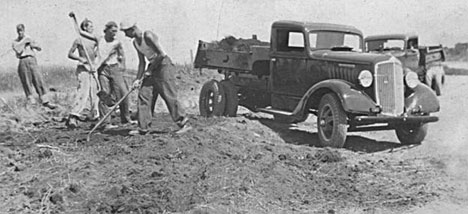
According to Wikipedia, the CCC was a public work relief program for unemployed, unmarried men that operated from 1933 to 1942. Originally for young men ages 18–25, the age range was later expanded to 17–28. The CCC was a major part of FDR’s New Deal that had two purposes: to provide jobs for young men and to relieve families who lacked income. Maximum enrollment at any one time was 300,000. Through the course of its nine years in operation, 3 million young men participated in the CCC, which provided them with shelter, clothing, and food, plus a wage of $30 per month, $25 of which had to be sent home to their families.
The CCC became very popular. In most cases an individual's participation led to improved physical condition, better morale, and more job skills. The CCC also led to greater appreciation of the outdoors and the nation's natural resources.
What I have written so far is the rather bland, bureaucratic description of the CCC. In contrast, Russell Roegner’s reminiscence, entitled “My Experience in the CCC” is personal and far more interesting.
Here are some excerpts.
“The induction center was a hot, crummy place upstairs in Chicago. I arrived there promptly at 8 am as instructed. Lesson no. 1: Hurry up and wait! After about an hour of that we were told to take off all of our clothes except our shoes and socks and get in line. There is nothing uglier than a room full of nude men on a hot summer day. The physical exam was fairly standard except that there were about six or eight doctors in ‘assembly line’ fashion.”
“After a lot more waiting the recruits were broken up into groups of eight and we were sent off to the trains that took us to Camp Fort Sheridan. With all the hurry up and wait, by the time we arrived it was getting dark and we were all hungry. We were introduced to the standard first emergency meal--HOT DOGS AND SAUERKRAUT. Even that tasted good. We were then assigned to eight-man tents with a single center pole.”
“We wondered a lot about where we would be stationed. The rumor mills ground out "straight tips": we were going to Washington--Alaska--Texas. I found myself assigned to Isle Royal in Wisconsin. The Island was a truly beautiful place, pretty much untouched by humans.”
Since Russell was an avid amateur photographer and knew how to create a primitive darkroom in which to develop them, he became the official photographer on his CCC project. He got some especially good pictures of the men engaged in firefighting, which was one of the most important jobs on the island.
If any readers of this column have memories of serving in the CCC or “tree army,” I’d like to hear from you.
Jerry Lincecum is a retired Austin College professor who now teaches classes for older adults who want to write their life stories. He welcomes your reminiscences on any subject: jlincecum@me.com