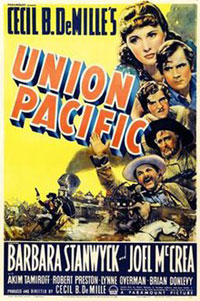
The basic plot is simple: the 1862 Pacific Railroad Act signed by President Lincoln authorized pushing the Union Pacific Railroad westward across the wilderness toward California, but there’s a big villain in the person of financial opportunist Asa Barrows, who hopes to profit from obstructing the process. Chief troubleshooter for the railroad is Jeff Butler (played by Joel McCrea), and he has his hands full fighting Barrows' principal agent, gambler Sid Campeau (Anthony Quinn). Campeau's partner Dick Allen (Robert Preston) is Jeff's war buddy and rival suitor for engineer's daughter Molly Monahan (Barbara Stanwyck). The question that keeps the audience interested is: Who will come out on top in the effort to push the railroad through at any cost?
Union Pacific was released in 1939, and part of the historical context is the fact that it came out two months after John Ford's Stagecoach, the movie that film historians consider responsible for transforming the Hollywood western from a mostly low budget, B-movie affair, into something greater. Film critic Wheeler M. Dixon, for example, notes that after the appearance of these two films, the western was “something worthy of adult attention and serious criticism, and therefore a yardstick against which all westerns have been subsequently measured.”
DeMille's film certainly took the genre to a new level, considering issues of national unity in an engaging and entertaining manner at a time when Americans were recognizing nationalism as an increasing public concern. Michael Coyne, who wrote a book on the Hollywood western, characterizes Union Pacific as a movie that depicts the role of railroad technology in linking the American West with the older half of the country. The spirit of unification in the film also parallels the industrial boom that had begun bringing the United States out of the Great Depression at the onset of World War II. Although the U.S. did not become involved in the war until 1941, the film’s emphasis on national unity anticipated the sentiment that would become much stronger once the country was at war.
The film is remarkable for other reasons also. The studio received full cooperation from the Union Pacific railroad, and in order to operate the number of trains required by the production, Paramount had to get a railroad operating license from the Interstate Commerce Commission. DeMille had directed epic films before, but this time the strain of directing three units simultaneously led to a breakdown and he had to be carried around on a stretcher for several weeks.
It was not only DeMille whose nerves were affected. The company had rented many local Pinto horses for the filming of an Indian attack on the train. During filming, however, local cowboys had to be hired to round up the horses, as they would scatter and sometimes stampede because of the noise and confusion. For an Indian attack on the train, Paramount hired 100 Navajo Indian extras.
The golden spike used in the film at the ceremony to mark the end of the construction was the same spike actually used in the May 10, 1869 event, on loan from Stanford University. The world premiere of the movie took place simultaneously at three different theaters in Omaha, Nebraska, on April 28, 1939, just three weeks shy of the 70th anniversary of the historic driving of the real Golden Spike that joined the rails of the Union Pacific and the Central Pacific Railroads at Promontory Summit, Utah, on May 10, 1869.
If this sounds like a movie you’d like to see, come to the Classic Movie screening and discussion at 6 p.m. on Wed., Sept. 12, at Covenant Community Center, 322 W. Pecan in Sherman. I’ll be leading the discussion after the movie. Admission is free, and popcorn and lemonade will be provided.