

DALLAS (SMU) – A $2.5 million grant from the National Science Foundation will enable SMU researchers to target the ongoing math struggles of U.S. elementary and high school students. The four-year NSF grant to SMU's Annette Caldwell Simmons School of Education and Human Development will lead to development of an assessment system to measure mathematical reasoning skills for children in kindergarten through second grades, a critical phase of a child’s mathematical development.
Research has found that students’ early mathematics knowledge is a more powerful predictor of their future socioeconomic status at age 42 than their family’s socioeconomic status as children.
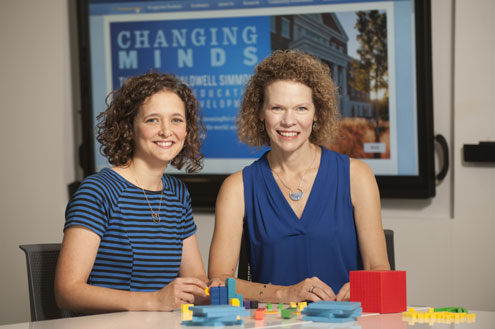
Number sense, the ability to work with numbers flexibly, in addition to spatial sense, the ability to understand the complexity of one’s environment, are consistently identified as two of the main components that should be emphasized in early mathematics standards and instruction, says Leanne Ketterlin Geller, director of Research in Mathematics Education at the Simmons School and co-principal investigator of the research. The Measures of Mathematical Reasoning Skills system developed with the support of the grant will contain tests for both numeric relational reasoning and spatial reasoning.
“I’m passionate about this research because students who can reason spatially and relationally with numbers are better equipped for future mathematics courses, STEM degrees and STEM careers,” said Lindsey Perry, whose 2016 SMU doctoral dissertation specifically focused on those two mathematical constructs. Perry is STEM research and assessment coordinator at the Simmons School.
“These reasoning skills have typically not been emphasized at these grade levels, and universal screening tools focused on these topics do not yet exist,” said Perry, who is co-principal investigator.
“Since intervention in the early elementary grades can significantly improve mathematics achievement, it is critical that K-2 teachers have access to high-quality screening tools to help them with their intervention efforts,” she said. “The development of this mathematical assessment system can make a real difference for K-2 teachers as they prepare the next generation of STEM leaders.”
The four-year project, "Measuring Early Mathematical Reasoning Skills: Developing Tests of Numeric Relational Reasoning and Spatial Reasoning," started Sept. 15, 2017.