

In 2017, there has been a significant transition from grain crops (wheat and corn) into cotton and some soybeans in the Northern Blacklands. From an agronomic perspective, this crop rotation is beneficial for pest and nutrient management. However, this increase in broadleaf crop acres is presenting some challenges in the region. Specifically, since a high percentage of the land is in pastures, summer pasture weed control options need to be considered carefully in order to prevent off-target movement and cotton or soybean injury.
Some counties, including Hunt, Collin, and Delta counties are categorized as Regulated counties by Texas Department of Agriculture. In Hunt and Delta counties are less restrictive than many other counites and only prohibit the applications of 2,4-D aerially from April 1 to September 1. However, it is always the responsibility of the applicator to keep any pesticide where it is intended to be applied (on-target). So, applicators must, at the minimum, follow the label application requirements to reduce off-target movement. There are some important things to recognize about the application equipment, herbicides, and the crops that can prevent off-target movement into susceptible crops, thus preventing the chances of complaints to Texas Department of Agriculture (TDA) and lawsuits.
The Crops: First thing to know is that cotton is very, very sensitive to all formulations of 2,4-D. Even the very lowest of rates 1/600 of the label rate can cause very visual signs (10-20% leaf malformation). Cotton is less sensitive to dicamba, and yield loss is less likely to occur if low rates of dicamba hit the cotton. Soybeans, on the other hand, are very, very sensitive to dicamba products, and low rates of dicamba can cause significant yield losses. Soybeans are less sensitive to 2,4-D products. See Figure 1 below for symptomology at low rates of 2,4-D and dicamba in cotton.

The Herbicide Formulations: The herbicide formulation has a huge impact on the potential for volatility of the herbicide and off-target movement of an herbicide. Volatility is described as the herbicide solution reaching the target, but converting to a gas form which can move long distances. See Figure 2. For example, the ester formulation of 2,4-D is much more volatile than the amine formulation of 2,4-D, especially under high air temperatures.
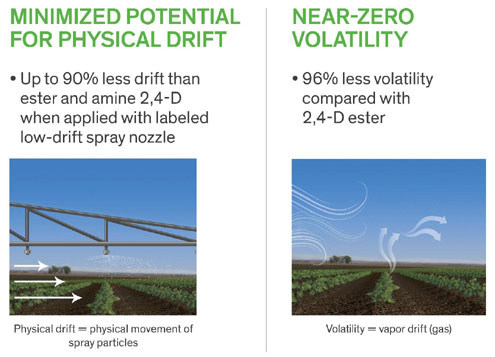
Application Equipment: Application equipment is the single biggest factor affecting the physical movement of herbicides into off-target locations. The type of spray tips, boom height and spray pressure all dramatically impact the potential for off-target movement. Herbicide drift is much less likely with boom sprayers (assuming an appropriate boom height), than cluster jet nozzles. Boom sprayers spray the solution droplets toward the weed target, where the cluster nozzle sprays in the air and lets the spray solution fall to the ground. The longer the spray solution is in the air, the higher the potential for off-target movement. Droplet size is critically important as well. The larger the droplet size the less likely for off-target movement. Selecting coarse, very coarse, or ultra-coarse droplets will further decrease the potential for drift. See the TeeJet Spray Application nozzle publication as an example of the different types and their uses. Since pasture herbicides are systemic herbicides (move within the plant), coarse to ultra-coarse droplet spray tips can be used with minimal impact on herbicide efficacy. Spray pressure also impacts the spray droplet size, with high application pressures creating many more small and fine droplets that are prone to off-target movement.
Environmental conditions: Wind speed and direction is probably the single most important factor affecting off-target movement into susceptible crops. TDA restricts herbicide applications to 10 mph or less for this reason. At very low (less than 3 mph), temperature inversions can occur and move fine and very fine herbicide solution very long distances. So, pay close attention to wind speed and wind direction.
What Herbicides Should I Use? As mentioned previously, cotton and soybeans are very sensitive to 2,4-D, Dicamba, and some other auxin herbicides. If you are in close proximity to a cotton or soybean field and the cotton or soybean are downwind, it is best to avoid using the 2,4-D, dicamba, triclopyr or other auxin herbicides. This leaves the following herbicides: glyphosate, aminopyralid, picloram, metsulfuron methyl, nicosulfuron, fluroxypyr, hexazinone, chlorsulfuron and sulfosulfuron. However, each of these pasture herbicides can cause injury to cotton and soybeans, so please be cautious about wind direction, wind speed, and application equipment.