

Sherman, Texas -- An ancient component of the Austin College IDEA Center comes into play Friday, March 20, marking the Spring (Vernal) Equinox in an event beginning at 1:15 p.m. in the Oscar C. Page Atrium of the center. The building itself serves as a large astronomical observatory that displays the movement of the Sun across the building’s atrium and marks the solstices and equinoxes along a meridian line in the floor. The event is free and open to the public.
Beginning at 1:15 p.m. in the atrium, David Baker, professor of physics and director of the Adams Observatory, will provide an overview of the ancient astronomical measuring system. Sunlight passing through a small gnomon hole in the roof radiates across the atrium floor. In this case, with Daylight Saving Time in place, solar noon actually is at 1:33 p.m. in Sherman, and at that moment, the beam of light should fall on the equinox marker, the Chinese symbol for the Sun.
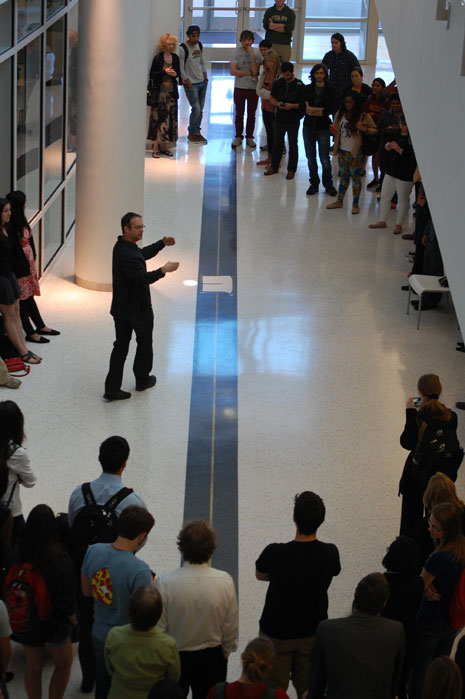
When the building was under construction, Baker and Austin College students worked to determine the precise locations for the markers. Precision was definitely important as the markers were permanently placed in the atrium’s terrazzo flooring. The placement has proved perfect in the seasonal events since.
"To watch the image of the Sun cross the atrium floor is mesmerizing," explained Baker. "It connects us with our past as cultures throughout the ages have marked the important timekeepers of solstices and equinoxes. In fact, before widespread use of the telescope, this type of solar observatory produced state-of-the-art science."
The vernal and fall equinoxes in the IDEA Center are marked by a Chinese symbol for the Sun to recognize Asian contributions to knowledge of the universe; the summer solstice is marked by the Greek/Macedonian symbol, recognizing Western contributions. The winter solstice is marked by the Mayan symbol to recognize Native American contributions.
Austin College, a private national liberal arts college located north of Dallas in Sherman, Texas, has earned a reputation for excellence in academic preparation, international study, pre-professional foundations, leadership development, committed faculty, and hands-on, adventurous learning opportunities. One of 40 schools profiled in Loren Pope’s influential book Colleges That Change Lives, Austin College boasts a welcoming community that embraces diversity and individuality, with more than 36 percent of students representing ethnic minorities. A residential student body of 1,250 students and a faculty of more than 100 allow a 12:1 student-faculty ratio and personalized attention. The College is related by covenant to the Presbyterian Church (USA) and cultivates an inclusive atmosphere that supports students’ faith journeys regardless of religious tradition. Founded in 1849, the College is the oldest institution of higher education in Texas operating under original name and charter.