

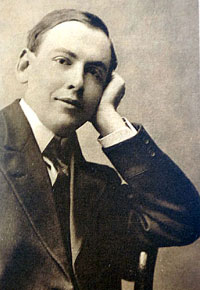
Steger found it amusing that the conversation among New York publishers at their luncheons in early 1910 often turned to John Lomax, Steger's former boss at the University of Texas, and Lomax's unusual book, Cowboy Songs and Other Frontier Ballads.
After a brief intermission, Steger and Lomax were once again communicating regularly. But a chasm had formed between Steger and Roy Bedichek, the person Steger had once thought of as his twin spirit.
Maybe the final letter from Bedichek to Steger arrived in February 1909.
"I am trying to read your letter now," Steger had written back in their typical jousting fashion. "It is somewhat difficult because in a fit of rage at your delay I tore it into several sections. It is foolish of you to talk of a gulf that is widening."
It seems doubtful that Bedichek even bothered to reply.
However, Bedichek was still sending articles and ideas to Lomax, who would, in turn, advise Steger.
"By all means send me the stories you have that Bedichek has written," Steger told Lomax. "It is unlikely that he will send any direct. He outlined to me last October, in a letter, a series of articles on the West that I am sure I could easily place for him if he would deliver the manuscript in a form at least near completeness. His address at Deming, New Mexico comes as a surprise to me; for he has not deigned to write since he left Eddy. I shall send him at once an insulting missive to arouse him. He ought to turn out some good stuff for our publishers who, I understand, are neither creative nor artistic, but only mere worms."
Hoping to branch out his literary base, Lomax submitted several poems to Short Stories magazine. Lomax and Bedichek had often made a point of chiding Steger for not fully grasping the significance of some of this same poetry during sessions in B Hall at UT.
The poetry was rejected by Steger, although with a great deal of respect for his old friend.
"I am afraid my own magazine does not use poetry," Steger explained. "Much as I would like, for the sake of our old friendship, and for the delectation of my readers to run it, I am under the accumulative pressure of 18 years, during which Short Stories has never published a single verse. You may rest easy in the assurance, however, that I shall see a fair chance given it elsewhere."
Lomax also stayed in touch with Steger's parents in Bonham, occasionally to the consternation of Harry. For, evidently, Mr. and Mrs. Thomas P. Steger and John Lomax were all concerned about Harry Peyton Steger's health. An elevated concern in Bonham resulted in an admonition from young Steger to his friend.
Dear Lomax:
Seriously, you made a great mistake in judgment when you wrote my people that I was suffering with a bad throat, and that I was jaded and other hopeless things, which I imagine you never really said, but which their own fancies have evolved. As a matter of fact my health and general physical condition have been getting better and better for the past two years---principally because I do not think anything about them.
I have, this morning, a characteristic letter from my father, whose hectic temperament has led him to picture me on the very verge of disintegration and nothing short of a physician's certificate, and a detailed photograph, will give him back his buoyant spirits. Of course, I look tired; when a man's throat has been hurting him for three or four days and he has been trying to talk through it, it is sure to take some of the bloom off the pansy.
Do not take this too much to heart; but I really think you ought to follow up your first communication with another certificate that you actually saw me walk, unaided, across streets and up steps. On second thought, do not write them at all as they would at once know that it was my doing and attribute to me all sorts of heroic motives. I suppose the physician's certificate is the only way out of it for me; I shall send you the bill.
Yours sincerely,
H.P. Steger
Lomax's wife, Bess Brown Lomax, had, of late, begun referring the Steger as simply "Stege," and the close association the nickname intimated warmed Harry's heart. In his early days at UT, Bess Brown had been one of the primary editors at the Cactus that Harry initially reported to.
"When I was in Johns Hopkins folks wore narrow black ties and called each other 'Mister,'" Harry wrote to Bess, "and I've never had a soft spot for the Hopkins'. This is to assure you how comforting to me your friendly greeting is. 'Stege' is the greatest intimacy I have achieved here. Again, thanks."
The note also included a statement of gratitude to John Lomax. It would seem Lomax had explained to his old friend, in rather plain English, just what he thought of Harry going by his middle name, Peyton, at the urging of his new set of friends on the East Coast.
"Tell Lomax," Steger relayed though Lomax's wife, "that his treatment has restored 'Harry' and cold type proclaims as much in the March issue of Short Stories."
Steger had a new wife and home, his position at Doubleday, Page & Company required a great deal of travel and 1910 was something of an Indian summer in the life of O. Henry. A collection called Whirligigs was published that year and included "The Ransom of Red Chief," a timeless story about two bumbling kidnappers who became victims of their own plot when the kid they took turned out to be so obnoxious that not only does the ransom not get paid, but the two kidnappers actually have to end up paying the father before he will let them bring the brat back home.
"I tried to be faithful to our articles of depredation," one kidnapper finally admitted to the other, "but there came a limit."
O. Henry's genius was well known in his beloved New York City and Steger's strategy of combining larger collections of the short-story author's work was paying off, but Steger's travels taught him that marketing had to improve if the writer and publisher were to reap anything close to maximum profit levels. For example, while visiting Nashville on business, Steger found O.Henry's work to be scarce throughout the city's bookstores. It was particularly demoralizing for someone who understood how badly the writer needed more income, just how good some of these short stories were, and yet there were bare shelves staring back at him when Steger went looking for O. Henry's work in Nashville.
Steger suffered a bout of pneumonia, but as soon as his energy returned, books were on their way to fill those empty shelves.
"The young gentleman with the glasses at the Presbyterian Book Store will shortly learn that I am not the liar that you have so ruthlessly allowed him to think me," Steger joked with Nashville native Verner Jones. "I shall send him soon so much O. Henry material that he won't be able to find window space for it. When I do, you and those others whom I reproached for the scarcity of O. Henry book readers in Nashville must in some way start a boom. So far as general publicity for Doubleday, Page & Company is concerned, I have practically let up on my efforts since you took things into your own hands. My reception at the hands of the Nashville Press, under your potent auspices, has completely turned my head. Seriously, I am determined to get back to Nashville. Use your own invention and help me find provocation. I am glad you told me some things about John Trotwood Moore, thus drawing me into correspondence with him. His latest communication is going to be a gallon of old corn whiskey. I am going to write him that it would be less courteous, but wiser, if he let it accompany a manuscript."
A native of Alabama, John Trotwood Moore moved to Tennessee where he went on to eventually become become state librarian, historian, and archivist, leaving behind a legacy of preserving Tennessee history. He was also a bit of a naturalist, as evidenced by insightful advice he left behind in "A Summer Hymnal."
"A little kindness and patience," Moore offered, "is the greatest thing in the world for making friends of birds....as well as of people."
Previous Steger articles:
http://www.ntxe-news.com/artman/publish/article_86954.shtml
http://www.ntxe-news.com/artman/publish/article_86956.shtml
http://www.ntxe-news.com/artman/publish/article_86957.shtml
http://www.ntxe-news.com/artman/publish/article_86955.shtml
http://www.ntxe-news.com/artman/publish/article_86965.shtml
http://www.ntxe-news.com/artman/publish/article_87117.shtml
http://www.ntxe-news.com/artman/publish/article_87118.shtml
http://www.ntxe-news.com/artman/publish/article_87121.shtml
http://www.ntxe-news.com/artman/publish/article_87207.shtml
http://www.ntxe-news.com/artman/publish/article_87123.shtml
http://www.ntxe-news.com/artman/publish/article_87213.shtml
http://www.ntxe-news.com/artman/publish/article_87214.shtml
http://www.ntxe-news.com/artman/publish/article_69808.shtml
http://www.ntxe-news.com/artman/publish/article_87235.shtml
http://www.ntxe-news.com/artman/publish/article_87310.shtml
http://www.ntxe-news.com/artman/publish/article_87311.shtml
http://www.ntxe-news.com/artman/publish/article_87313.shtml
http://www.ntxe-news.com/artman/publish/article_87316.shtml
http://www.ntxe-news.com/artman/publish/article_87617.shtml
http://www.ntxe-news.com/artman/publish/article_87618.shtml
http://www.ntxe-news.com/artman/publish/article_87620.shtml
http://www.ntxe-news.com/artman/publish/article_87759.shtml
http://www.ntxe-news.com/artman/publish/article_87765.shtml
http://www.ntxe-news.com/artman/publish/article_87766.shtml
http://www.ntxe-news.com/artman/publish/article_87767.shtml
http://www.ntxe-news.com/artman/publish/article_87768.shtml
http://www.ntxe-news.com/artman/publish/article_87769.shtml
http://www.ntxe-news.com/artman/publish/article_88065.shtml
http://www.ntxe-news.com/artman/publish/article_87929.shtml