

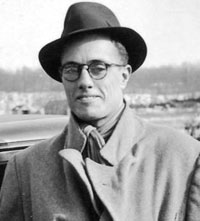
Noted literary figures such as Carl Sandburg remarked that some of these traditional cowboy songs from the rapidly fading American West had an undeniable Homeric quality. The foreword, interestingly enough, was written in Roy Bedichek's shack at the foot of the Florida Mountains in the New Mexico Territory -- the shack Bedichek admitted had holes big enough to throw a cat through. So, it would seem Lomax and Bedichek had some time commiserate and console each other for the difficult path they had chosen in life.
No doubt, Harry Peyton Steger's ears were burning.
When the conversation turned to Harry -- actually he had dropped the Harry and was now calling himself Peyton Steger at the counsel of his new set of friends in the publishing world -- suffice to say Bedichek and Lomax were less impressed with their old friend than he seemed to be with himself these days.
Remember, it was Steger that wrote to Bedichek with nary a hint of modesty.
"Here I am," Steger said, "doing disgusting things: (1) enjoying the comforts and luxuries of and expensive hotel, all at the cost of a vested interest in the form of Doubleday, Page & Co.; (2) playing tennis every afternoon in the warm sunshine with Booth Tarkington and Harry Leon Wilson; (3) and driving in the morning with Mrs. Tarkington."
How do you think that played with Bedichek, a man that was Steger's intellectual equal, yet one who found himself scraping out a meager existence living off wild frijole beans he managed to gather and an occasional rabbit that would wander into one of the traps Bedichek had set out in the high desert country?
A quick glance in The Roy Bedichek Family Letters reveals just about what you might imagine.
"He is no good as game," Bedichek wrote to his fiancée Lillian Greer about the demise of his old friend, Harry. "Got to running with Booth Tarkington and cattle of that sort."
Now, to be fair, Tarkington was a Pulitzer Prize-winning author. Even the venerable Orson Welles thought enough of Tarkington's work that Welles' second feature film was a celluloid version of The Magnificant Ambersons, a sensational novel by Tarkington that would garner a Pulitzer Prize in 1919. The Magnificant Ambersons was nominated for Best Picture in 1942 and starred memorable actors Joseph Cotten, Ray Collins, Ann Baxter and Agnes Moorehead. If you never saw Moorehead in this movie, maybe you'll remember her as the witch Eudora in the TV favorite, Bewitched. Even by today's standards, The Magnificent Ambersons is still regarded as one of the greatest American films ever produced, along with Welles’ first feature film, of course, Citizen Kane.
But all of the honors eventually bestowed on Tarkington could not have filled the void Bedichek felt after losing his close friend to what he saw as the snobby, if not outright elitist, East Coast publishing establishment.
Yet, even though Steger and Bedichek would never be close friends again, their lives paralleled at times. Both were married in 1910. Harry Peyton Steger, now a highly respected literary advisor for Doubleday, Page & Company would take the hand of Dorothy McCormack, an Irish immigrant and the daughter of hard-working middle class parents. Harry and Dorothy's first home would be in Garden City, an upscale Long Island suburb just over 18 miles east of downtown Manhattan.
Conversely, Bedichek's blushing bride in 1910, Lillian Greer, was a UT grad and the daughter of a vice president at Baylor University. Lillian -- bless her heart, it must have been true love -- left the family's new home in Waco for Bedichek's shack eight miles southeast of the small city of Deming in what was then the New Mexico Territory.
"Bedi and I came by our delusion honestly," Lillian would write in The Roy Bedichek Family Letters. "His forebears and mine had trekked across the continent a generation-jump at a time, from South Carolina, Virginia, and Maryland to Kentucky, Louisiana, Missouri, Illinois and finally Texas. The momentum of three generations shoved us on."
Lillian had taught Latin at Grayson College in Whitewright for two years until that impressive brick structure burned and then she returned home to teach in the Waco school system. When Bedichek convinced his bride-to-be to join him out west, Roy secured Lillian a teaching job and a place to live in Deming while they decided on the possibility of matrimony. They tied the knot on Christmas day, 1910.
Again, from The Roy Bedichek Family Letters...
"We were married on Christmas morning in 1910, by an elderly justice of the peace in failing health," Lillian wrote. "Although it was not quite seven o'clock, he was clean shaven and neat in his Sunday clothes; but, as the train left at 7:30 a.m., we could not wait for him to put on his shoes, so he married us in his sock feet. His wife called in two of the boarders to act as witnesses and herself wept as if Bedi had been an only son. She had never seen us before, never saw us again. Perhaps she was remembering her own wedding."
Or maybe the lady with tears rolling down her cheeks had heard about Bedichek's shack his glowing bride would soon call home.
Another memory from that day made Lillian smile for as long as she lived. After the rather unceremonious ceremony, the couple went to the train station for a newlywed trip up into the mountains to a resort at Faywood Springs. Bedi had gone to purchase tickets, leaving Lillian alone when the president of the Bank of Deming, John Corbett, chanced by.
Tipping his hat, Mr. Corbett asked, "My goodness, Miss Greer...what in the world would bring you down to the station at daybreak on Christmas morning?"
"Oh, uh...well, Bedi and I are going up for a week at Faywood," Lillian replied.
"Now, that's just fine," the bank president answered. "And I hope the both of you have a splendid time."
As Mr. Corbett tipped his hat again and walked off, suddenly Lillian's mouth fell open. It dawned on her that she had omitted to mention the most pertinent fact that she and Bedi had just been pronounced man and wife. Mr. Corbett hadn't so much as raised an eyebrow, she kept reassuring herself over and over. Still, all week long Lillian couldn't help but imagine that Corbett had gossiped about their meeting at the train station and townspeople were, on every corner, casting aspersions upon her character in absentia. After the honeymoon, Lillian returned to find the bank president hadn't breathed a word about their encounter.
Ever the romantic, Bedi brought his terrier-bulldog cross, Bo, on the honeymoon.
"Our room was on the first floor with windows opening on the long front veranda," Lillian wrote in the Bedichek Letters, "which was a great convenience for our dog. Although the mornings were nipping and the mercury near freezing, we spent our days in the open. To escape the full force of the wind, we sought shelter in Trujillo Canyon or camped in the lee of a massive boulder of the City of Rocks, a notable example of wind erosion. These huge stones, shaped like strange animals, aboriginal gods, giant chairs, some 40-feet high and big as a church, presented from a distance the illusion of a city. While Bedi drove, I got out and ran along the flinty ground behind the buggy until my hands and feet thawed out. Meanwhile Bo ranged far and wide routing out chilly rabbits, investigating tantalizing smells, then returning to see how we were faring. He was glad enough, though, to lie down with us by a fragrant cedar fire until the sun was high and the wind died down. In mid-afternoon, we returned to the empty old hotel. Not that we minded the lack of company."
Everyone in Deming knew Bo, or at least they did after the Albuquerque Boosters hit town with a half-grown brown bear. Every man who thought he had a bear dog came down to the railroad station where the bear was chained, glaring at any canine that dared so much as glance in its direction. About the time all the men realized there wasn't a real bear dog in Deming, the gnashing teeth of a rangy stray stung the bear. The bear twirled to retaliate, but the dog was one step ahead and already nipping flesh again on the beast's backside.
"Hey, fellers, looks like we got us an honest-to-goodness bear dog," someone in the crowd called out, but most realized this dog knew no master.
Legend had it Bo had been found in a hollow log down by the Mimbres River. Every man that had tried to chain him or lock the dog up soon found that the black-and-white mixed breed valued freedom more than any man in Deming. An alcoholic paper hanger had come the closest to capturing the heart of the terrier-bulldog cross because he never tried to chain up the dog and early risers noted the two often ended up sleeping on the porch together. But the drunk would spend his last dime on his next drink, leaving Bo to sneak around back doors for scraps, which in those days meant risking an occasional scalding. Until the day he died, Bo would jump in horror anytime he saw someone throw so much as a glass of water. Bo had been making the rounds and searching for scraps at eating establishments in Deming when the rangy dog spotted a sympathetic face.
Bedi had been eating supper at a Chinese restaurant -- Chinese workers had been employed in large numbers to build the railroads across the West -- when he looked up and locked eyes with a dog that had obviously missed many a meal. With every bite Bedi took, he could feel the desperate stare of the starving dog. Finally, it was too much. Bedi asked the waiter to wrap up a dime's worth of scraps and the dog caught the first bone in midair. Bedi smiled.
They would be friends for life.
As Bedi walked home that evening, the skinny stray walked 20 steps behind him, slowly gnawing a big bone and never taking his eyes off the man who had tossed it to him. Bo slept outside Bedi's door that night.
In addition to submitting articles to newspapers, Roy Bedicheck had been working as secretary for the Deming Chamber of Commerce and had even managed to borrow enough to buy a stake in The Deming Headlight.
At age 31, Roy was now running his own newspaper -- the dream he had written about a decade earlier in his diary had come to life. And, of course, just as soon as school let out and her teaching responsibilities allowed, Lillian raced down to the newspaper office to help out.
Braced by the addition of two very bright and dedicated UT graduates, the Headlight prospered. On nights they could make it out to their homestead, since there really wasn't room to sleep inside the shack, they made a pallet in the sand. On a tarp, Roy and Lillian would spread blankets and pillows.
Lillian was learning to cook by reading Marian Harland's White House Cook Book, although Lillian would grin to herself at the obvious fact that any stove in the White House would sit firmly on four legs, while the stove in her shack had three legs and dared to, on occasion, tilt over and dump its load of hot coals onto the floor.
Then one glorious day Lillian looked out to see Roy pulling up in the yard with a big kitchen range practically filling his buckboard. Yes, it was definitely used, although still a vast improvement over the older, smaller stove. But it turned out that this stove wouldn't quite connect to the flue that carried the smoke outside. Roy solved that dilemma by finding a sturdy wooden box just the right height and then, with leverage and an improvised ramp, working the box underneath the big kitchen range so that now the flue fit perfectly.
This arrangement came with certain inherent advantages and disadvantages. Lillian found herself climbing up on the edge of the box and then precariously balancing while she stirred her skillets. On the other hand, it was pleasant to just walk up and look straight into the oven without even bending over.
Previous Steger articles:
http://www.ntxe-news.com/artman/publish/article_86954.shtml
http://www.ntxe-news.com/artman/publish/article_86956.shtml
http://www.ntxe-news.com/artman/publish/article_86957.shtml
http://www.ntxe-news.com/artman/publish/article_86955.shtml
http://www.ntxe-news.com/artman/publish/article_86965.shtml
http://www.ntxe-news.com/artman/publish/article_87117.shtml
http://www.ntxe-news.com/artman/publish/article_87118.shtml
http://www.ntxe-news.com/artman/publish/article_87121.shtml
http://www.ntxe-news.com/artman/publish/article_87207.shtml
http://www.ntxe-news.com/artman/publish/article_87123.shtml
http://www.ntxe-news.com/artman/publish/article_87213.shtml
http://www.ntxe-news.com/artman/publish/article_87214.shtml
http://www.ntxe-news.com/artman/publish/article_69808.shtml
http://www.ntxe-news.com/artman/publish/article_87235.shtml
http://www.ntxe-news.com/artman/publish/article_87310.shtml
http://www.ntxe-news.com/artman/publish/article_87311.shtml
http://www.ntxe-news.com/artman/publish/article_87313.shtml
http://www.ntxe-news.com/artman/publish/article_87316.shtml
http://www.ntxe-news.com/artman/publish/article_87617.shtml
http://www.ntxe-news.com/artman/publish/article_87618.shtml
http://www.ntxe-news.com/artman/publish/article_87620.shtml
http://www.ntxe-news.com/artman/publish/article_87759.shtml
http://www.ntxe-news.com/artman/publish/article_87765.shtml
http://www.ntxe-news.com/artman/publish/article_87766.shtml
http://www.ntxe-news.com/artman/publish/article_87767.shtml
http://www.ntxe-news.com/artman/publish/article_87768.shtml
http://www.ntxe-news.com/artman/publish/article_87769.shtml