

Not long ago a visitor from San Angelo stopped by my house for a visit. Bill Yeates is many things: he’s a retired seismologist for the oil industry, a private pilot, a photography enthusiast, and a World War II buff whose encyclopedic knowledge of everything pertaining to the old Texas Army Airfields west of the 100th meridian is staggering.
When he was at my house last summer he asked if I had every visited any of the old World War II era bombing targets in the area.
“Targets?” I quizzed, knowing I’d missed something in my fifteen years of living in Childress.
Turns out, his query had merit and a simple question set in motion a personal research project that connected the latest consumer technology with some old fashioned detective work and ended in a glorious afternoon outdoors in the Texas Rolling Plains.
By the time we first met, Bill had already done a bit of research and found the rough coordinates of some of the targets - information he’d garnered from pouring over old war maps.
Using the software program Google Earth, we honed in on a few of the areas were the targets presumably lay. A bit of scrolling and we found the tell-tale outline of old targets that time and hi-tech satellite imagery couldn’t hide. While the target shapes vary by location, the one in which we’re interested looks like a giant crosshairs precisely laid across a hardscrabble piece of Panhandle ranchland.
“I think I can get us on this place,” I tell Bill. “If I am correct, I know who owns this property. While Bill had to leave and head back for San Angelo, I promptly sent an e-mail and confirmed the location of the targets and turns out, I did get permission.
Seven months later, Bill and I are winding our way across powder-dry ranch roads navigating our way to where the target ought to be. Using a GPS, a print-out of the Google Earth screen, and a measure of country savvy we wander into the unknown.
While Bill stared as his GPS, he was just about to speak when I interrupted him and said, “Look there!”
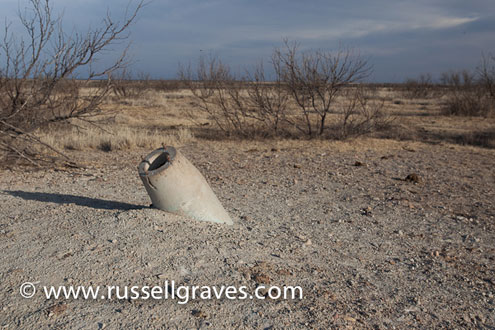
Tilted in the same fashion as the Easter Island monoliths, the tower at Pisa, Italy, and the Cadillacs in Amarillo, the back end of a concrete bomb jutted mightily from the caliche mound that marked the target’s center. It’s lasting monument of some unknown bombardier trainee who, at least for a moment, mastered the Norden bomb sight because of his training at the air base in Childress. Then, at the precise moment, he released the practice bomb from the AT-11 trainer and it sailed silently on a downward arc until it’s final, unceremonious thump into the dirt.
To the untrained eye, you might think that the concrete pieces and metal fragments from the faux munitions scattered amongst the cactus and mesquite are just scrap dumped by someone. To me and Bill, though, these pieces of World War II flotsam represent much more than that.
Each hunk of aggregate, chicken wire, and cement were made by American hands, placed in the bombers by American servicemen, and dropped by the same Americans who make up the greatest generation the world has ever know. Men like my Uncle L.D. Hall from Bonham, Texas and others who fought and defeated perhaps the greatest evil to ever lay scourge upon the earth. And they did it not for the fanfare or the fame and glory. Instead, they did it because they are Americans.
Before Bill and I leave, I walk over to where we started our mission and visit the lone bomb atop the mound one more time. Instinctively I touched the bomb and wonder about the person who dropped this over 60 years ago. While I may never know the contribution that the bombardier made to the overall war effort, I do know this: because of him and servicemen and women like him, I can snap one more picture and walk away proudly knowing, I am an American.
Any questions or comments? Contact Russell at russell@russellgraves.com or visit his website at www.russellgraves.com