

When Texas was just a burgeoning state, fantastic tales of human-like creatures permeated the folklore.
“In the spring of 1845 when going to my work one morning I discovered the tracks of three persons who had been near the house the night previous,” wrote Samuel Rogers, whose story was re-told in the J. Frank Dobie book Tales of Old Time Texas.
“...the unknown folks had been around us nearly I year. Then we missed the tracks of the big one and the little one. I must say that I felt a little sorry that the one that made the small tracks was gone without ever finding out who it was or what induced the person to live such a life. I spent many nights watching but never could get a glimpse of any of the three wild ones.”
Sam Rogers accounts, perhaps the first written, gave rise to the bigfoot legend in Texas even though spoken accounts of a creature living along the banks for the Navidad River began as early as the 1830s. Settlers along the Southeast Texas river bottoms had numerous, secondhand encounters as reports about pilfering crops, livestock, and supplies in the rural area were numerous.
Today, the legend of The Wild Woman of the Navidad persists and stories of an unknown creature living even found its way its way into a retro-styled, 2008 independent horror film that draws upon journals written in the 1970s by Dale Rogers of Sublime, Texas. However, there’s been no gap in bigfoot sightings from the 1830s to the time the film released. Texas is peppered with historic and contemporary bigfoot sightings (the reports come mainly from the densely forested land east of Interstate 35) and there’s even a group who’s dedicated to uncovering the mystery of the cryptid by using old fashion detective work and high tech science.
A New Breed of Hunters
“The combined total amount of forestland in the four-state region [Texas, Oklahoma, Louisiana, and Arkansas] equates to roughly 65,000,000 acres, or 100,000 square miles,” says Texas Bigfoot Research Conservancy (TBRC) conference coordinator and organization co-founder Jerry Hestand. By day, Jerry is an elementary school teacher in Bells, Texas but on weekends and the summer, he dedicates much of his time to research the anomalous bigfoot (sometimes referred to as Southern Sasquatch). “That’s an area the size of the state of Oregon.”
The group in which Jerry belongs was originally formed ten years ago as the Texas Bigfoot Research Center but has since morphed into a federally recognized non-profit organization and was rebranded and re-organized as Texas Bigfoot Research Conservancy to put more emphasis on the scientific basis of their work.
“We not only take reports and catalog bigfoot sightings but try to sift through and discover the credible ones,” he says. “The ones that look like they amount to something, we’ll send a team out to investigate.”
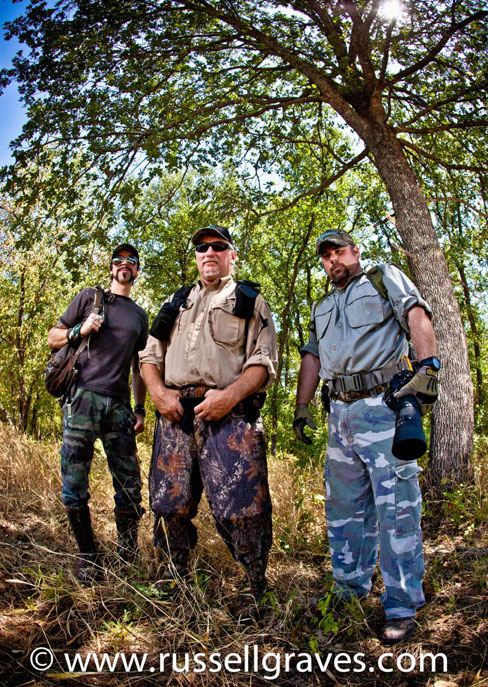
Texas Bigfoot Research Conservancy members (from L to R) Lyle Blackburn, Jerry Hestand, and Chris Buntenbah in Fannin County, Texas.
In their investigations, members of the TBRC search for physical evidence such as hair samples and other relevant artifacts and will re-interview their lead contacts in order to establish a cohesive picture of what people may or may not have seen. Hestand reports that members of his group are made up of everyday people who have a common passion - to seek the truth. “These guys are college professors, teachers, and guys from everyday walks of life who are interested in finding out the truth behind the bigfoot phenomenon.”
Part 2 Next Week
Any questions or comments? Contact Russell at russell@russellgraves.com or visit his website at www.russellgraves.com