

Model building and flying enhance classroom training
DENISON, Texas (April 28) – On Monday, April 23, cadets from Civil Air Patrol’s Texoma Composite Squadron participated in a model rocket launching activity at North Texas Regional Airport in the second phase of CAP’s three-level Model Rocketry Program. The activity provided the cadets with a hands-on demonstration of scientific principles, and the opportunity to have a little fun at the same time.
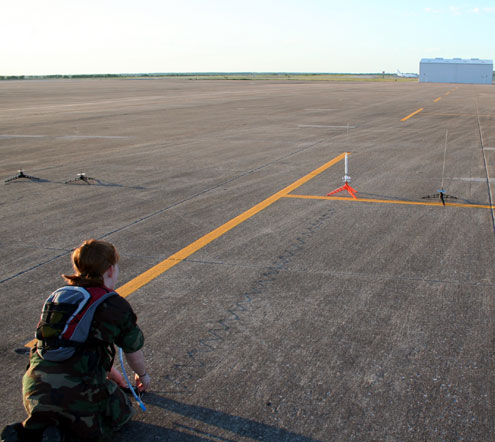
Cadet SrA (Senior Airman) Margaret Flood prepares to launch her model rocket.
The launching was supervised by the squadron’s Public Affairs Officer, 2d Lt. Michael Bernier, who has built and flown model rockets for many years. Cadets were first given a safety briefing, then shown how to prepare to launch their models, which had been constructed in a previous training session. When all of the rockets were ready, it was time to go flying.
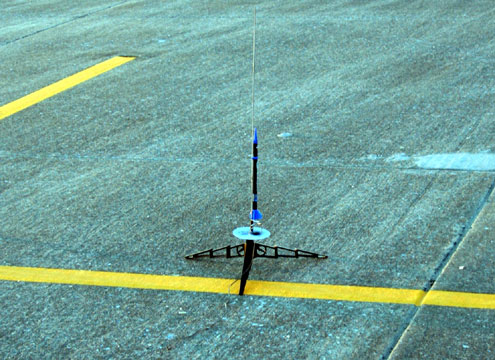
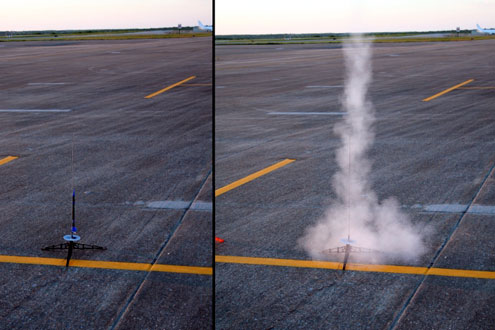
Now you see it…
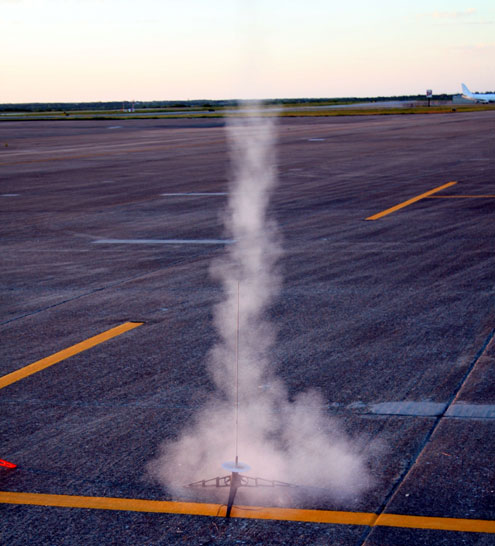
…and now you don’t!
Using two launch controllers and four launch pads lined up on the airport ramp, the rockets were flown at a steady pace. Each cadet was shown how to place his or her rocket on the pad, how to connect the ignition leads, and how to operate the controller. Then, after a quick check of the skies for nearby aircraft, the cadet sounded off a countdown that ended with a press of the firing button to send their rocket soaring skyward. Other cadets took turns serving as a “recovery crew” to follow each rocket as it came down and bring it back to the launch area. Some took longer to launch due to minor technical problems, but eventually all of the rockets were flown and recovered successfully.
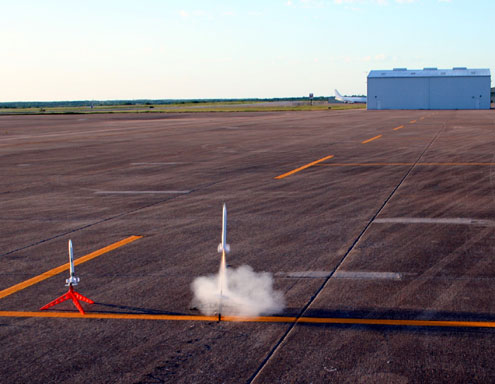
Liftoff! A cadet’s model rocket streaks off the launch pad.
After all of the cadet rockets had been launched, Lt. Bernier ended the activity by launching a two-stage rocket. Flying much higher than the cadet’s single-stage models, the last rocket also took much longer to land, giving the enthusiastic cadets ample time to follow and safely recover it.
“Another squadron member built that model many years ago when his son was a cadet, and he asked me to fly it as part of a demonstration last summer,” he said. “That flight was a real crowd-pleaser, and bringing it out this time also reminds the cadets of what they will be working on next.” The third level of the program requires cadets to build and fly either a two-stage rocket or a rocket that carries a payload.
Each level of the CAP Model Rocketry Program consists of two parts, written classroom training and hands-on activities. In the classroom phase, cadets study the history and development of rocket technology, the scientific principles involved in successfully building and flying rockets, and the uses and benefits that come from rockets and rocket technology. In the hands-on phase, cadets build and fly an assortment of rocket models that reinforce the classroom lessons. Each model demonstrates a different principle such as propulsion, aerodynamics and guidance systems. As cadets progress through the program the model building becomes more sophisticated, providing additional challenges. Cadets who successfully complete the program are awarded a distinctive badge and patch to wear on their uniforms.
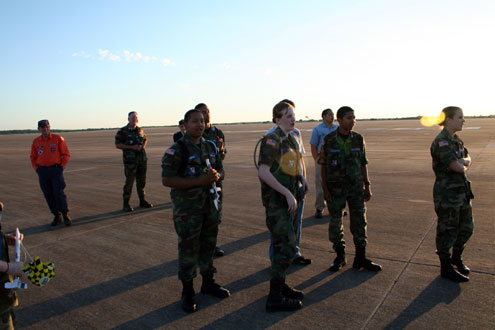
Squadron members look on as a cadet prepares a rocket for launch.
For more information about Texoma Composite Squadron and its programs, please call (903) 786-6227 or visit www.captexoma.org.
Civil Air Patrol, the official auxiliary of the U.S. Air Force, is a nonprofit organization with more than 61,000 members nationwide, operating a fleet of 550 aircraft. CAP, in its Air Force auxiliary role, performs 90 percent of continental U.S. inland search and rescue missions as tasked by the Air Force Rescue Coordination Center and was credited by the AFRCC with saving 54 lives in fiscal year 2011.
Its volunteers also perform homeland security, disaster relief and drug interdiction missions at the request of federal, state and local agencies. The members play a leading role in aerospace education and serve as mentors to nearly 27,000 young people currently participating in the CAP cadet program.
CAP received the World Peace Prize in 2011 and has been performing missions for America for 70 years. CAP also participates in Wreaths Across America, an initiative to remember, honor and teach about the sacrifices of U.S. military veterans.
Visit www.gocivilairpatrol.com or www.capvolunteernow.com for more information.