

The family is a place to nurture, love, train, and teach children to grow into mature, responsible, well-functioning adults. Many parents, family members, and friends celebrate the birth of the child, although, some have other feelings. Not all parents feel they can support the child. There are complicated needs and constant care for the infant. This was the situation in the case of a sister and brother who have been adopted from Russia by a Grayson County couple, Sam and Melissa.
For unknown reasons and circumstances, their mother abandoned the brother and sister. After birth, the boy was left in the hospital, so he never knew his mother or a home.
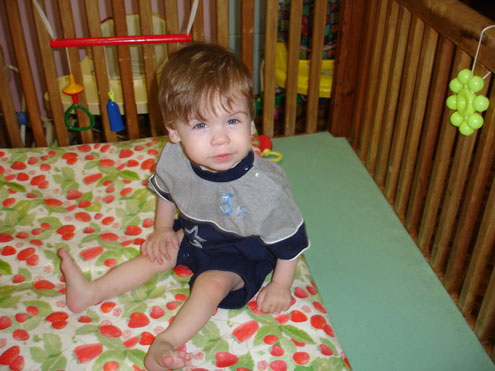
Boy in bed at baby home
The sister, sixteen months older than her brother, was placed in a baby hospital by an acquaintance who was keeping her when the mother did not return. The girl went to the hospital at ten to sixteen months of age. Then she was transferred into an orphanage after becoming too old for the hospital.
When plans for the adoption began, it was for the boy, but when the couple discovered he had an older sister, they wanted both children to be theirs and grow-up together. Finally in 2008 they traveled to Russia and brought the children to the United States. The boy was twenty-two months old and the girl was just over three years old.
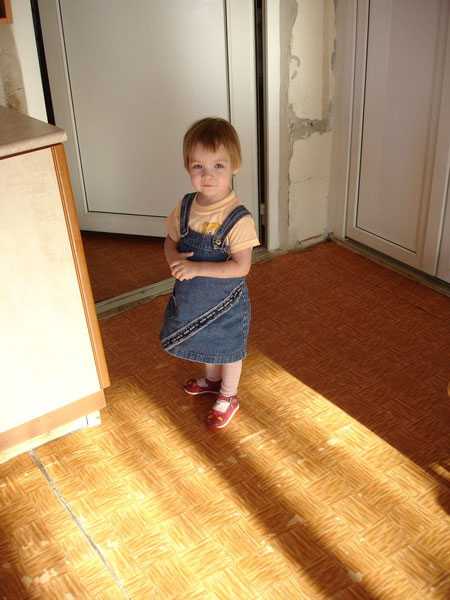
Girl standing in orphanage
A baby immediately begins learning after birth. Parents and others cuddle, communicate, kiss, and meet all the needs the infant has. These children had never received this kind of care because of being institutionalized. Thus they were developmentally delayed. The son was diagnosed with failure to thrive at 18 months.
About a month before the children arrived in the U. S., Melissa randomly met a staff member from Mental Health Mental Retardation Services of Texoma at a women’s club meeting. The children were the topic of discussion since Melissa had some knowledge of the Early Childhood Intervention (ECI) program hosted by MHMRST through her association with the club. She knew she would be facing unique challenges with the children and was seeking information on services in the community for children. The staff member suggested that she contact ECI to have the boy evaluated. The girl was already three years old and did not meet the age requirements for ECI. But she was told that ECI could give her information on resources and services available that could enrich the girl’s development.
A baby or a child brings new stresses and strains to a family. Children with developmental delays bring even more stress and complications. In this family’s life, the stresses would be great and multiplied by two. They were ready for the challenges and went to work immediately. An appointment was made with ECI and an evaluation was conducted. The evaluation included a speech therapist, an early intervention specialist/case manager, and a licensed professional counselor.
"Our Early Intervention Specialist was Joanna Gallegos. At 24 months, our son sat up by himself, but he did not walk or crawl. His communication consisted of a grunt. He did not cry, play, reach, or touch things. Even as an infant, he was not held when he was fed. He had been fed with a bottle (the bottle had tea in it, not milk) propped up on the crib railing. It had the top of the nipple cut off where he did not have to suck. The liquid ran down his throat, all over his face, and into his ears. Thus he never learned to suck. He currently has problems aspirating when drinking. We tell him to pause from drinking, to take a breath, and begin drinking again. He has problems with specific foods where he doesn't chew. We constantly remind him to chew before he swallows to keep food and drink from going into his lungs," says Melissa.
"He had never touched a toy and had no other stimulation. He had been spoon fed a broth while he was tied in a chair with a towel, but he had never had any solid foods, finger foods, etc. His sensory skills were almost none. He did not understand his tongue, lips, or mouth. Jan Tooley, ECI speech therapist, worked with him and his sensory needs. She introduced foods and exercises to help him learn to eat. His language and speech are so precise now. "
"He had never been outside or had the wind blow on his face and could only see the sun from a window. He was never taken out of his crib except to eat or to have his diaper changed. He really had not had face to face contact with anyone. He shared a room with 9 or 10 other children who received the same type of care. Adam Metts was his licensed professional counselor who was there for the whole family. He gave us recommendations and resources for our daughter. He was our constant guide in all of this. He knew the great stress we were going though and helped us figure everything out one step at a time and explained to us what was happening. We were in constant transition. He would always say that everything is going to be fine," she continues.
"ECI educated us. They taught us as parents to look for clues to use as teachable moments and to build concept on top of concept. The staff helped us to identity milestones. We were told over and over that our children were two to three years behind developmentally and change would come, but not overnight. ECI provided us with a path from the very beginning. I thought we were very capable people and would we figure it out, but ECI made the path easy. Since ECI we have had to piece things together ourselves, it has taken some time to do it, but I would not trade what it took us to get here. Today I have a heart to help people who are in crisis the way we were. We are happy and adjusting and we love being the family we are," she added.
"Our daughter had a different set of problems that took different solutions. She is doing well now and there are more adjustments for the children. Both of the children are excelling in activities at school and extra curricular activities such as equine therapy and gymnastics. Our son wants to be a brain surgeon. Our future looks bright," ended Melissa.

Brother and sister today
ECI serves children birth to 36 months of age who have developmental delays in Grayson, Cooke, Fannin, Hopkins, Delta and Lamar counties. For more information on services and requirements, call 903-957-4810.