

SHERMAN, TEXAS — Austin College’s newest mobile application is a true innovation: ‘The Austin College App’ was produced by five computer science students last fall.
Senior Ryan Gant, junior Will Gagne, junior Simon Frazier, junior Phillip Cohen, and junior Jackson Walsh spent their time in their Objective-C course building a sophisticated iPhone app.
The app, available through the Apple iTunes online store, is compatible with the iPhone, iPad, and iPod Touch. It includes a campus map, a Roo Route bus map, a searchable directory, a College news feed, College event listing, and access to WebHopper, Moodle, and Give Now.
Aaron Block, assistant professor of computer science, led the course.
“The iPhone class was everything I was hoping teaching was going to be,” he said. “It was wonderful.” Block is in his second year of teaching at the College.
Ryan Gant, a computer science and business double-major, took a particular interest in the project, spending his extra time after class and during January Term making sure the app was realized.
“Even before the class, someone brought up the idea of an iPhone app. I thought it was a great idea. Then during the class we designed it out in our heads,” he said. “The semester ended so quickly, it kind of dropped off. We had all these plans, but nothing actually set in stone. I didn’t want it to just go away, so over Jan Term I worked on it some. It was really a collaboration (with Block).”
Though other colleges and universities have similar programs, Block’s class is unique. There were no college-level textbooks for Objective-C, the iPhone programming language, and Block had to start from scratch.
“There are very few resources out there, and there are probably fewer than 10 similar classes at the time the class was offered,” he said. “My understanding is, right now, Austin College is the only one with a student-made college app.”
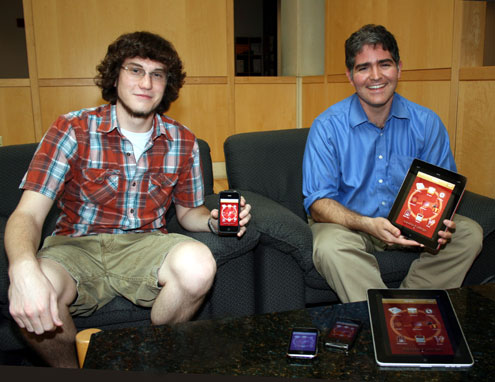
Senior Ryan Gant (left) and assistant professor of computer science Aaron Block (right) show The Austin College App on iPhones and an iPad. Austin College is among only a few colleges that allow students to create an iPhone application in a course.
The best-known iPhone application course was offered at Stanford University beginning in 2008, and the podcasts of the lectures had over 1 million downloads in the first week they were available. But that course was only for programmers who were already highly technical.
Ryan had tried to learn Objective-C through the Stanford class. “I tried, and I just couldn’t. Having Aaron there to walk us through it and answer questions made all the difference,” he said. “I wouldn’t have been able to do it without that class.”
More recently, other colleges have offered this kind of course, but the class sizes were large and students didn’t work on applications for their school.
“It was definitely an advantage to have a small class. A lot of the work and teaching was done by example. He would code something and show us how it worked,” Ryan said. “The fact that I can go ‘hold up, what is that’ and interrupt and ask questions, it’s nice to be able to have that one-on-one with the professor. And after class, if I had trouble, I could go to his office. When you get to college with 50-60 people, the professor can’t stop and give you that much time.”
At one school, the class size was smaller, but students received money and assistance from professionals. At Austin College, students did all the work themselves, and the only budget was $100 from the computer science department to host the app on iTunes.
“The one thing I wanted to make sure my students got was a lot of hands-on experience developing and making things that people really use. It’s great to talk about the theory, but it’s another thing to build something that people actually use,” Block said. “The other thing is that I really wanted to teach the language that is used for an iPhone application. It’s similar but very different from anything else out there. It’s a good chance for students to learn something that is beginning to be widely used.”
Block, who checked codes for problems at Microsoft before joining Austin College, made his class part lecture, part product think tank. The Roo Route section of the finished app was a homework assignment.
For the final product, students each picked a segment to tackle individually, and then checked in with the group during class time.
“We came up with a list of what we wanted to get done, and we split it into five parts. For the rest of the semester, it was about trying to refine the ideas, refine the components,” Block said. “If we had been writing a group paper in class, it was like we were editing. We were writing and editing for a month.”
Block checked the code for errors, and they combined their efforts. The app passed Apple’s stringent guidelines and was officially posted for download in iTunes in April.
“It exceeded my expectations. I was hoping we would see something we could put on the app store that students could show to people like ‘hey, here’s what we did,’” Block said. “Now I would really like to have every student with an iPhone has it and uses it regularly. In the future I’d like to see every student and alumni with an iPhone and an Android uses it every time they think of the College.”
The app was posted to Austin College’s Connect page just in time for the start of school.
And Ryan has more plans for the app in the future. “I’m hoping to keep adding more and more, as long as I can get partnered with IT (at the College),” he said. “I want to do more social aspects, like ‘what is a good place to eat around Sherman?’ I’d like to add more interactive things to the app.”
Also has Block to offer more app-coding classes in the future, including applications for other platforms like Android. As for this project, he is thrilled. “I hope it works well for the school, and I hope it helps my students get jobs,” he said.
Ryan is hoping to one day work for app giant Apple, but he has already heard from Rocket Powered Apps in Dallas for a possible job after graduation. He said the company doesn’t typically take new graduates, but his experience with the app impressed them.
Austin College has another mobile app, available on iPhone, iPad, iPod Touch, Android, and Blackberry. The MOX app provides a list of important phone numbers, a College news feed, a College event listing, a campus map via Google Maps, and directions to the Lake Campus. The MOX app is College-run and maintained.
Austin College is a leading national independent liberal arts college located north of Dallas in Sherman, Texas. Founded in 1849, making it the oldest institution of higher education in Texas operating under original charter and name, the college is related by covenant to the Presbyterian Church (USA). Recognized nationally for academic excellence in the areas of international education, pre-professional training, and leadership studies, Austin College is one of 40 schools profiled in Loren Pope’s influential book Colleges that Change Lives.