

Giant or historic bois d’arc trees, livestock gates, wagons, massive wheels to extract tannin from leather processing, paling fences, rural mailboxes resting on bois d’arc posts, pianos, guitars, cemetery headstones. Many other appearances of the bois d’arc tree distinguish the Northeast Texas landscape and attract attention in homes and museums. Such uses of bois d’arc are now being inventoried.
Leaders of the Bois d’Arc Kingdom will be at Bonham Heritage Days on Saturday, July 23, to record the location of these cultural emblems in the only place on earth where the tree grows in its native habitat.
Prime Ministers Allen Rich of Bonham and Fred Tarpley of Commerce will be in the Fannin County Courthouse, along with the Bois d’Arc Capital crafters, to exhibit, demonstrate, and sell bois d’arc decorative and useful creations as well as register bois d’arc landmarks and items of interest as bois d’arc destinations to visitors. The Bois d’Arc Kingdom is now being formed from Northeast Texas counties in which the tree thrives.
The heaviest and densest wood in North America is ideal for building livestock fences and gates. When barbed wire replaced the bois d’arc hedges that fenced the prairies, no better fence post could be found than the sturdy, decay-resistant, long-lasting bois d’arc post.
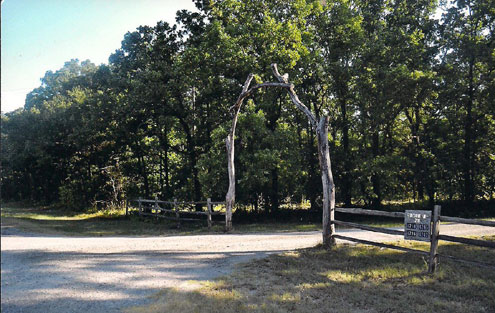
Clifton Haddock, a Northeast Texas resident, has constructed a legacy of uniquely designed fence gates and fence lines concentrated in Delta, Hunt, and Hopkins counties. The entrances are easily recognized by his trademark of two upright bois d’arc tree trunks sawed off at the top just above the fork of two limbs. The fork holds the trunk of a third tree spanning the space between the two uprights. At the entrance to the gate, Haddock uses sturdy bois d’arc posts wired together as a strong paling fence. In the fence line of barbed wire he mounts on steel posts, he intersperses two or three double-sized bois d’arc posts to add additional anchorage to the stretched wire.
The Bois d’Arc Kingdom inventory seeks descriptions and locations of other gates and fences in Northeast Texas. Also sought are cemeteries where frontier settlers used bois d’arc as headstones until marble and granite became available. Then the long-lasting bois d’arc slabs were placed under the heavy stone marks as stabilizing foundations, as now found in Wildwood Cemetery in Bonham and other burial grounds.
Northeast Texans are also asked to report the involvement of bois d’arc in museum exhibits throughout Northeast Texas.
The following list suggests some of the items to report:
bois d’arc dowels used instead of nails, hanging trees, insect repellants, rolling pins; pestles and mortars for crushing food; bows and arrows; kitchen utensils; boot jacks; lathed pens, pencils, vases, bows, and ornaments; walking canes; paper weights; billy clubs; paper weights; patented clicky sticks; and furniture. The record of bois d’arc items will include the location (description, address or directions including name of nearest community) contact information for owner, and name and address of the person providing the information.
Reports for the inventory will be accepted at the bois d’arc exhibits in the Fannin County courthouse on Saturday, July 23. Information may be transmitted by mail to Bois d’Arc Kingdom, 4045 FM 1568, Campbell, TX 74222 or by telephone to Fred Tarpley, 903-886-6498. The information will be researched and printed for the public on maps of the Bois d’Arc Kingdom and in lists of bois d’arc destinations.