

When Dr. Christine Evans scoops up a handful of Northeast Texas soil, she doesn’t need a microscope to know what she’s holding. The soil scientist in the Department of Agricultural Sciences at Texas A&M University-Commerce scans the landscape for geological clues to micro processes and then decides where to classify this specimen among the twelve orders she was trained to recognize.
In the Commerce area, when she sees soil north of the South Sulphur River, she recognizes the blackland gumbo as Vertisol, taking its name from inverted clay soil containing dark mulch that hardens and cracks. This soil loves cotton and other crops, but when it splits, sidewalks and house foundations need repairs. Sediments of sodium and soluable salts from the Gulf of Mexico and the Rocky Mountains give this soil distinctive character and explain the salty nature of local water supplies. Dr. Evans finds this soil ideal for cotton, but she encourages crop rotation to rejuvenate the earth.
At the blueberry farm recently acquired by A&M-Commerce a mile south of the South Sulphur, Dr. Evans classifies the soil as Alfisol, earth infused with aluminum and iron (alfi), yielding a lighter color and making it less likely to crack but more partial to pine trees and blueberries than Vertisol. The surface of most of the Hunt County is covered by Vertisol, Dr. Evans believes, but she intends to work with students to discover confines of Alfisol. Looking at the landscape bordering the South Sulphur, Dr. Evans has spotted the geological features compatible with the two types of soils.
Among her assignments at the Commerce university is interaction with regional farmers and ranchers.
“Mostly, I’ve been learning from them about how they work with the land,” said the Michigan native beginning her second year on the blackland prairie, “but I’m available to answer their questions about soil.”
She has already collected samples of soil to test for contamination. Dr. Evans also leads college students into a deeper appreciation for the land in her courses, especially in a course called Soil Ethics in U.S. and World Agriculture she is teaching this semester.
The class considers the question of how to live on the land that supports human life with six to twelve inches of top soil and in return takes care of the fragile gift from nature.
In discussion groups, students have already concluded, “You can’t grow good food without good soil; you can’t grow good people without good food; and you can’t grow good soil without good people.”
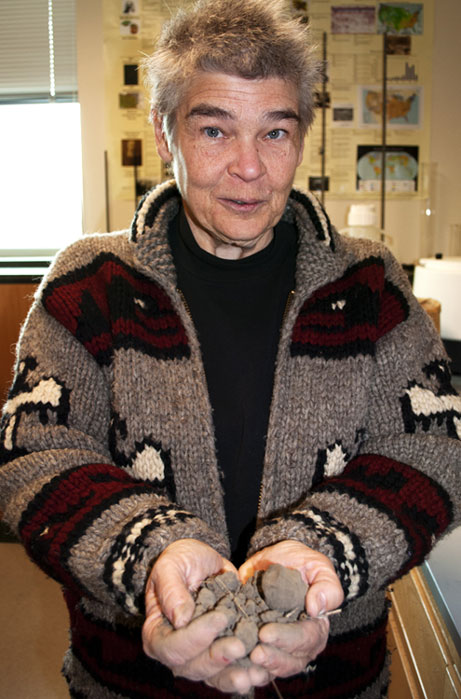
Dr. Evans began college as an English major at Oakland University in Michigan. Social turbulence beginning in the 1960s caused some of her professors to persuade students that education and other traditional values were irrelevant and that existentialist hippy life should be their calling. Caught up in student unrest, she began to skip classes for the more important experience of sitting in the lap of Mother Nature and “writing poetry about how unreasonable the world was.”
Now as author of several published articles on soil science, Dr. Evans has been told that early training in English energizes her otherwise scientific prose.
Leaving college for seven years to explore the world and sample different jobs, she returned to college to become a veterinarian but declared a major in soil geology. She sought a way of thinking not centered on human entanglements but on the natural world.
“As a teacher I can sympathize with students going through similar periods of discovering their mission as I did,” Dr. Evans said.
While completing an M.A. degree in soil science from Purdue University, she mastered identification of the fifteen soil orders. Her third degree in soil science was earned at the University of Wyoming, and she entered the small circle of specialists with a doctorate in soil science. Before coming to Commerce, she taught at the University of New Hampshire and at the University of Wisconsin-Kenosha.
Dr. Evans has already bonded with the soil and the people of Northeast Texas.