

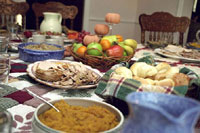
That is, you will need to listen, make appropriate remarks, and, occasionally, say something entertaining or informative. This is a heavy burden that all adults bear.
Here are some facts about Thanksgiving that might impress your new dining companions.
The Pilgrims didn’t really celebrate a yearly “Thanksgiving.” They, like other groups of pioneering people, met occasionally to give thanks for a variety of things - mostly, survival. The first time the Pilgrims gathered for gratitude was in 1621. The very first public thanks giving gathering in North America was at Jamestown, Virginia in 1619. Of course, Yankees dispute this.
In 1789, George Washington declared a day to express thanks to “the great and glorious Being,” but the day wasn’t a national celebration until President Lincoln proclaimed the last Thursday in November as “Thanksgiving.” Lincoln took his cue from a magazine editor, Sarah Josepha Hale, who started a letter writing campaign in favor of the holiday.
However, it wasn’t until 1941 that Congress made the day official. They were moved to action because President Franklin D. Roosevelt had changed the day of the holiday to the third Thursday in November in order to give retailers an earlier start on the Christmas season. Many people didn’t take kindly to FDR’s initiative, calling his holiday “Franksgiving.” Congress stepped in to end the squabble with an official proclamation that the national Thanksgiving was the fourth Thursday in November.
By the way, Washington’s original proclamation was “lost” until 1921 when an assistant chief of the manuscripts division of the Library of Congress stumbled upon it at an auction in New York. The document, written in long hand by President Washington’s secretary, William Jackson, was purchased for $300 and returned to the Library of Congress.
Turkey was plentiful game in the New World. Long before the Europeans even thought about crossing the ocean, the Aztecs were already domesticating turkeys to use for food and in religious ceremonies.
President Harry Truman “pardoned” a turkey the day before the White House Thanksgiving dinner one year. Since then, the Presidential pardoning of a turkey has been a tradition. The lucky turkey spends the rest of his life at a petting zoo in Herndon, Virginia.
In 1955, frozen and fully stuffed turkeys were introduced to the consumer. It was an idea that, shall we say, “went bad.”
The state of California raises more turkeys than any other state; some of them even hold public office.
Cranberries are native to North America. Native Americans pulverized the berries into a paste and combined it with dried meat to make a staple of their diet, pemmican.
Cultivated cranberry production started in 1815 in Massachusetts. Today, Wisconsin is the leading producer of cranberries.
Some of today’s top producing cranberry beds are over 100 years old.
Since a ripe cranberry will bounce, they are also called “bounceberries.”
This gets a little confusing. Sweetpotatoes are not potatoes and, although similar in appearance to yams, aren’t yams, either. Sweetpotatoes, one word according to the North Carolina SweetPotato Commission, aren’t even in the same botanical family as yams.
The sweetpotato, a member of the morning glory family, is a fleshy root, naturally sweet, and native to the Americas. The true yam is a tuber, starchy, and native to Africa. The word “yam” is the English version of the African word "nyami" which apparently means “starchy tuber.”
The sweetpotato/yam confusion started when a new variety of sweetpotato, a sweeter sweetpotato, was sold under the name of “yam” to distinguish the variety from the original paler sweetpotato. These “American Yams” have a vivid orange color and are moister when cooked.
If your “yam” is grown in the US, has a thin, smooth skin, it’s a sweetpotato. If it’s imported from the Caribbean, has a rough thick skin, it’s really a yam.
Still confused? Read the label; the US Department of Agriculture requires that the name "yam" always be accompanied by "sweetpotato" when it is, in fact, a sweetpotato.
Sweetpotatoes have been around since pre-historic times and it’s very likely that dinosaurs enjoyed them. Native Americans were cultivating sweetpotatoes when Columbus arrived in 1492.
A Colonial physician recommended children eat sweetpotatoes because he felt they prevented nutritional diseases. He was on the right track because sweetpotatoes are high in beta-carotene.
The green bean casserole recipe that spread like kudzu after Campbell’s developed it in 1955 is enjoyed by almost 20 million persons each year. That’s a lot of cream of mushroom soup.
One of our “traditional” Thanksgiving dishes that was actually handed down from the Pilgrims is pumpkin pie. The Pilgrims made a pudding by baking a pumpkin shell that was filled with cream or milk. Eventually, they made a few changes to the recipe; replacing the pumpkin shell with a crust and combining cooked pumpkin with the cream. Our waistlines have not been the same since.
These conversational tidbits should not only get you through dinner but also an invitation to the adult table next year. Stick to these topics to avoid the conversational forbidden fruit, also known as “can of worms.” Topics like your uncle’s after-shave that smells like beer or anything you heard your mother tell her sister in the kitchen.
Just to be safe, let’s go over the other things you shouldn’t do at the adult table. No talking with your mouth full, no elbows on the table, and no playing “show me.”
Congratulations, you are now well prepared. Dine and converse with confidence.