

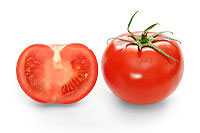
As with many love affairs, the origin of my affection for homegrown tomatoes is recorded not with a date, but with a string of memories. Grandmother Nan grew tomatoes in a tiny flowerbed beneath her kitchen window.

Tomatoes, native to the
Even after the Spanish and Italians started consuming them, many people still thought tomatoes, a member of the nightshade botanical family, were poisonous. When the tomato was introduced to the stock market in 1812, two aficionados with an investment to protect, proved the fruit was harmless with the strongest argument possible. They ate tomatoes in public. Oddly, at one time, some people also thought the tomato was an aphrodisiac, a belief that, apparently, no one wanted to prove - or disprove - in the public forum.
Aphrodisiac or not, modern science says the tomato is a very wise food choice. Tomatoes are packed full of vitamins, particularly A and C, which don’t seem to deteriorate even when the tomato is cooked. Additionally, the tomato or “Lycopersicon lycopersicum” contains an antioxidant called, what else, “Lycopene” which helps thwart cancer, heart disease, and some age-related diseases.
The tomato has a dual citizenship; it is both fruit and vegetable. Because the tomato is the seed producer of the plant, it is classified as a fruit in botanical circles. However, the courts have determined that for legal matters, the tomato is a vegetable because it is usually eaten with the main course of a meal.
The agriculture industry has improved tomato varieties, growing and shipping methods to the point that ripe tomatoes are available throughout the year. However, even with these advancements, the commercial product just doesn’t compare with one from your own yard. Once tasted, the homegrown tomato will drive a person to extremes as evidenced by the following true story. The names and location have been changed because, well, because I promised. But the story is still true.
Waldo moved his lovely family to a quaint 100-year-old home in metropolitan BigCity late last spring. It’s a family friendly place with a large well-shaded backyard. Too shady. In fact, the tree-lined yard just didn’t allow enough sunlight through for a tomato garden. So, being a man with intelligence, pluck and a chainsaw, Waldo determined that he could get enough sunlight to grow the object of his lust with the removal of only one tree.
He carefully went about this task with diligence and calculations befitting a scientist, which Waldo is, so you know he’s no slouch when it comes to brain-matter. The angle of the cut, the direction of the fall, wind gusts, air temperature and harmonic convergence were all taken into consideration. Waldo even determined that the retaining wall that separated his property from the city easement for the commuter rail service would guide the sacrificed tree to a desirable, safe resting place.
Everything went as planned until the tree exhibited a stubborn willfulness heretofore characteristic only of computers and small children. With complete disregard for Waldo’s brilliant scheme, the doomed tree jumped the wall, slid down the other side and straddled the rails of the BigCity Rapid Transit system. The line was shut down for the rest of the day.
Any shameless tomato lover might summarize Waldo’s afternoon adventure as
tomato plants: $4.50
fertilizer: $6.95
lost revenue from afternoon of blocked light rail traffic: $10,074.75
homegrown tomatoes: worth it