


While bow hunting last fall, I noticed several longbeard gobblers and vowed to return for a spring hunt. Last week’s hunt proved what I suspected last fall: the ranch is every bit as good for hunting turkeys as it is for deer!
To be a successful turkey hunter, one must be able to ‘read’ the terrain and adjust positions to intercept a gobbler. There are several schools of thought as to the best techniques for hunting turkeys. I’ve known guys that set up in an area they know is frequented by gobblers and stay put, sometimes for many hours. Their success is based on the fact that the birds will eventually work into the area and be coaxed within bow or shotgun range by their decoys and calling.
I prefer to remain mobile and if the gobblers won’t come to me, I’ll take the hunt to him. There are many reasons that a distant gobbler might not close the distance to your calling and decoys. Geographical features such as mountains, fences, streams or rivers or heavy cover might distract a bird 400 yards away from coming to you. But, if you ‘read’ the terrain and cut the distance in half by heading to the bird, it’s often possible to entice him to come to you.
The bird I harvested earlier this week was a good example of how ‘closing the distance’ can often result in a bagged bird! This run-and-gun style of turkey hunting requires a lightweight, portable blind, especially if you do your turkey hunting with a bow. The GhostBlind (www.ghostblind.com) I use is ideal for providing instant, total camouflage. It weighs about 15 pounds and sets up in a matter of seconds.
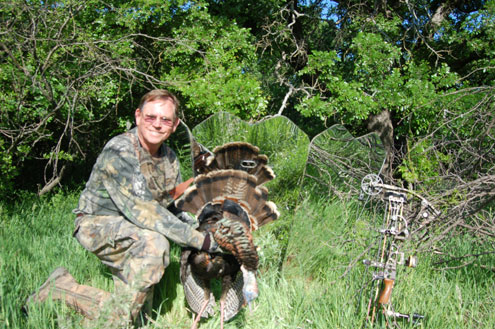
The gobbler answered my series of hen yelps, but he was obviously at least 600 yards away, in the direction of the West Fork of the Trinity River, which traverses the north side of the ranch. I stayed put for about 10 minutes and continued calling. He responded by gobbling each time but was not interested in traveling such a great distance for a chance encounter with what he thought was a receptive hen.
I use a portable GPS when hunting area that I am unfamiliar with. With a GPS position locked in so that I could easily find my way back, I make a bee line for the turkey. When I was within an estimated 200 yards of where I thought the gobbler was sounding off, I quickly set up the GhostBlind, got behind it and began a series of plaintive hen yelps. At the first strike of the box call, he boomed his answering gobbles back in the bottoms. I waited another minute then called again, much more softly.
The hair on the back of my neck stood up when he responded. He had closed the distance quickly and was gobbling his head off what appeared to be about 60 yards back in the brush. It’s amazing how precisely a turkey gobbler can pin point sound. He had traveled well over 200 yards and was heading straight for me. With a couple of hen and a gobbler decoy set 25 yards in front of the blind, I was ready for him.
When a bird is this close, it’s often best to remain silent and watch closely for his appearance. Sure enough, in a matter of seconds, I watched his head and neck bobbing back in the brush. Once he spotted the decoys, the deal was closed. He came trotting in, stopped and gave the gobbler decoy the evil eye. The shot was close and easy, the way I like it! My mind fast-forwarded to turkey fajitas from breast meat and turkey soup from the dark meat!
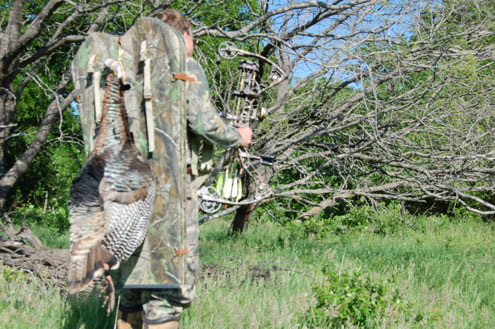
My bird went down about a quarter mile from the spot our oldest son, Matthew took his first gobbler over 20 years ago. That’s the time I instructed him to shoot a Jake when a boss gobbler with a 10-inch beard was lurking just around a bit of brush but… that’s another story!
To learn more about hunting trophy whitetail, exotics and turkey at Squaw Mountain Ranch, call Keith Weiser at 214-769-3151 or visit www.squawmountainwhitetails.com.
Listen to Outdoors With Luke Clayton at www.catfishradio.com.
Contact Luke via email at lukeclayton@prodigy.net
FISHING ROUND UP
TEXOMA STRIPERS - Bill Carey with Striper Express (www.striperexpress.com) reports stripers have been on a good top water bite the past week.
“We’re throwing big Pencil Poppers into shallow water around the mouths of creeks and pockets off the main lake at first light," tips Carey. "On cloudy days, the top water bite is holding up until mid morning. When the fish move out of the shallows, we following them to the nearby ledges and drop offs and catching them close to bottom with Sassy Shad bodies on a half-ounce jigs head. We’re already picking up some of the fish holding near bottom on slabs. The spring bite is on!”
TAWAKONI CATFISH - Guide George Rule (www.trophycats.com) says the channel catfish spawn is underway.
“We caught 50 keepers in 2 hours yesterday from water 14 inches deep," remarked Rule. "A good, smelly punch bait fished on a #6 treble hook works best. We prefer using slip floats that make casting much easier. In a few days, the fish should move into areas with standing willows in water 2-4 feet deep. Fishing around the rock rip rap is also a good way to land a good ‘mess’ of catfish."
Rule suggests dropping baits vertically to avoid getting snagged in the tackle-eating rocks. Regardless whether one is fishing the rip rap or shallow water vegetation for spawning catfish, it’s important to keep on the move until a concentration of fish is located. Once you find them, it’s common to limit out of fish in the 1.5 to 4 pound range from the same area.
LAKE LAVON CRAPPIE- Guide Billy Kilpatrick (www.straightlineguide.com) says now is prime time for catching shallow water crappie.
“Minnows or jigs work fine right now, but it’s easier to fish with jigs," says Kilpatrick. "I’m concentrating on water 2-5 feet deep around weed beds or any shoreline cover. The best action has been early morning and late afternoon and into the evening. Shad are shallow now and white bass, catfish and crappie are feeding heavily on them during early morning.”
Freshly caught shad, threaded onto a #2 crappie hook works well for catching the white bass from the bank. A small split shot crimped about 6 inches above the hook/bait makes casting easier and keeps the bait near bottom.