

I usually reply with something like, “I enjoy it all; it depends upon what I’m doing at the time.”
If I’m catching crappie during the spawn, it’s crappie fishing. If I am bowhunting whitetail in the fall, it’s bowhunting deer.
But, after a bit of deep soul searching, I believe I can truthfully say that if I had only outdoor endeavor to enjoy, it would be pursuing turkeys during the spring season. I have some very good reasons to back up my love for the sport.
Hunting spring turkeys is the essence of hunting. One actively takes the hunt to the birds, it’s a run-and-gun type of hunting that has a smorgasbord of built-in challenges. Are the gobblers vocal during the hunt or do they sneak into the caller silently? What is it that causes gobblers to sound off at every sound they hear one day and become totally silent the next?
I’ve often commented that I’ve never had two turkey hunts unfold exactly the same way. Year before last was a good case in point. I was hunting The Holt River Ranch up in Palo Pinto County and around mid morning, had what sounded like two gobblers responding to my hen yelps across a fair size stream. As I walked down off the mountain from which I was calling, it became clear that the birds were responding from the far side of the stream. They were hidden from view by a long row of driftwood that had stacked up from previous flooding.
I quietly approached the water’s edge, concealed myself in some shoreline brush and began a series of plaintive hen yelps, attempting to entice the gobblers to fly over the obstruction of driftwood and close the distance to my hen decoys. Nothing doing! By the sounds of their gobbles, I ascertained that the birds were walking back and forth on the far side of the brush line. They were NOT coming over to my side.
Turkeys are often like that, they like taking the easy route and often distain crossing obstructions like fence lines and water courses but, not always. I have had gobblers fly across streams immediately after hearing my hen yelps. But not this time! I was afraid my gobblers would soon lose interest in what they perceived to be a hen looking for love. I had to make a decision and make it quickly. That’s what I like about spring turkey hunting, it’s a game of cat and mouse and the mouse (gobbler) usually has the upper edge!
I walked downstream a hundred yards, waded across a shallow stretch of the stream, and found a small opening in the row of driftwood. No time to set up a hen decoy, the birds were gobbling their heads up about 60 yards behind the brush. I backed into a brushy cedar and began calling. With each series of yelps, both gobblers sounded off.
They were heading my way, and fast. Within two minutes, I watched the two mature gobblers round a corner in the brush and strut! If there is a more beautiful sight than a brilliantly colored turkey gobbler strutting with a pale green background of early spring shoots of grasses and leaves, I’ve yet to find it!
I had my shotgun pointed in the direction of the approaching birds. BOOM, a heavy load of #4 shot anchored the biggest gobbler in his tracks. Last spring, early in the turkey season, I was again on the Holt River Ranch and an entirely different scenario unfolded.
This hunt was textbook spring turkey hunting. I was bowhunting and had a couple of hen decoys set out just outside a big live oak with low hanging limbs. My position at the base of the ancient tree was an excellent vantage point. With my first series of yelps, I had a gobbler sound off what sounded like 300 or so yards down the slope, from the direction of the Brazos River. I yelped, he gobbled.
In a matter of five minutes, he was strutting between the hen decoys within 18 yards of my position. I drew my Mathews Drenalin bow to full draw while the gobbler was strutting with his back to me, when he turned sidewise, I released the Grim Reaper mechanical broadhead. I had my first gobbler of the season on the ground within fifteen minutes of when I made my first call!
These two very different hunts from the past two springs pretty well sum up what turkey hunting is all about. It’s a thinking game and can be likened to a game of chess played out on the hills and valleys inhabited by spring turkeys. Yes, come to think of it, I DO enjoy hunting spring turkey best of all. Well, maybe until those channel catfish move into the shallows to spawn!
Listen to Outdoors With Luke Clayton at www.catfishradio.com. Email Luke at lukeclayton@prodigy.net
TURKEY HUNTING OPPORTUNITIES- At last check, John Bryan at the Holt River Ranch near Graford in Palo Pinto County, had a few openings for turkey hunters. Bryan can be reached at 940-452-3415 (www.theholtriverranch.com).
If a hunt for eastern turkeys is in your plans this spring, contact Mike Ford (903-674-3750) at the Rio Rojo Rancho in Red River county.
OUTDOOR TIP OF THE WEEK - The opener of spring turkey season is quickly approaching. I’ve always been challenged by packing all the gear I use for turkey hunting into the woods. Years ago, an oversized turkey hunting vest work fairly well but it’s just too small to accommodate all the gear I require today.
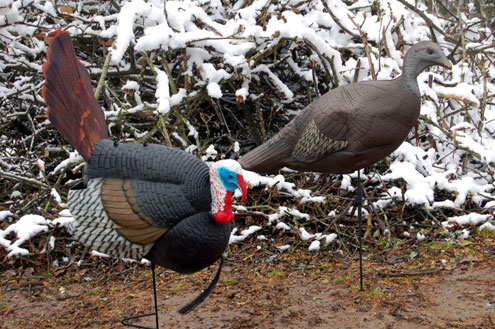
My set-up includes three turkey decoys, (a strutting gobbler and 2 hens), calls, portable stool and lightweight GhostBlind to conceal my movements. The real challenge is transporting the turkey decoys. The hen decoys fold to save space but the gobbler decoy is more rigid. I needed a bag with back straps to carry all my gear, something I could use like a field pack over my shoulders and keep my hands free to carry the lightweight blind.
After looking around at several outdoor retail stores without success, I discovered I had the perfect ‘turkey pack’ in my storage building! You probably have at least one in your garage as well! Remember that camo ‘dove hunting chair’ that you bought for the dove field? It probably came with a camo carrying bag complete with back pack straps! These elongated bags are perfect for carrying multiple turkey decoys and all the gear necessary for spring turkey hunting. If you don’t have such a chair with carrying pack, they are readily available, economical and will solve the problem of carrying all your turkey hunting gear.
CRAPPIE SPAWN UPDATE- Lake Lavon crappie guide Billy Kilpatrick (www.straightlineguide.com) says last week’s blast of Arctic air slowed the crappie spawn by a few days.
“Just before the cold front, we had started catching a few male crappie from shallow water,” says Kilpartick. “
The cold weather/water pushed the spawners back to deeper water but it will only take two or three sunny afternoons with the temperature near 70 degrees to trigger a major movement of spawning crappie back into the shallows.
Once this shallow water action begins, it should get progressively betters through mid April. Once the males show up, the females usually begin heading into the shallows with a few days.” (Note: This report is from Lake Lavon, situated about 30 miles northease of Dallas but these patterns should be accurate on all the lakes in the region.)