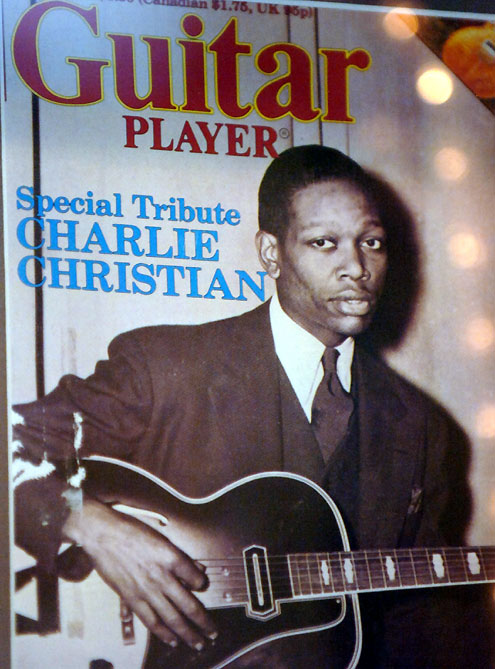
The UNT College of Music hasn't forgotten Charlie Christian. Jazz fans around the world know the name. Last month,
But ask almost anyone in Bonham, the birthplace of Charlie Christian, if they know July 29 is legendary guitarist Charlie Christian's birthday and the likely answer will be, "Who's Charlie Christian?"
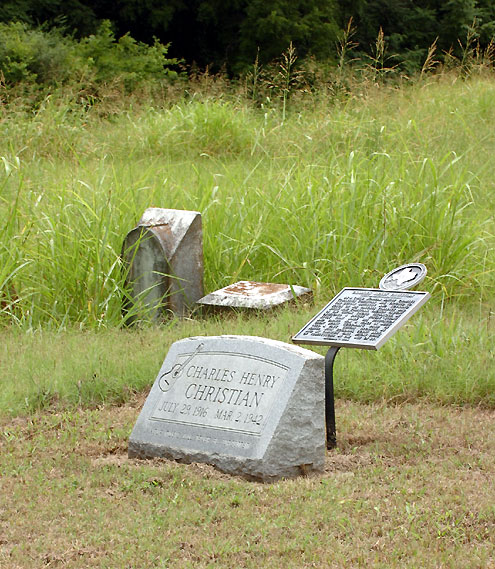
The grass is getting a little high in
Down at the Fannin County Museum of History, the unmistakable sound of Charlie Christian's dazzling guitar work with the Benny Goodman Sextet softly plays. A steady trickle of visitors comes to Bonham specifically to visit the museum's display Tom Scott assembled to honor Christian, with the most recent being a young man who just moved into southern Fannin County and a young lady from the Metroplex.
Maybe the person that gets the prize for traveling the greatest distance to pay tribute to Christian would be Takashi Hotta. After saving money for most of his life, Mr. Hotta left Japan in 2002 with a plan to see only three places on the other side of the globe; he wanted to see the home of saxophone wizard Charlie Parker in Kansas City, jazz icon Miles Davis’s home in New York City, and he had to visit Charlie Christian’s grave in Bonham.
Thanks to the wealth of information provided by former director of the

Amazing isn’t it, that a man would circle the globe to see a house that the average person on the street in
You almost have to stand on

Charlie Christian died before he ever really got started. He lived fast, played faster and was gone before his 26th birthday. The world only had 24 months to capture, on tape, the individual whose amplified, single-note style defined the role of guitarists forever…the man that went from Johnson Street in Bonham to the Rock and Roll Hall of Fame.
Charlie was inducted posthumously along with Louis Armstrong in 1990, and that was a full decade before Nat king Cole and Billie Holiday were voted in.
-- Quotes --
"That cat tore everybody's head up."
—Wes Montgomery (from Guitar Player, 1973)
"Without Charlie Christian, jazz and blues wouldn't sound the way they do today or be nearly as popular. Everybody might still be playing a banjo!"
—Jimmie Vaughan
"Charlie Christian had a depth of feeling that in my estimation nobody past or present has ever achieved. Besides being harmonically advanced for his era, the rhythmic time with which he played his notes set him apart from all others no matter what instrument they played."
—Herb Ellis, a native of
"Charlie Christian managed to change the sound of jazz guitar in the three short years he played with the Benny Goodman Sextet."
Stevie Ray Vaughan - Caught in the Crossfire (Little, Brown & Company 1993)
"Charlie Christian was the Jimi Hendrix of his generation."
—Warren Haynes (The Allman Brothers Band, Gov't Mule)
"The history of the electric guitar as an important jazz voice certainly begins with Charlie Christian. Fundamentally a swing player, he is nevertheless often considered a proto-bopper of sorts. Indeed, many of the most admirable elements of bop musicality — the soaring excursions beyond the confines of the familiar, the joyous sense of real-time discovery and delight, and that wonderful combination of "freshness" and "rightness" that distinguishes the playing of the great early boppers — are present in abundance in his work. The originality of his conception, the hard-driving swinging qualities of his sinuous lines, and the perfect marriage of tone and content in his playing are, in my opinion, unmatched to this day. Charlie Christian is deservedly considered the most influential electric jazz guitarist of his or any time, and listening to his recordings is always a blast."
—Walter Becker (Steely Dan)
"I had the fortune to work with Charlie Christian and he was more aggressive, forceful and louder than I was. I said to him: "You play loud"—not as a criticism or anything. He said: 'I like to hear myself!'"
—Barney Kessel,