

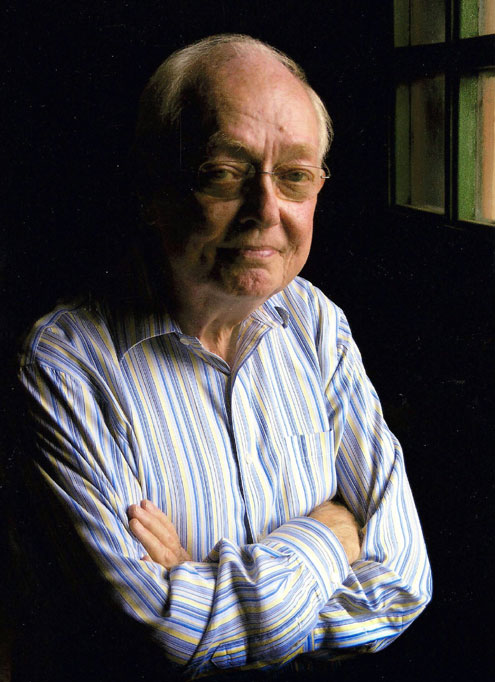
Tom Scott, 77, a man who had come to embody the colorful history of Fannin County and its people through his dedication to the Fannin County Museum of History, died late Thursday evening, July 16 following a lengthy illness.
Yet, Mr. Scott's passion to preserve the fascinating local history of North Texas was merely one facet of his personality that endeared this man to the community he proudly called home.
Tom Scott was a 1949 graduate of Bonham High school and considered by many to be one of the brightest students of his era. He backed up that assessment by earning his B.A. and M.A. in Communications from Baylor University, a M.S. Counseling Certificate from the University of Texas and Ed.S. in higher Education/Psychology from Auburn University.
Tom enjoyed telling people he fought at the "Battle of Lackland," which was his way of saying he was a drill instructor at Lackland Air Force Base from 1954-1958.
He also had an impressive career as a college professor before returning to his hometown to develop into an accomplished history detective. It was Tom's research that first indicated that some of the buildings on the east side of the Bonham Square are constructed from bricks kilned in 1859 to construct the ill-fated 1860 Fannin County Courthouse.
Mr. Scott taught at Temple College and Grayson College before returning to graduate school for training in counseling and psychology. He was then named Director of Student Guidance Services at Henry State College in Alabama. It was there that Tom had an opportunity to get to know Harper Lee, author of To Kill a Mockingbird.
Tom returned to Bonham in 1982, served three terms as chairman of Fannin County Historical Commission and chaired Bonham's Main Street Committee. He became curator of Fannin County Museum of History in 1987 and is one of the primary reasons this museum enjoys a stellar reputation across the state.
There really isn't a word that encompasses all the qualities woven into the fabric that was, and always will be, Tom Scott. Certainly, history held a special place in his heart, but so did art, music -- "cool jazz" was his favorite -- literature, architecture, poetry, film, education, psychology, government and at least a dozen other disciplines. Years before most of us had ever heard the phrase, Tom was our very own Renaissance Man. His love for any skill truly performed with a discerning eye was so moving, it had the power to make those around him appreciate the beauty he saw.
Whether the subject at hand was Charlie Christian, an African American jazz guitarist born in a section of Bonham near the railroad tracks called Tank Town, the poetic lyrics of Bailey, Texas native Ruby Allmond, or Harry Peyton Steger's place in local history as our only Rhodes Scholar, Tom Scott had the gift to separate the wheat from the chaff and simply light up with his appreciation of genius. For those fortunate enough to be near him, some of that glow rubbed off.
In the case of Charlie Christian, a phenomenal musician who broke all color barriers on his way to earning a spot in the Benny Goodman Sextet and, eventually, a seat in the Rock and Roll Hall of Fame, and likewise with Harry Peyton Steger, arguably Bonham's most accomplished intellectual --- both men, amazingly enough, would have been virtually forgotten in their own hometown without a tireless champion in their corner like Tom Scott.
"Tom Scott was Fannin County history," remarked Bonham Mayor Roy Floyd. "He knew more about Fannin County history than any man I know. I've talked to people across the world that had questions about Fannin County history. Tom Scott was always ready and willing to find an answer. We have lost a treasure."
More than once, friends stepped into the Fannin County Museum of History to find Tom gazing off in the distance in deep contemplation as he slowly nodded his head and said in quiet awe, "Today, I'll think about the rain...now that's a title!"
He was referring to a particularly poetic set of lyrics from a song by Ruby Allmond. Profound observations affected him profoundly.
The friends of Tom Scott would like to believe there will be a special recognition for this man that changed the way many of us look at Bonham and Fannin County. There will be days, once the sorrow of loss has eased, when the observations and causes championed by Tom Scott will surely lead to his own place in Fannin County history.
But, today, we think about the rain.
Friends, colleagues, associates and admirers of Tom Scott will gather Sunday afternoon, July 19 at the Fannin County Museum of History for a reception in his honor.
The reception will be held immediately following the funeral services at Wise Funeral Home and interment at Willow Wild Cemetery.
In lieu of flowers, donations in honor of Tom Scott may be made to the Fannin County Museum of History.