 |
Front Page
The life and times of Casey Grimes
By Tim Davis
Jul 15, 2009
Among the many individuals from the past who have contributed to the written record of Fannin County history, perhaps the least known was a gentleman named Casey Grimes. The book Bonham: The Era Is Gone, But Memories Linger On (1976) contains a couple of his articles (pages 51, 56). Moreover, Fannin County Folks and Facts Illustrated (1977) published his article about the Texas and Pacific rail yards and surrounding businesses, and his drawing of the same as they looked in the early 1900s (pages 56-57).
While there are plenty of articles by Grimes, there is almost none about him. Naturally, my curiosity got the better of me. I decided it was time to research a little further.
William Casey Grimes was born in Golden City, Missouri on October 15, 1892 to Mr. and Mrs. W. C. Grimes. (The mother’s name is not legible on census records.) By 1900 the Grimes family had moved to Texas, to the Danner community, northeast of Bonham. Mr. Grimes is listed on the census as a farmer, and Mrs. Grimes as a housewife.
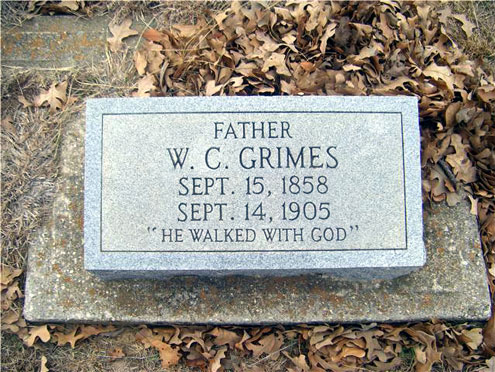
If they had high hopes for life in Texas, tragedy soon put a damper on them. On September 14, 1905, one day shy of his 47th birthday, Mr. Grimes died.
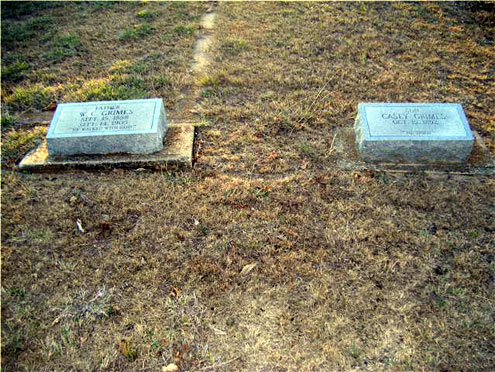
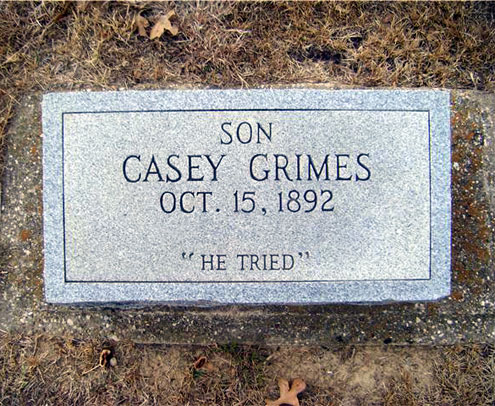
He was buried in the Danner Cemetery (aka the Owens Chapel Cemetery). The death of his father apparently had quite an impact on young Casey. He eventually bought the plot next to him, fully intending to be buried there some day.
What happened to the Grimes family next is unclear. They don’t appear on the 1910 census in Fannin County. However, Casey’s childhood and young adult memories offer some clues. First, the jobs he held were in Bonham: messenger boy for the Southwestern Telephone Company, night caller for the T & P railroad and grease monkey at T & P’s roundhouse.
Secondly, marriage records at the Fannin County courthouse show that on February 1, 1913 Casey took Miss Elsie Cooper, a local woman, for his wife. Deed records show that they eventually bought a house in the 700 block of South Fifth Street. It seems that the Grimes family stayed close to Bonham after the elder Grimes’s death. At least Casey apparently did.
A little more than a year after their marriage, a daughter, Helen, was born. The 1920 census and Casey’s World War I draft registration card shows that he supported his young family by working as a baker at a local bakery. Deed records show that Casey and Elsie made a small profit on a couple of real estate deals in South Bonham in the early 1920s as well. It seems they had every reason to stay in Bonham. But, they didn’t.
The 1930 census shows the Grimes family living in Albany, Oklahoma, near Durant. Apparently they followed the call of religion. Elsie’s occupation was that of a “pastor-church,” while Casey’s was listed as a “minister-evangelist.”
For reasons unknown, Casey and Elsie’s marriage fell apart and they eventually were divorced. Casey married for the second time in April 1944 to a Zula Mae Patillo. By 1956 they moved from Durant to the Lubbock-Acuff area, where Casey continued working as a minister.
By the early 1970s Casey Grimes was approaching his eighties, and he apparently started thinking back on his childhood days. Rather than let those memories go unrecorded, he put them on paper. They reportedly made it into the Bonham Daily Favorite in the form of a “Reminiscences” column. Among his reminiscences were:
his boyhood days in the Lamasco-Danner-Ivanhoe area and the small country schoolhouses he attended;
the devastating flood of July 1903 (which he mistakenly dates as July 1900);
getting to know all parts of Bonham as a messenger boy, including “Tank Town, Locksborough, Russell Heights, Seven Oaks, South Side [and the] East End”;
his bare feet guiding him “among the wagons and buggies and horses around the square on First Mondays”;
Dad Marshall driving “the street sprinkler pulled by a horse and mule. All we kids ran through the spray to cool off in the hot summer time . . . .”
And many more.
As well as writing, Casey also dabbled in art. Memories of his days of kicking around the Texas & Pacific rail yards area were so vivid that he decided to draw them on paper. The finished sketch, drawn in the early 1970s, and its companion article (both mentioned in my opening paragraph) originally appeared in the February 24, 1974 Bonham Daily Favorite.
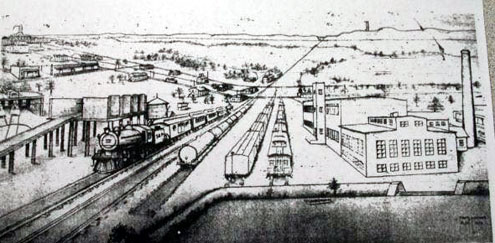
The following is part of the article:
On the right is the Morgan home place on South Main, with the old West Grocery store across the street, looking down on the Cotton Mill and T&P railroad reservoir. Powder Creek runs between the smokestack and warehouse of the Cotton Mill.
To the East. The Bridge Saloon spanning Powder Creek and South on Main is the Dee Haley Place. Further East on South Center is the Frank Teague Iron Smelter and Foundry.
Powder Creek winds its way to Bois d’ Arc Creek and in the distance can be seen the old water system standpipe. This is south of Clendennon Cut where the T&P Railroad goes east under overhead bridge.
Shown to the left is one of the six passenger trains which passed through Bonham each day, besides the specials. While stopped here they often took on water and coal at the coal [chute] and water tanks.
East in the drawing can be seen the dining hall and T&P depot, the Oil Mill and Katy branch line depot at the left.
On the left is the pump house also and Jake Myers Coal Oil tank; the Bonham House Hotel, Yeager Hotel and the old trolley car heading up Main street.
East on Center street is the Dick White produce house and Tennessee House Hotel. Further East is the old Fisher home place, one of the first houses built in Bonham and the home of the builder of “Fisher’s Mills,” south of town. Old timers said two outlaws were hung on one of these trees.
Return to the railroad area and note the turn-table and the old roundhouse at the left. Northeast in the drawing is the Polly Clendennon ice plant west of the Bonham wholesale grocery. North of that is the Commercial hotel, complete with outdoor privys and chimney features of the hotels. All heating was done by wood and coal stoves and some coal-oil fuel.
Shown is the marble yard north of the Commercial hotel and across Main street from P.O. Robinson’s Livery Stable and Ben Baker’s mule barn was East of it. Shown to the left is Smith Moore Williams and Tab Ragsdale’s store, and East across Main street is Bonham Hardware store and Bonham steam laundry. Shown on Center street is the Hardin’s Wagon Yard and World’s dry goods store. To the North and East can be seen the Hardy Hotel and county jail.
Though the sketch is not accurate in every detail, it nonetheless is a good visual representation of the rail yards and surrounding grounds. And when you consider that we have virtually no photos, at least none that we know of, of that area in its heyday, the sketch takes on even more importance.
By the 1980s Casey Grimes was entering his waning years, and his health began to fail him.
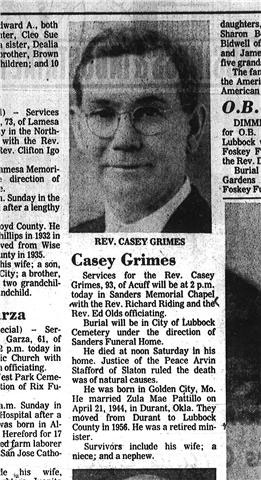
Casey Grimes's obituary and photo as they appeared in the July 14, 1986 Lubbock Avalanche Journal.
He passed away on July 12, 1986. Time and circumstances had caused him to rethink his earlier idea of being buried next to his father in Fannin County. Instead, he was laid to rest in the Lubbock City Cemetery. His wife was laid next to him in October 1998.
 |
Though his life took Casey Grimes many places, apparently none of them impressed him as much as the Bonham of his youth. “I shall never outgrow,” he once wrote, “Bonham and its fine people.”
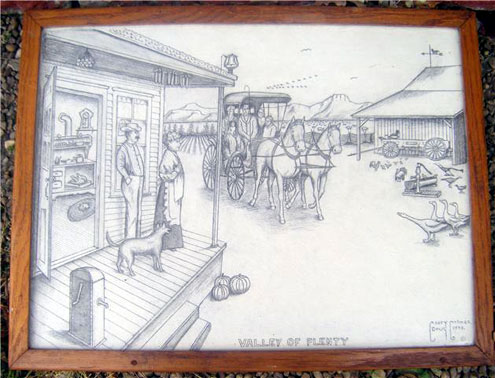
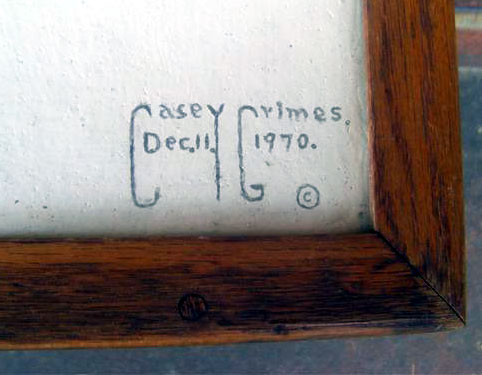
This Casey Grimes sketch, a general farm scene entitled "Valley of Plenty," is housed at the Fannin County Historical Museum. It is dated December 11, 1970.
Many thanks to the ladies at the Bonham Public Library, the staff at the Fannin County Historical Museum and Historical Commission for their help with documents. Also, big thanks to Suzie Henderson to helping to get a good copy of the T & P rail yard sketch from microfilm to a scanner.