

Rainwater harvesting is an ancient method of obtaining water that has drawn renewed interest in recent years as a viable water supply practice for many regions of the world. For over 4,000 years, people in various parts of the world have diverted and captured rainfall to use for drinking, cooking, cleaning, and irrigation.
With a population that is predicted to double from year 2000 to year 2050 and a limited amount of readily available water, Texas faces a growing problem. Metropolitan areas are looking farther and farther abroad for potential water sources to meet their ever increasing demand. It is estimated that 30 to 50 percent of the total water used is used for landscape irrigation.
There are a number of advantages to using rainwater as opposed to a central water supply system. Capturing rainwater for use in the landscape makes efficient use of a valuable resource, reducing water bills, and reducing demand on water supply systems. Harvested rainwater may help some Texas watersheds close the gap between the supply and demand projected by the Texas Water Development Board.
Rainwater harvesting can also help to prevent flooding and erosion, turning storm water problems into water supply assets by slowing runoff and allowing it to soak into the ground. Capturing and storing rainwater allows it to be applied at a rate that allows it to infiltrate the soil. It also helps reduce the contamination of surface water with sediments, fertilizers, and pesticides in rainfall runoff.
Rainwater is soft. It significantly lowers the amount of detergents and soaps needed for cleaning. There is no need for a water softener as there often is with well water. Also, water heaters and pipes are free of the deposits caused by hard water and should last longer.
Rainwater has a low pH (6.0 to 7.0) and often has a nitrogen content that provides a slight fertilizing effect. Perhaps you have noticed how much better your yard and plants look after a 1 inch rain than they do if you water them twice a week all summer long. Also, if your pets are like mine, they prefer to drink rainwater out of the birdbath or a muddy hole in the driveway rather than the bowl of water I carry out from the house.
Rainwater harvesting conserves energy. Many non-potable systems can operate on gravity flow and if you choose to use it as a household supply, in many cases only a small pump is required to create water pressure in the pipes. It promotes self-sufficiency and fosters an appreciation for water as a critical resource.
Rainwater harvesting systems can be simple or complex. A simple system consists of a catchment, a distribution system, and a landscape holding area. The catchment is any area from which water can be collected. It could be a roof, or pavement, or a soil surface.
The distribution system could include gutters, downspouts, hillsides, sloped sidewalks, street curbs, channels, and ditches that are used to channel water from the catchment to the landscape holding area. The holding area is a concave depression covered by grass or plants that will store the water to allow it to infiltrate the soil rather than run off. The intention is that the water will soak in within 3 days to avoid problems with mosquitoes. Multiple holding areas can be linked with channels or ditches.
A complex system rainwater harvesting system consists of catchments, a conveyance system, storage, and a distribution system. Complex systems are more expensive, but yield greater water savings. The catchment is again any area from which water can be collected. The conveyance system consists of canals or gutters and downspouts to direct water into the storage containers.
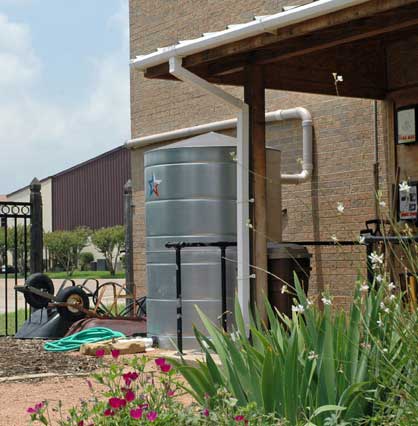
The storage container can be as small as a trashcan or 55 gallon drum, or it can be as large as commercially available storage tanks that will hold from 100 to 2,500 gallons. There can be multiple containers linked by pipes so that when one is full, it overflows into the next. The distribution system will carry water from the storage containers to your garden, lawn, field, or wherever you want.
You can start with simply a trash can under a downspout and I think you will be impressed with how much water you can capture as well as how much your landscape will appreciate cool, clear, clean water.
There is information available at the Texas AgriLife Extension Office at 201 S. Main, Bonham. The telephone number is 903-583-7453.