

Think of the bright side--we may not be losing a community as much as gaining a town.
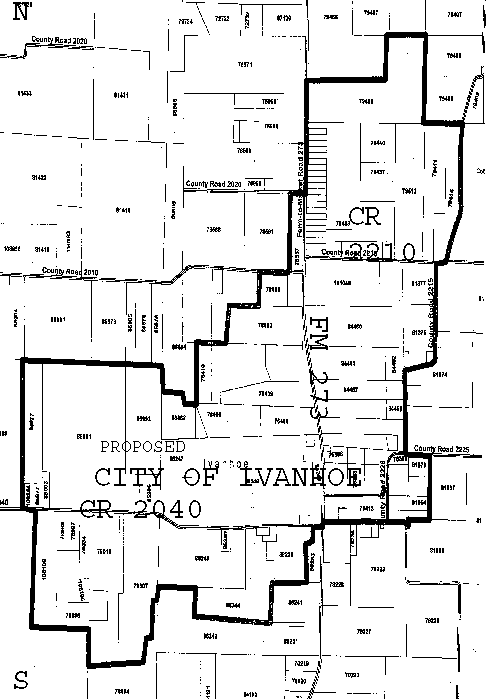
On May 10, voters in the unincorporated community of Ivanhoe will go to the polls to decide if Ivanhoe should join the current list of incorporated cities and towns in Fannin County.
Fannin County's list of towns and cities is comprised of Bailey, Bonham, Dodd City, Ector, Honey Grove, Ladonia, Leonard, Pecan Gap, Ravenna, Savoy, Trenton, Whitewright and Windom.
If voters decide to place Ivanhoe among that number, Elwood, Telephone, Gober and Randolph are some of the remaining unincorporated communities in Fannin County.
Early voting begins May 10 at First Baptist Church in Ivanhoe.
To call an election to incorporate, a petition bearing the signatures of at least 10% of registered voters in a mapped area must be presented to county commissioners and the signatures then verified through the county clerk's office. The petition to incorporate Ivanhoe contained 20 registered voters, easily exceeding the 12 signatures required. The mapped area has a total of 124 registered voters and 231 residents, which make the population center comparable to Ravenna and slightly smaller than Windom.
Incorporation status allows for revenue-gathering mechanisms such as a city sales tax.
If the voters in Ivanhoe decide to incorporate, the town would then be responsible for maintaining roads, culverts, ditches and bridges within city limits.
Residents in Ivanhoe had until March 10 to sign up for mayor and the city commission. Gabe Parker will be the only candidate for mayor, while Richard Danner and Roger Sadler have signed up for the city commission.
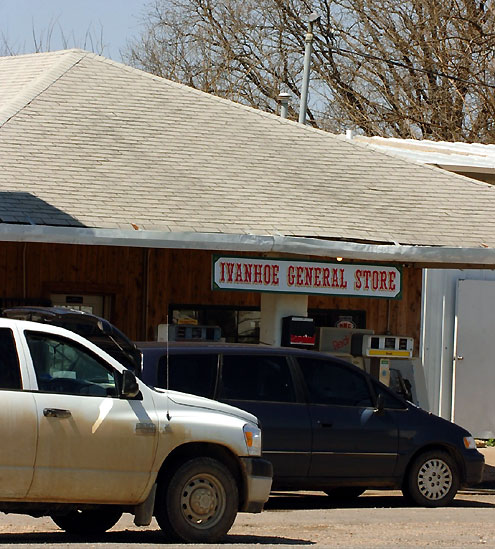
According to the Handbook of Texas, Ivanhoe was originally named Hawkins' Prairie after Strother Hawkins, a pioneer who settled there in 1845. In 1885 Capt. Joe Dupree, a Confederate veteran, named the town Ivanhoe after Sir Walter Scott's novel, when the United States Postal Service rejected the original name. The Baptist church was organized there in 1872. In the mid-1880s the community had two general stores, a blacksmith shop, a steam mill and cotton gin, a hotel, a physician, and a school. Stage connections to Bonham could be made regularly from Ivanhoe. In the 1880s 150 residents lived in Ivanhoe. The population climbed to about 200 in the 1890s but dropped by 1915 to only seventy-five.