

With dove season quickly approaching, retail stores all across the country are advertising specials on shotguns. There is no better time to purchase a shotgun, whether it be a trim little 20-gauge over-and-under for dove and quail or a 10-gauge for pass-shooting geese.
As a youngster learning to hunt upland birds back in the sixties, I grew up in the school of thought that a man shoots a 12-gauge, period. In the circles where I learned to hunt and shoot, those little 20-gauges were for kids and ladies. As a result of this mind set, I found myself packing an old, ill-fitting 12-gauge pump at a time when my age and size was much better suited for a lighter 20-gauge with a whole lot less ‘kick.’
Shotguns, just like golf clubs, are made for specific purposes. Not that I am a golf expert, truthfully, I do well to shoot par at the miniature version of the game, but I know one doesn’t use a putter to move the ball a couple hundred yards down the green, but neither do most folks pack a 10 gauge waterfowl shotgun on dove hunts. A quarter century ago, I learned that a 20 gauge is what many, including myself, consider to be the perfect gauge shotgun for almost all upland shooting, with the exception of late seasons pheasants that are knows for flushing well ahead of the dog, here a 12-gauge with a heavy load of #5 shot is in order.
I remember hunting with a gentleman back in the seventies that was a livelong quail hunter. He kept a kennel of no less than 8 pointers and setters and they were all good dogs. A lease I was hunting up in Jack County, Texas for deer was overrun with quail and my older buddy offered the services of his dogs to help thin their numbers. He packed a slim little O/U 20-gauge and I, of course, was still shooting a heavy 12-gauge. He let me use the little shotgun and I soon learned I could kill as many quail with it, possibly more, than I could with a shotgun that was much better suited for waterfowl shooting! At the time, my budget simply did not warrant purchasing a firearm that cost about three times our monthly house payment.
Today, import shotguns from Turkey are priced very reasonably, Tri Star Arms offers a great field grade over/under (Hunter EX Model) with a price tag of just over $500 that I’ve been shooting. The gun is well balanced and feels as good as one of the finer and much more expensive imports from Italy that come with a price tag about four times higher.
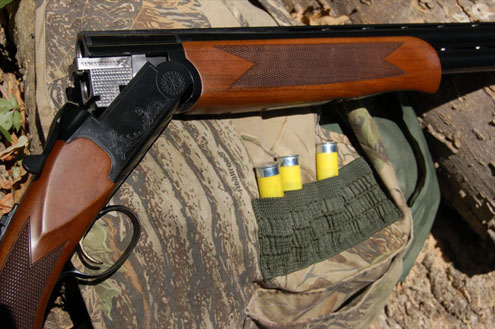
With a recoil pad, vent rib and barrel selector switch, it’s every bit as functional in the field as the more classic over/unders that I still find a bit out of my price range.
Ryan Bader, with Tri Star Sporting Arms (www.tristarsportingarms.com), says sales are going very well for these affordable imports.
“Most folks can’t afford to spend a couple thousand dollars or more on a shotgun, but the popularity of over/under is at an all time high," says Ryan. "Our firearms are made in Turkey where the manufacturing process and quality control is tightly scrutinized. These guns lack some of the ‘glitz’ of more classic over/unders but they do the same job in the field, and for a fraction of the cost. We have also enjoyed banner sales with our autoloaders. Our Viper was chosen as the DU shotgun of the year. It’s also make in Turkey.”
A new shotgun, whether it’s a field-grade gun or one of the classics, must fit the shooter properly. Proper stock length is key to having a shotgun that mounts and swings easily. If the gun doesn’t ‘feel’ right when brought up into the shooting position, incorrect stock length is often the major culprit. Very often, adding a thicker recoil pad will correct the problem for those that need a little more length. For shooters with shorter arms, shortening the stock will customize the firearm to fit the shooter. But, make sure and consult a qualified gunsmith or shooting pro to help determine just how much of the stock needs to be removed.
This is not a job for guesswork. Guns come from the factory with ‘standard’ stock lengths that are designed to most closely fit the average shooter. Since shooters come in all shapes and sizes, expecting a shotgun to fit perfectly right out of the box is asking a lot.
Just as a 6' 5" golfer requires a different set of clubs than his counterpart a foot shorter, so it is with shotguns. Getting your new shotgun, regardless if it’s one of the expensive classics or a field grade model, sized to the proper length by this simple and economical procedure will make hitting the target with it much easier.
There is still plenty of time until the opener of dove season to purchase that new shotgun and, if necessary, get it’s stock customized to fit your specifications. From past season openers, I’ve learned that shooting a shotgun, just like driving, casting a rod, shooting a bow, or any other endeavor that requires motor skills, requires practice. I find myself rusty about this time of year and always devote a few sessions to shooting clays before the dove season opener. If you live close to a trap, skeet or sporting clays course, set aside a few hours to practice.
If shooting at a range is not an option, buy a couple cases of clay targets, a hand thrower and find a safe place for a little practice. Don’t spend all your time shooting at the easier, going away targets, either. Have the thrower present crossing targets and have them thrown at different angles.
My sons and I developed a game where the thrower positions himself behind the shooter, both facing the same direction. There’s no yelling PULL in this game. The thrower tosses the clay targets whenever he wishes, from behind, in efforts to add a bit of ‘surprise’ to the shooting game.
Just as a darting dove appears unannounced, the clay disc appears from a wide variety of angles. This practice technique is much better than simply shooting going away targets that are launched in a predetermined direction.
Dove season opens in Texas on September 1 in the North Zone this year, a Monday. Of course, we Texas must have our traditional “dove season opener cook out” which this year, for many hunters, will occur the following weekend. If you have a couple of extra vacation days coming, give some serious consideration to taking them the first couple days of the season. I’ll see you in the dove fields!
Listen to Outdoors With Luke Clayton at www.catfishradio.com and check out the new outdoors videos at www.lukeshotspots.com