

COMMERCE, Texas - A neuroscientist at Texas A&M University-Commerce is aiming at a better understanding of diseases such as Parkinson's and Alzheimer's by setting his sights on the brain's visual system.
By shedding light on the basic processes that help the brain become "wired" properly, Dr. Frank Miskevich's work may one day aid in the development of treatments for neurodegenerative diseases.
Miskevich, an assistant professor of developmental biology at A&M-Commerce, works from A&M-Commerce's new $28 million state-of-the-art Science Building, which opened in January and is to be dedicated Tuesday, April 4.
He studies the complex biochemical signals responsible for forming connections between brain cells, or neurons, and the eyes.
While his work has broad applications in understanding how vision works, much of his research focuses on how calcium moving in and out of neurons interacts with other molecules and proteins in those cells.
Those interactions, called "signaling pathways," activate genes that ultimately change the physical makeup and function of the brain. Calcium signaling also plays a role in determining the fate of neural stem cells, special cells in the brain that have the potential to become any type of brain cell.
"Scientists are very interested in studying neural stem cells," Miskevich said. "The idea is that, eventually, we could take these undifferentiated stem cells, put them into a brain damaged by Parkinson's or Alzheimer's and replace the neurons that are lost in those diseases - theoretically. But you have to know the signals that are involved in converting those cells into functioning brain cells. Calcium is one of those signals."
Neural stem cells that receive one type of chemical signal may be coaxed to turn into neurons that can produce dopamine, Miskevich said. The degeneration of these so-called dopaminergic neurons is a hallmark in the brains of patients with Parkinson's disease. Similarly, loss of brain cells called cholinergic neurons is associated with Alzheimer's disease.
Calcium ions - atoms of calcium with a +2 charge - travel in and out of cells through pores in the cell membrane called ion channels. Once inside the cell, calcium ions trigger a cascade of biochemical reactions that lead to genes being turned on and off.
Activated genes produce proteins, which carry out all of life's functions.
"Calcium is able to signal processes that turn on specific genes and change the proteins that the cell is making," Miskevich said. "This then changes the characteristics of the cell."
Calcium, for example, is key to making the connections between neurons stronger and increasing the stability of the "wiring" within the brain. While researchers have been studying calcium and other signaling processes in the brain for many years, Miskevich said new research tools and information are allowing more questions to be investigated.
One of those new research tools is called RNA interference.
In a paper to be published in an upcoming issue of the "Journal of Neuroscience Methods," Miskevich and his former colleagues from the Massachusetts Institute of Technology describe how they used the technique to reduce the amount of ion channels in frogs in an effort to better understand the channels' role in forming neural connections.
"We're looking at the basic mechanisms involved in neural development, how are these connections being made and what genes are involved," he said. "There is still much more to learn about these processes, and how they relate to human health and disease."
Miskevich uses animals, such as chickens and frogs, in his research because while their visual systems are very similar to that of humans, they are much simpler organisms to work with.
"In the visual system of any vertebrate, you not only have to form the correct cells at the right locations in the brain, but also you must get the connections going from the eyes to the rest of the brain," Miskevich said. "Those connections are very specific. There are a lot of proteins and molecules involved in this complex process, but the signaling pathway I'm most interested in involves calcium ions."
Miskevich, who joined the faculty of A&M-Commerce's Department of Biological and Environmental Sciences in 2004, said one of his goals is to bring more students into his research. A grant proposal he has submitted to the National Institutes of Health would not only aid his research program, but also help support more students.
In addition to Miskevich's department, the Department of Physics and Department of Chemistry also call the new Science Building home. The 110,000 square foot, three-story Science Building features modern classrooms and up-to-date laboratories for biology, physics, chemistry and agricultural research.
The complex also includes a state-of-the-art planetarium that screens features for the public on Friday and Saturday nights.
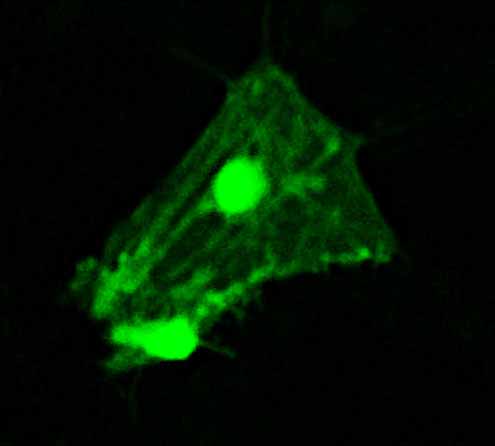
LIVING ART - This image captured by a confocal microscope shows some of the processes of two neurons in a living tadpole brain.
Dr. Frank Miskevich, Texas A&M University-Commerce biology professor, is exploring the brain's visual system and shedding light on the basic process of how the brain becomes "wired" properly. His work may one day aid in the development of treatments for neurodegenerative diseases like Parkinson's and Alzheimer's. Miskevich uses tadpoles because their visual systems are very similar to humans but are simpler organisms to work with. (A&M-Commerce photo/Frank Miskevich)