COMMERCE, Texas - Sandy Kimbrough sometimes makes babies cry.
That's because her friends ask her to test the reflexes of their newborn to see if their child's motor development is normal.
An assistant professor in health and human performance at Texas A&M University-Commerce, and mother of two young daughters, her research interests are early childhood motor development and fitness in early adulthood.
As a test, Kimbrough will clap her hands to see how a baby reacts.
At hearing the sudden noise, the baby should stretch out its arms and legs reflexively then pull them back.
And often, she says, the startled infant will also cry. "But it's doing what it is supposed to do," she reassures.
Kimbrough is a "three time" graduate from Texas A&M - bachelor's, master's and doctoral degrees - and taught at that university for nine years before a brief stint at Eastern Kentucky University.
A year later she finds herself back in Texas.
"It's not that I didn't like Kentucky," says Kimbrough, an avid Cowboy fan. "But Texas is home."
She and her husband have extensive family here, and they constantly found themselves commuting back to Texas to visit relatives.
Kimbrough says she doesn't think about the motor development of her children "a whole lot," although her father does ask if his grandchildren are exceptional.
"I don't know if they will turn into champions," says Kimbrough. "They are perfectly great as they are."
She describes her daughters as being "best friends" and says they are almost always together.
Kimbrough will be teaching elementary physical education methods, motor learning and control, as well as organization and administration of physical education at A&M-Commerce.
She says that of all the jobs she has, her favorite and most rewarding is being "a mom and a wife."
Kimbrough enjoys working out and also runs, bikes and swims in triathlons. She has access to a lake, so indulges in water sports, particularly water skiing, wake boarding and fishing.
She has also found time to write a number of books and articles on health and fitness, the most recent being an article, The Half Moon Rises, in "American Fitness."
And she plays a mean game of Texas Hold'Em.
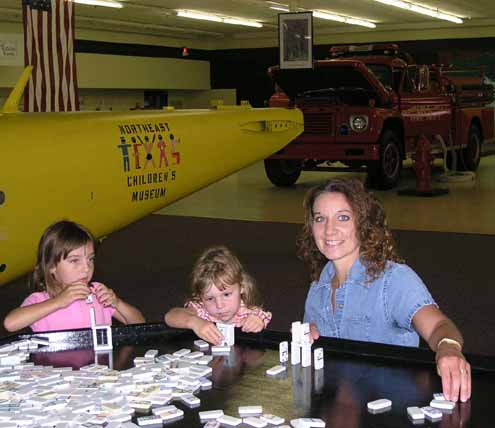
FOCUSED FINGERS - Dr. Sandy Kimbrough builds houses from dominoes with daughters Kaylee (left) and Tara. Kimbrough is an early childhood motor development specialist at Texas A&M University-Commerce. (A&M-Commerce photo)
SIX STEPS TO IMPROVING YOUR CHILD'S MOTOR DEVELOPMENT
Dr. Sandy Kimbrough offers these suggestions on how best to help your child develop great motor skills.
1. Birth to one year: As a baby gets ready to reach and grasp, provide toys and objects that are safe - not too small - and easy to see. Most objects will end up in the baby's mouth. As the baby gets ready to explore on tummy and knees, be sure the surface is clean and safe. Babies need exploring time on the floor with Mom and Dad.
2. One year old: Play games like peek-a-boo and "where's the toy?" with baby. The baby is learning about the world through the integration of information from different senses.
3. Two years old: Avoid too much television time and let the baby interact with his peers through play. The child is probably not ready for cooperation during play, but will imitate and interact with others. Provide a structure to the day and be sure to include reading time.
4. Three years old: As the brain continues to develop, provide as many different movement experiences as you can. Visit playgrounds, parks, museums, and zoos. This is a critical time for the development of gross motor skills.
5. Four years old: Do things that your child enjoys; just about anything can become a game when approached from your child's point of view. Model healthy habits for the child - if the parents are active, the child will be active, too.
6. Five years old: As the child is entering sports programs, avoid focusing on winning and competition. Encourage the development of skills in general - throwing, kicking, jumping, catching, for example - and encourage participation as a way to have fun and be healthy.