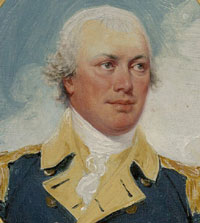
Throughout his short life, Greene built a reputation that made him one of George Washington’s most trusted generals during the American Revolution. Colleagues had considered him a potential successor to Washington, and his efforts helped destabilize the British positions in the South. Greene, also called the “Fighting Quaker,” has been seen as one of the best generals during the American Revolutions.
Nathanel Greene was born into a wealthy Quaker family in Rhode Island in 1742. He grew up on the family farm where a tutor taught him law, math, and the classics, inspiring him to study military history. By the early 1770s, The Greenes started clashing with British officials after they seized a transport ship owned by the family.
The family won a lawsuit to reclaim their ship, but Greene was increasingly upset with the British as a result. In 1774, after the British passed the Intolerable Acts in retaliation against the Boston Tea Party, Greene organized a Rhode Island militia called the Kentish Guards.
Later in 1774, Greene married Catharine Littlefield, with whom he would have seven children. Greene continued to grow concerned about British designs on the American colonies. He wrote, “I am determined to defend my rights and maintain my freedom or sell my life in the attempt.” When the Continental Congress created the Continental Army in 1775, they appointed George Washington to command it. Washington then appointed sixteen generals, including Greene.
In the early years of the war, Greene fought at Washington’s side. He helped Washington lay siege to the British occupation of Boston, forcing the British to retreat by March 1776. In June, he accompanied Washington and Continental forces to New York where Greene began building fortifications to defend against a British attack. Though Continental forces were ultimately forced from New York and New Jersey, Greene was part of Washington’s counterattack at the Battles of Trenton and Princeton, helping the U. S. regain momentum.
When the British launched an attack on Philadelphia in 1777, Greene’s actions at the Battle of Brandywine prevented the entire army from being captured. In early 1778, Washington appointed Greene as quartermaster general of the army, where he established important supply depots at critical locations to keep the army supplied. That summer, he also commanded a brigade at the Battle of Monmouth Courthouse which forced the British out of New Jersey.
By 1778, the British shifted their strategy from attempting to retake the Northeast to securing control of the South, believing the South’s agricultural wealth could offset the loss of the Northeast. Though there were still many Loyalists in the South, there was a large group of determined troops fighting for independence. After a series of demoralizing defeats, the Continental Congress appointed Greene as the commander of the southern theater in October 1780.
Much of the fighting had deteriorated into partisan warfare and small militias between Loyalists and forces for independence. Greene was outnumbered and out-gunned. He studied how southern partisans were fighting and began directing them into a more organized strategy, relying on the strength of their hit-and-run attacks to force the British to retreat. He began inflicting increasingly heavy casualties on the British, leading their own commander, Gen. Charles Lord Cornwallis, to remark that Greene was “as dangerous as Washington.”
The fighting across the South was brutal. In a letter to Washington in 1781, Greene wrote, “We fight, get beat, rise, and fight again.” Greene’s efforts pushed Cornwallis north into Virginia, where Washington organized American and French forces to confront the British at the Battle of Yorktown by September 1781. After two weeks of fighting, Cornwallis surrendered to Washington.
Though the fighting with the British had ended, British troops still occupied Charleston, South Carolina, and Savannah, Georgia. In addition, there were still pitched battles with Loyalist militias to whom the fighting had become personal. As negotiations between the United States and Great Britain continued in Paris, Greene continued to command Continental forces in the South in case fighting resumed.
But the newly-independent United States was teetering on the edge of bankruptcy after the war, so Greene often paid for uniforms, food, and supplies out of his own pocket into 1782 and 1783. The government had difficulty reimbursing Greene, and the debt he incurred providing for his men would lead to court cases that lasted years after his death.
Several months after the Treaty of Paris was finalized in 1783, Greene resigned his commission with the Continental Army. He briefly returned to Rhode Island, but with deep debts, he moved to Savannah to run a plantation that the State of Georgia had awarded him in honor of his service. Inventor Eli Whitney would become a tutor to his children afterward.
In 1785, a Georgia state senator, James Gunn, twice challenged Greene to a duel stemming from a dispute over Gunn’s sale of army horses for his own use. Greene had nearly had Gunn court-martialed over the incident, but Gunn would not let the issue rest. Other generals and officers defended Greene, claiming that a superior officer should never have to answer to a subordinate for his decisions.
Greene died in June 1786 at age 43 after suffering a heatstroke. A statue of Greene stands in the U. S. Capitol in Washington, DC, and a memorial to him was dedicated in Savannah. His homes in Rhode Island and Georgia are now historic sites. The navy would name several ships for him. Greensboro, North Carolina, and Greenville, South Carolina, were named for him as well as more than a dozen counties and other communities across the nation.