There was a time in my life when I thought a successful deer hunt always resulted in venison for the freezer or antlers for the wall. This is not that time! That was my mindset as a young hunter. I was all about filling my tag. Oh, I enjoyed being in the outdoors but my primary goal was to kill a deer and, if I didn’t, in my mind the hunt was unsuccessful.
What’s the old saying about taking time to smell the roses? I guess as one grows older the roses must put off a sweeter smell because as I matured as a hunter, I began to relish just ‘being out there’, regardless if I shot or even saw a deer. By the time I reached forty, and had seriously hunted deer 25 or so years, I began to slow down and enjoy everything about the hunt, everything from the planning to sitting in a stand and smelling that hard-to-describe scent of fall; decaying leaves mixed with the freshness of a stiff, north breeze pushed south all the way from the wilds of Canada.
I had the privilege of spending a couple days bow hunting with my friend Jeff Rice at his ranch in Wood County this past week. Nary an arrow was loosed but we had a blast in the early fall woods. The area we hunted is within walking distance of camp. There is something special about actually walking from camp to where one hunts. It has always reminded me of hunting in the old days, way before it became commonplace to ride a four-wheeler to a deer stand.
I was hunting from one of the new see-through pop-up blinds situated at the junctions of a couple trails in an area where pine and hardwoods meet. These blinds are prefect for bowhunting, one can see the surroundings looking through the walls of the blind but remains totally invisible from game on the outside. It was the perfect spot to hunt with bow and arrow with good visibility in front and along either side of a heavily used deer trail.
Walking to the blind on the first afternoon hunt, I noted several scraps and freshly rubbed saplings. The rut (breeding season) is getting underway and deer were on the move. I settled into a comfortable chair inside the blind about three hours before dark and after an hour-long peaceful sit in the woods, I caught movement just on the other side of a brush line to my left.
I was just back from Oklahoma where I shot a couple of doe for the freezer but Jeff had yet to put his venison on the meat pole. I planned to shoot any mature buck or doe that came withing comfortable bow range. Jeff was hunting one of his favorite tree stands a quarter mile or so to the southwest. The approaching deer, a big, mature doe, eased along the opposite side of the tree line. I could make her out well through the sparse brush and drew my bow just before she was about to step into the opening.
The movement required to draw the bow is a challenge bowhunters learn to overcome and drawing before an approaching animal comes into view is a good way to accomplish this. I pulled the bow back low in the blind, below the window, and eased it up into shooting position. Most modern bows have eighty percent let off and with my bow set at 56 pounds, I was only holding a little over ten pounds draw weight.
The old doe somehow knew something was not right; just as her head and shoulders cleared the brush and she paused and looked my way. I was frozen at full draw with the sight pin settled on the deer’s shoulder. But there was one vine blocking a clear view of my aiming point.
Oh, I could have possibly attempted to shoot a couple inches either side of this obstruction but when bowhunting, there is little margin for error with arrow placement. That darned little vine was blocking what would otherwise be an easy 18-yard broadside shot.
Ten pounds is not a lot of weight to hold but after a minute or so of holding back on the bowstring, I was beginning to wonder when the deer would take that next step.
Her next step was in reverse! She simply stepped backwards and stood still, looking in my direction with plenty of cover blocking a clear shot. She stood there a good two minutes and I eased the string down on my bow to release the tension. A minute later she simply vanished back into the brush. Jeff had also seen a couple of deer but nothing that presented an ethical shot.
The next morning I counted a total of 11 gray (cat) squirrels eating corn at the feeder I was hunting over. Soon we’re going to break away a from a morning of deer hunting and harvest a few busheytails for a huge pot of squirrel and dumplings. Jeff saw what would have been a fine eight-pointer at his stand but the buck had broken half of one antler.
This hunt I rate a twelve on a ten scale. No deer were taken but such is often the case when bowhunting. We enjoyed a fine meal and shared some stories of hunts past that evening back at camp and set up a new Mag Feeder and filled it with Timber Tines deer feed. These feeders are gravity flow and water- and raccoon-resistant by design; they mount on a sapling cut about 48 inches above ground level or on a 4X4 post.
We now have a new spot to hunt. A trail camera is set up near the feeder and we’re expecting deer to sniff out the strong peanut aroma of Timber Tines soon. The feed is 24 percent protein and 34 percent fat, a blend my biologist friends tell me is idea as a food supplement for deer.
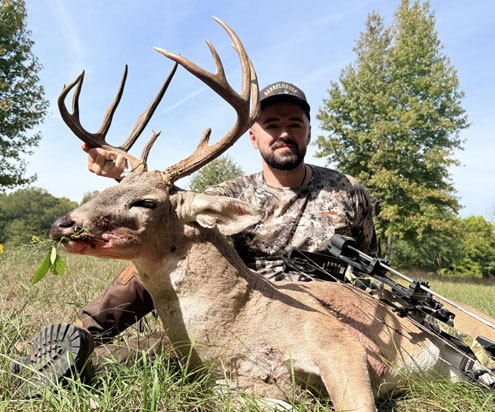
A couple days after our hunt, Jeff returned with his friend Mirza Kovacevic and Mirza arrowed arrowed a buck of a lifetime, a heavy antlered ten-pointer. The buck was arrowed on a trail leading to our new feeder! I know where I’ll be hunting next week when Jeff and I return for round two with our bows!
Listen to Luke’s weekly radio show, “Catfish Radio with Luke Clayton and Friends” on many radio stations, his website www.catfishradio.org or podcast just about everywhere podcasts are hosted.