For Gary Costlow, managing land isn't just a job—it's a lifelong dedication to conservation. At Brushy Creek Timber Company and Poverty Hill Ranch in Palestine, Texas, Costlow's innovative efforts are transforming these lands into thriving ecosystems. His passion for preserving natural beauty and wildlife habitats is evident in every decision he makes, from strategic timber management to pioneering conservation practices.
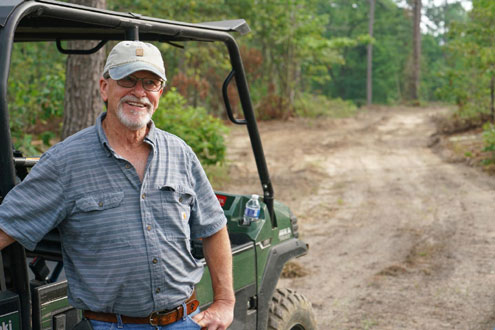
Costlow manages Brushy Creek Timber Company and his own property near Palestine, Texas. He is also the land manager of Poverty Hill Ranch, where he’s worked for over a decade. He was initially drawn to the area for its wildlife and access to outdoor activities.
“From a landowner standpoint, I manage for another landowner. He expects me to make good decisions and he also expects me to look forward down the road long-term,” says Costlow, who cherishes the entire Brushy Creek area, appreciating its tranquility and natural beauty. “It’s important to me to make good decisions whether it’s timber or cattle to provide a better future.”
The land Costlow manages is a testament to how dedication and collaboration with agencies like the Natural Resources Conservation Service (NRCS) can lead to substantial benefits to the land.
“You don’t get to see things like this often,” NRCS District Conservationist Kelsey Cavener-Sumner says. “You get to enjoy the day hanging out with a landowner who really cares about the natural landscape and wants to make a difference.”
Cavener-Sumner is talking about the slew of practices Costlow has been involved in to improve the landscape, from prescribed burning to a native grass restoration project and open pine program.
A change in careers leads to more than imagined
While Poverty Hill Ranch was purchased in the late 1900s, Costlow’s own property, about 15 miles north of Palestine, dates back to 1859.
“This is kind of like going back in time when you come to Brushy Creek,” Costlow says. “It means a whole lot to me that my family can continue to enjoy being away from the hustle and bustle. You can just kind of relax when you come out here.”
When the Goodyear plant where he’d worked closed, Costlow looked for new opportunities and soon found himself managing the ranch land after a tip from a fellow neighbor. “In a couple of months, I was hired, and that’s going on 11 years ago. It’s been a real blessing. I thank the Lord it’s been a good job,” Costlow recalls.
Shortly after starting his new role, Costlow also founded the Brushy Creek Wildlife Management Association. “We put about 11,000 acres together, and now it’s a wildlife co-op of landowners who work alongside partners such as NRCS, Texas Parks and Wildlife Department (TPWD), and the National Wild Turkey Federation (NWTF),” Costlow explains. The co-op aims to enhance wildlife habitats through collective efforts.
Implementing conservation practices
Beyond timber sales and managing Poverty Hill Ranch, Costlow is working with a forester to improve the land through tree thinning and prescribed burns.
He is actively involved in an Open Pine 5-Year Project via NRCS’s Environmental Quality Incentives Program (EQIP). The area spans over 2,000 acres and involves heavy timber thinning to increase sunlight penetration to the forest floor. Following, prescribed burns are planned on a short interval rotation to increase herbaceous species response, which are monitored through data collection locations across the property. The monitoring locations will help determine habitat conditions and long-term management actions needed to create optimal habitat for native wildlife species such as songbirds, Eastern wild turkey, as well as white-tailed deer.
The work he is doing is a steppingstone through which Costlow hopes to eventually move into a Conservation Stewardship Program.
Costlow holds his relationship with NRCS in high regard. The support from the agency has enabled him to make substantial progress in conservation efforts. “Working with NRCS has been a game changer,” Costlow says. “I advise anyone in my shoes to connect with NRCS and Texas Parks and Wildlife. I’m only as good as the people I surround myself with.”
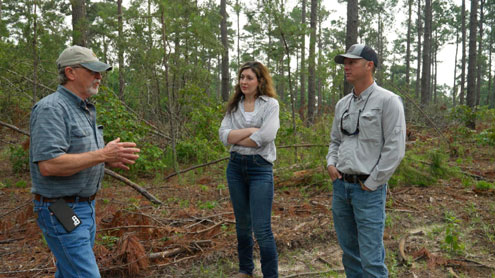
Before working with NRCS, Costlow had been involved with TPWD to do prescribed burning and native grass conversions. While he’s done a lot of the burning on his land himself, NRCS helped fund the last one.
He routinely runs a bulldozer around the property to install fire guards and make sure they remain clear. “They’ll be used with prescribed burning in future years to help prevent wildfires,” NRCS Wildlife Biologist Frank Baca says.
Costlow’s dedication to land management has earned him recognition, including the 2021 Lonestar Land Steward Award. “It meant somebody was paying attention to what we were doing, and it made me feel really good,” Costlow says. “My family was proud of the fact.”
He also recently won the Lower Mississippi Valley Regional Conservation Award for his work on the Open Pine Project.
“There’s not many people in the world doing this type of integrated management. It’s very uncommon,” Baca says. “Mr. Costlow’s focus on wildlife habitat along with timber production is unique. Historically, timber production has been the main focus with wildlife being secondary. However, landowners and their use of the land are changing gradually to be more recreationally geared.”
Repairing a forest desert
Working with Cavener-Sumner and Baca, Costlow is focusing on tree thinning and prescribed burns to maximize wildlife habitat. The goal is to maintain a basal area between 40-60 for the Open Pine project. They’re running below 50 here.
“Personally, I think it looks really good,” Costlow says. “We’ll grow a lot of grass where the sunshine gets on the ground, which is what we’re after.”
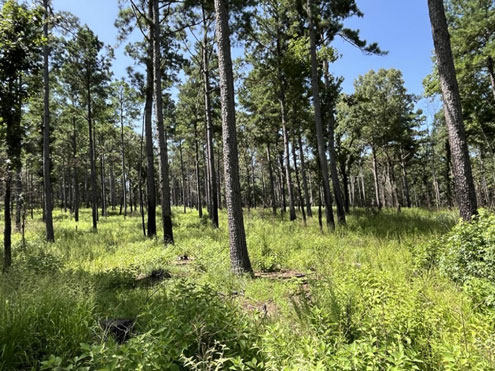
East Texas is known for its dense forests, which can create wildlife deserts in the understory. To combat this, Costlow is improving five tracts of land through thinning, burns, and habitat monitoring over five years. This work not only makes the land safer against wildfires but also enhances the habitat for wildlife by allowing more sunlight to reach the ground, allowing forbs and grasses to grow.
Beyond this, Costlow has implemented several wildlife-friendly practices, such as creating food plots for turkey and deer as supplemental food sources and building wetlands for waterfowl use. In addition, he utilizes rotational grazing of cattle on pasture and areas he’s converted from introduced to native forages on the property.
The importance of water management
Because water runs through the property, Costlow is careful about how it is managed. He has installed streamside management zones to prevent erosion and protect water quality. “We do that for a buffer for erosion, so we don’t let the timber cutters cut right to the bank of the creek,” Costlow explains.
“In this part of the world, especially on pine plantation country, most of your mass-producing trees exist along the stream side management zones, like your oaks,” Baca continues. It’s important to maintain those areas as corridors and linkages to habitats. They also serve as to provide additional food sources and habitat types.
The interspersion of habitat types is important for maintaining year around habitat quality.”
In one wetland section of the property, Costlow worked with NRCS to construct a levee with a water control structure to hold back and manipulate water levels for waterfowl, using technical assistance from Baca and NRCS engineers. This addition has created a new ecosystem, attracting numerous waterfowl species such as wood ducks and mallards.
“I enjoy seeing someone apply management that’s having very positive benefits to the ecosystem. Not only does it have positive benefits to this piece of land and the species that inhabit this property, but it’s further reaching,” says Baca.
Educational outreach and future goals
Opposite of the old saying ‘Can’t see the forest for the trees,’ not only does Costlow understand and appreciate the larger situation, but he’s made it his mission to consider each concern to take care of the whole.
“I can remember when there was no deer here. I can remember when deer first started coming into the county. That was dinner on the table. So, they were under pressure—always,” Costlow says. “Now we have a manageable herd and that makes me feel real good that we have accomplished that.”
And he loves that he has the chance now to share what he’s learned with others. Costlow’s land has become a “classroom” for students and researchers. Graduate students from Stephen F. Austin and the University of North Texas come to study honeybees and turkeys, respectively. Costlow’s willingness to share his knowledge and experiences makes him a valuable advocate for conservation.
The land manager’s commitment to conservation is unwavering, according to Baca. “It’s really awesome to see the changes. Mr. Costlow is very active in his management. Coming out and learning from him has helped me to be able to transfer that knowledge to other landowners.”
For Costlow, the work he’s doing at Brushy Creek is more than a job. It’s personal. “It’s important to me to provide whatever I can to the wildlife to give them the best possible chance of survival,” Costlow concludes.