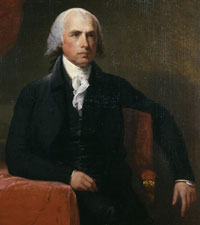
The fight for ratification of the Constitution in 1787 and 1788 would be one of the major tests of the new nation’s ideals. Madison passionately argued in favor of ratification, proclaiming, “Every word decides a question between power and liberty.” The three branches of government created a government of limited power designed for accountability to all parts of the government with enough power to take action when needed but one that would respect the rights of the people.
Madison worked with Alexander Hamilton and John Jay to write The Federalist, a series of 85 essays in New York newspapers attempting to convince that critical state to ratify the constitution. In one of his most famous Federalist essays, Madison responded to fears of open partisanship tearing apart the country by saying that the principle of free elections and majority rule promised by the Constitution would make it difficult for one faction to permanently dominate the country without responding to the people. By 1788, enough states had ratified the Constitution to allow the new government to begin.
Virginia voters elected Madison to the House of Representatives for the first Congress. Though he initially did not believe that a bill of rights was necessary, critics of the new Constitution worried there were not enough protections for the people. Nevertheless, Madison made the Bill of Rights a priority once he arrived in New York City, then the nation’s capital.
Drawing from his experiences in Virginia, he drew heavily from the Virginia Bill of Rights and proposed twelve amendments on June 8, 1789. These amendments would guarantee freedom of speech and religion, jury trials, and due process of law for everyone, among other freedoms. Ten of the amendments were ratified by December 15, 1791, and became the cornerstone of the civil liberties of the people. A proposed amendment regarding the initial number of seats in the House of Representatives was dropped and forgotten about, and the other lost amendment stating that Congress could not accept pay raises without an election first was not ratified until 1992 as the Twenty-Seventh Amendment.
As disputes rose in the new government, new political factions emerged. With Thomas Jefferson, he co-founded what is now the Democratic Party in 1795, which is now the oldest surviving political party in the U. S. As part of an agreement with Hamilton of the leading Federalist Party, the capital was moved to Washington, DC, by 1801.
After Jefferson’s election as president in 1800, Madison was chosen to serve as Secretary of State. As he helped craft foreign policy, he helped push through the Louisiana Purchase in 1803, which doubled the size of the nation overnight. However, a continuing war between Great Britain and France led Britain and France to both blockade American ships while Britain went so far as to kidnap American sailors on the high seas and incite Native American tribes in the West to attack American settlers. With Jefferson, he proposed a number of policies to resolve these issues, but they were blocked at every turn.
In 1808, Jefferson decided not to seek a third term, and Madison quickly became the favorite to succeed him. Madison won the election easily and would be re-elected in 1812. His wife Dolley, whom he married in 1794, continued to serve as a close advisor to him and became the center of Washington social life.
However, problems with Britain continued. In 1812, he asked Congress for a declaration of war, and the War of 1812 began. However, the nation was unprepared for war, having only a small army and navy and little financing available. And the nation was divided over the war. Though the US won a number of important victories, there was also a steady series of disasters.
In 1814, the British attacked Washington, DC, leading the Madisons and the government to flee the city. The British set the White House and most of the city on fire before leaving. British losses convinced them to agree to a settlement of the war with the Treaty of Ghent on Christmas Eve 1814. Realizing the serious problems the nation faced during the war, he spent the last years of his presidency pushing for a national bank, economic development, and a new system of roads and canals to build the nation.
After the presidency, he quietly returned to Virginia. He largely stayed out of the public eye but quietly advised his successors and other prominent politicians. In 1829, he served as a delegate to the Virginia Constitutional Convention, the state’s latest attempt to modify its government. In his later years, his health declined and personal debts mounted. He died quietly at his home on June 28, 1836, at age 85.
In 1908, the State of Virginia established James Madison University. The federal government also put Madison’s image on the rare $5,000 bill. Numerous other schools across the nation have been named for him. The Constitution he helped construct for the nation is now the oldest constitution still in use in the world and has only been amended 17 times since the ratification of the Bill of Rights. Nineteen counties across the country were named in his honor, including Madison County, Texas.