In 1842 Texas was a republic, a country – not a state, and was only six years down the road from its fight for independence from Mexico, and a few years away from joining the United States. Folks of vision saw the chance to change the landscape.
Among them was John Neely Bryan of Tennessee. Already credited with helping to start the town of Van Buren, Arkansas, Bryan left that area in 1839 and, according to historian Michael Hazel, in his excellent little book entitled Dallas, “traveled southwest to Holland Coffee’s trading post on the Red River where he clerked.” While there, Bryan apparently formed a close friendship with Coffee.
Not content to work for someone else, Bryan drifted further south into the new republic and secured ownership of acreage on the east bank of the Trinity River. Bryan’s new land eventually became the city of Dallas.
Of interest to readers in this area is how Bryan used resources in Fannin County to help make professional and personal goals, such as selling lots in his new city and getting married, come about.
On the professional front, after acquiring the land east of Trinity River, Bryan hired a surveyor to begin mapping out the earliest streets of Dallas. Shortly afterwards, Bryan began selling lots on those streets for establishing homes, businesses, churches, etc.
In 1842 Bryan’s new city was located in Nacogdoches County, one of a handful of huge counties in the Republic of Texas at that time. (Fannin County was among them, with borders that stretched much farther west and south than now.) In order to file land-related records in the county seat, Bryan would have to travel roughly 180 miles to the town of Nacogdoches. To skirt that inconvenience, the republic apparently allowed Bryan to occasionally file papers in a county seat closer by. In this case, the town of Bois d’ Arc (now Bonham) in Fannin County, only 80 miles away.
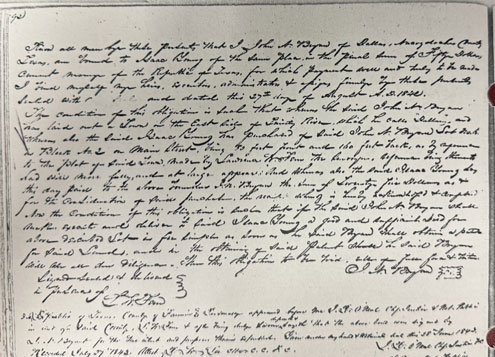
For evidence of this, one need only look at page 92 of Deed Record Book B in the Fannin County clerk’s office to find the closing of the sale of a lot on Main Street in Dallas by Bryan to an Isaac Young. Details of the record states that Bryan appeared in person to make the transaction. Since deed records at that time were handwritten, they are often hard to read. Fortunately, historians Shirley Caldwell and Newton Fitzhugh, in the Heritage News (Vol. XI, Winter 1986-87) clarified key points in the document writing, “by August 27, 1842, Bryan had named his town ‘Dallas,’ had gotten Lawrence W. Fern to plat and survey the town, and had sold Isaac Young a lot on Main Street for $50.” (Some argue that this deed record might be the first time that Bryan referred to his town as Dallas in print.)
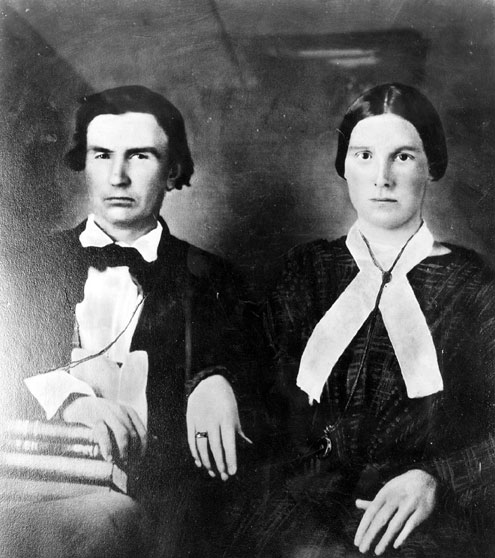
On the personal front, former Dallas Morning News genealogy writer Margaret Ann Thetford, writing in the December 6, 1980 issue, recorded that Bryan and his fiancé, Margaret Beeman, made the 80-mile trek from Dallas to Bois d’ Arc to get married on February 26, 1843. Thetford wrote, “They had traveled four days to … (present day Bonham, Texas) 80 miles north to be married.” I immediately thought, what was her source for this fact? This sort of detail is not typically found in marriage documents, court papers, etc. On the contrary, it’s the sort of personal thing that appears in family letters, journals, diaries, or perhaps just oral family history. And, perhaps a family member once shared the interesting story with an inquiring newspaper reporter.
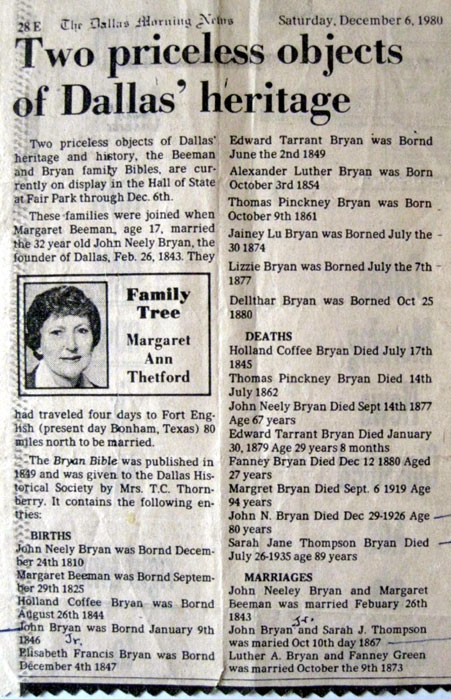
Unfortunately, while sources such as genealogy websites, newspaper articles and Bryan/Beeman family Bibles (kept at Dallas Historical Society building in Fair Park and give the date of marriage only) agree on the marriage date of February 26, 1843, and some mention the location where it happened, none of them give the source for the story about the four-day trip to Bois d’ Arc.
So, what other evidence appears to support the assertion that the young couple (Bryan was 32, Beeman was 17) traveled to Bois d’ Arc to get married? First, the deed transaction discussed earlier shows that Bryan was no stranger to riding to Bois d’ Arc to conduct paperwork business such as obtaining a marriage license, and perhaps locating a judge or minister to marry them.
Secondly, if friends were needed as witnesses to make it all legal, they both had those in the Bois d’ Arc area in the persons of Mr. and Mrs. Mabel Gilbert and Holland Coffee. It is recorded that Gilbert and his family were friends with the Beemans, and that Gilbert had moved his family at one point to the Dallas area at the urging of Bryan. (In fact, it is argued that Gilbert’s wife, Charity, won a contest to name Bryan’s new city by arguing that it should be named Dallas after the well-known naval hero, Commander Alexander Dallas, or perhaps after politician George Mifflin Dallas who soon became vice president of the United States.) By the time Bryan/Beeman decided to get married, Gilbert was a resident and landowner in the Bois d’ Arc area.
Also, Bryan’s former employer and friend, Holland Coffee, was still doing business in the area. While the location of his trading post is now seen as being more in the Grayson County area along Red River, at that point in time it was in Fannin County – Grayson County did not yet exist. And just how much did Bryan think of his former employer? I’ll put it this way, when the Bryan’s first child, a son, was born, he was named Holland Coffee Bryan. Unfortunately he died just shy of his first birthday.
Could it be that having the Gilberts and Holland Coffee as witnesses was another reason that Bryan/Beeman chose Fannin County for their nuptials?
Thirdly, location, location, location. Why travel 180 miles to Nacogdoches when the trip to Bois d’ Arc was only 80 miles?
In short, logical evidence supports the assertion that Bryan/Beeman were married in Bois d’ Arc.
So, while Bois d’ Arc, destined to become Bonham, the county seat of what would soon be a much smaller Fannin County, was muddling through its infancy, it served as the place where John Neely Bryan could conduct business related to starting his family, and his city of Dallas, destined to become one of the largest and busiest cities in Texas.
Many thanks to Laura Robinson at the Fannin County Clerk’s office for help with the deed record books.