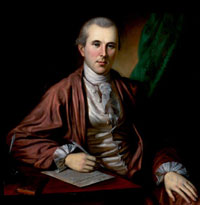
Benjamin Rush was both in January 1746 on his parents’ farm in what was then just outside Philadelphia. He was the fourth of seven children, but his father died when he was only five. His mother, overwhelmed with seven children and running a store and a farm, sent him and an older brother to live with his uncle, who ran a school.
He was extremely intelligent and was sent to the College of New Jersey (now Princeton University) and earned a bachelors degree at age 14 in 1760. Because there were no medical schools in the colonies, he apprenticed under a Philadelphia doctor in order to learn medicine. In 1766, he went to the University of Edinburgh in Scotland to advance his medical studies. He returned to Philadelphia in 1769 and began practicing medicine.
Rush became close friends with fellow Philadelphian and scientist Ben Franklin. Franklin would help pay for Rush’s early medical education and secured him a position as professor of chemistry at the College of Philadelphia, the college co-founded by Franklin that became the University of Pennsylvania. The two would work very closely together on local causes and remained strong allies throughout the American Revolution.
He became a fierce critic of corruption and British abuses of power. “Where there is no law, there is no liberty,” he once wrote. He joined the Sons of Liberty, a group that originated in Boston with Samuel Adams that organized protests against the British. After Ben Franklin convinced Thomas Paine to journey to Philadelphia from England in the years before the American Revolution, Rush soon became friends with him and gave Paine advice on his famous pamphlet Common Sense.
Rush married Julia Stockton in 1776, and they had 13 children together. However, only nine survived to adulthood. One son, Richard Rush, would serve in the cabinets of six presidents.
He also became a delegate to the Second Continental Congress in 1776 as fighting spread between the British and the colonists. He advocated independence and would sign the Declaration of Independence. In 1777, he stepped away from the Continental Congress to spend the next year as surgeon general for the Continental Army.
Rush would serve as a delegate to Pennsylvania’s ratification convention for the new Constitution. In December 1787, Pennsylvania became the second state to ratify the Constitution, following Delaware.
He joined the staff of Pennsylvania Hospital in 1783. That year, he also founded Dickinson College in nearby Carlisle. He worked to expand what had been a small boarding school into a respected university and named it after John Dickinson, then the governor of Pennsylvania, an early leader of the movement against the British, and author of the Articles of Confederation, the nation’s first constitution.
He became an outspoken defender of education, public schools, and the education of women, declaring, “Freedom can only exist in the society of knowledge. Without learning, men are incapable of knowing their rights.” Rush helped educate an estimated 3,000 medical students.
Rush was a devout Christian, though his religious ideas shifted throughout his life. He co-founded the Pennsylvania Bible Society, and helped Rev. Richard Allen co-found the African Methodist Episcopal Church, the first major denomination led by African-Americans.
He remained active with many different causes. He was also an outspoken abolitionist and against the death penalty. He pushed for reforms in the criminal justice system, trying to push Pennsylvania away from corporal punishment and public beatings to a penitentiary system to punish wrongdoers.
In 1791, he became treasurer of the U. S. Mint, serving in that capacity until his death. In 1804, he consulted with Meriwether Lewis as to what medical supplies they would need on the long Lewis and Clark Expedition. After Thomas Jefferson left the White House in 1809, it was Rush who encouraged Jefferson and John Adams to reconcile their friendship that had been strained by years of political fights.
In April 1813, he contracted typhus and died several days later at age 68. After his death, a number of his students moved to the West and established Rush Medical College in Chicago in 1837, named in his honor. Many scholars have praised his efforts to improve the study of psychiatry and medicine, though many of his ideas and techniques had long since been considered outdated. He has sometimes been called the Father of American Psychiatry. The American Psychiatric Association includes an image of him in their organization’s seal. A school in Philadelphia as well as a number of parks and schools have been named for him.