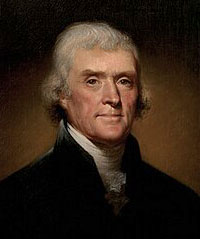
After the Declaration of Independence had been adopted by the Continental Congress in 1776, Jefferson returned to Virginia and was re-elected to the legislature that fall. His chief task was to revise Virginia’s colonial laws for an independent America, based on the ideas he spelled out in the Declaration of Independence. In 1779, he was elected governor, succeeding Patrick Henry. He raised money and troops to keep the war effort going and moved the capital from coastal Williamsburg to Richmond.
He also looked to the future, attempting to establish a public education system for all the children of Virginia, laws to protect the rights of the people, reform the judicial system, guarantee freedom of religion, and end state-mandated support of the church. He met with mixed success against skeptical planters unwilling to give up their political power to the common man.
In 1781, as the British pushed northward, Jefferson was forced to order an evacuation of Richmond as the British set fire to the city. The British advance would be stopped by George Washington’s combined American and French forces at Yorktown, a battle the ended the war that fall. Jefferson also left the governor’s office. The next year, his wife of 10 years died.
Outside of politics, he would devote himself to science. He would devise a number of inventions, including a folding ladder, the dumbwaiter, a clock that also showed the date, a revolving book stand, and a writing aid that would allow a writer to make a perfect written copy of a document (which he called a polygraph). In 1785, he completed his book Notes on Virginia, a scientific examination of the resources, economy, and society of Virginia, one of the earliest scientific examinations of the state. He was a voracious reader and later sold his collection of 6,500 books to the federal government to create the Library of Congress.
Jefferson wrote about many religious ideas. Though an Episcopalian, he often expressed frustration with organized churches. In 1777, he proposed the Virginia Statute for Religious Freedom, which would grant any individual the right to practice any religion in Virginia and that individuals should not be forced to support churches with their tax dollars. His friend James Madison, considered the Father of the Constitution, joined Jefferson in his support for the measure, noting in 1785 how combining church and state invariably corrupted the other. The measure passed the Virginia legislature in 1786.
In 1785, Jefferson became the U. S. Ambassador to France, serving for four years. Immediately upon his return to the U. S., newly-elected President George Washington asked him to be the first Secretary of State. In this role, he often clashed with Treasury Secretary Alexander Hamilton on everything from government spending to relations with France. Between the two, they secured an agreement that moved the nation’s capital from New York City to the newly created Washington, D. C., by 1801.
He challenged John Adams for the presidency in the first partisan election in 1796. Because of the quirk in the electoral college at the time, he became vice-president after he finished in second. As vice-president, he bitterly disagreed with Adams's policies, including the controversial Alien and Sedition Acts of 1798.
In 1800, Jefferson defeated Adams in a bitter election, with Aaron Burr becoming vice-president. Jefferson’s election has sometimes been called the “Revolution of 1800,” being the first transfer of power between parties, one that occurred peacefully because of the nature of the men involved and their hopes for the nation. In his inaugural address, Jefferson called for partisan unity, stating, “Every difference of opinion is not a difference of principle.” He created the U. S. Military Academy at West Point, slashed spending, and cut the national debt in half.
In 1803, America secured the Louisiana Purchase. The addition of Louisiana doubled the size of the nation overnight in what became the largest peaceful transfer of land in history. Thirteen states emerged, from Louisiana and Arkansas to the Dakotas, and from this $15 million purchase added land that produces trillions of dollars each year in goods and services.
Jefferson, always the scientist, authorized several expeditions into the area, including the famed Lewis and Clark Expedition of 1804-1806 that helped secure an American claim on the Pacific coast as the western border. Jefferson was re-elected easily in 1804, but his second term was dominated by increasing disputes with both Great Britain and France over blockades of American trade with the other as they waged another war with each other. In 1808, he signed a law banning the importation of slaves, but smuggling continued for decades.
In 1809, he stepped away from the presidency, which he came to call “splendid misery.” He resumed his friendship with John Adams, and the two would write each other often. In 1819, Jefferson teamed up with two other presidents, James Madison and James Monroe, and founded the University of Virginia. Jefferson would design the university’s main building, which opened in 1825. He suffered serious money problems in his later years and his health failed.
He died on July 4, 1826, at age 83, on the fiftieth anniversary of independence. His last words were of his old friend John Adams. Of all his accomplishments, on his epitaph he asked only three things be listed: “Author of the Declaration of American Independence, Of the Statute of Virginia for Religious Freedom, and Founder of the University of Virginia.”
His birthday of April 13 is nationally recognized. Dozens of streets, schools, counties, cities, and buildings have been named in his honor. But each July, the nation celebrates not the July 2 anniversary of independence but his July 4 declaration that a free nation had been born.