The success of the American Revolution came from the hard work and bloodshed of thousands of people. Behind the scenes, legislators and diplomats worked to fund the armies and rally the people. Of those men and women, of all faiths and of all races and rich and poor alike, it was the words of one man who wrote the sentence that defined the cause and announced to the world that America had become an independent nation. Lawyer, scholar, legislator, inventor, scientist, and diplomat Thomas Jefferson became that man with his work on the Declaration of Independence in the fateful summer of 1776.
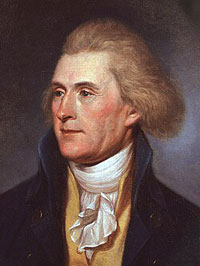
In 1757, his father died. He inherited more than 2,700 acres at age 14 and worked to care for his mother. In 1760, he enrolled at the College of William and Mary, graduating in two years. In 1762, he began studying the law under George Wythe, one of the most respected legal minds in Virginia and himself later a judge and a delegate to the Continental Congress.
Jefferson was admitted to the Virginia bar in 1767. Two years later, he was elected to the colonial legislature. He built a respected law practice, taking on some of the most prominent cases in the colony and even defending slaves suing for their freedom. In 1768, he began building Monticello, a mansion that he designed and even today is still a tourist attraction. He married Martha Skelton in 1772. They had five children but only two daughters survived to adulthood.
As a legislator, Jefferson became increasingly critical of the British. In 1774, he pushed a resolution through the legislature calling for a boycott of all British goods in response to the Intolerable Acts. Afterward, he published a pamphlet, “A Summary View of the Rights of British America,” which defended the idea of self-government for the colonies and limited power for the king.
He traveled to Philadelphia in 1775 as a member of the Second Continental Congress. By the next year, independence was on the horizon as the fighting spread. Congress decided in June 1776 to make a statement to the world, which would become the Declaration of Independence. A committee of five was selected to write the document, which included Jefferson, John Adams, Ben Franklin, Roger Sherman, and Robert Livingston. The majority of the task fell to Jefferson.
Jefferson agonized over the working for weeks, ultimately borrowing heavily from English philosopher John Locke for his ideas of government as defending the rights of the people and how Britain had failed the colonies. The Continental Congress declared independence on July 2, but the document itself, the Declaration of Independence, was approved on July 4 as the British army prepared to wage an invasion of New York.
“We hold these Truths to be self-evident, that all Men are created equal, and that they are endowed by their Creator with certain unalienable Rights, that among these are Life, Liberty, and the Pursuit of Happiness,” Jefferson wrote. It was a sentence that would come to define the United States and its hopes for itself; and it was a sentence that would ignite dozens of revolutions, independence movements, and social movements across the globe for the next 250 years.
The declaration that “all men are created equal” was a radical idea for 1776, especially for a British society built around social class. It meant there were rights beyond the reach of Parliaments, legislators, and kings. It meant that freedom belonged to all Americans and that the law was to protect everyone. Freedom and consent of the governed would be the new nation's guiding principles. Jefferson would say years later, “If men were angels, no government would be necessary.” But he knew that in a free society that imperfect men, flawed men, could strive each day to be more than what they were the day before and should not be limited to where they came from or who they were but only by the limits of their imaginations.
Jefferson tore through the years of grievances against the British. He listed 27 grievances against the British and the continued attacks on the rights of the people. Of these grievances, taxation was only listed once, noted alongside the dissolution of legislatures and the loss of jury trials and the declaration of martial law. He pointed out the pettiness of King George III and Parliament with their attacks on the colonists for, as Jefferson declared, “For opposing with manly firmness, his invasions on the rights of the people.”
He included a line condemning the British slave trade, but Congress struck it down to gain the support of southern planters. Though Jefferson was a slaveholder, he expressed skepticism and moral agony over slavery in his writings. In a contradiction that defined his life and puzzled biographers, he could never justify the system; but he could never part with the comforts that it provided for him.
The Declaration concluded with the promise that the delegates would “pledge our lives, our fortunes, and our sacred honor.” The long war lay ahead, and much more lay ahead for Thomas Jefferson and the nation he helped bring into existence.