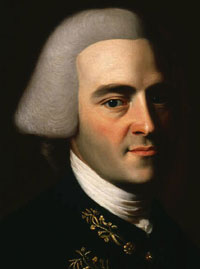
John Hancock was born in Massachusetts in 1737, the son and grandson of Anglican ministers. In 1744, at age 7, his father died. Afterward, he went to live with his uncle, Thomas Hancock, a wealthy and successful merchant.
The younger Hancock completed Boston Latin Grammar School in 1750. Afterward, he graduated from Harvard in 1754 at age 17. As a young man, he joined his uncle’s business and learned about shipping. He gradually became acquainted with the leading members of the local business community. In 1760, he went to live in England for a year to better learn the shipping business and to build business relationships.
When his uncle died in 1764, Hancock inherited his business and his entire fortune, making him one of the wealthiest men in the colonies. After the French and Indian War ended in 1763, Britain was deeply in debt and looking to the colonies to help pay off its wartime expenses. As the British Parliament’s tactics became increasingly heavy-handed, Hancock slowly began to speak out. In 1765, he was elected a selectman for Boston and elevated to the colonial House of Representatives in 1766. In the legislature, he began working closely with Samuel Adams, long an outspoken critic of the British.
The ports became the center of British abuses, as customs collectors harassed sailors and raided docked ships in the belief they were sneaking out of port without paying the required taxes. In 1768, the British targeted Hancock, accusing him of smuggling, and attempted to seize one of his ships. He was tried by a vice-admiralty court, a board of naval officers, instead of a civilian court. With John Adams as his lawyer, the panel soon dropped all charges.
After the Boston Massacre in 1770, Hancock led a legislative committee demanding that all British troops withdraw from Boston. The troops were temporarily withdrawn, which led to an easing of tensions. By 1773, after the passage of the Tea Act, giving special tax breaks to one British company, tensions and mistrust rose again. As discontent grew, Hancock delivered fiery speeches demanding action. “Let every man do what is right in his own eyes!” he said on the eve of the Boston Tea Party.
He married Dorothy Quincy in 1775. The couple had two children, but both died in childhood.
When the Second Continental Congress convened in Philadelphia in May 1775, fighting had already erupted between Britain and the colonies. Hancock was selected by the other delegates to become president of the Continental Congress, a position similar to the modern role of Speaker of the House and not the current chief executive under the modern system. He replaced Peyton Randolph of Virginia.
By 1776, the colonies decided reconciliation with Britain was impossible, and it was time to declare independence. Though independence was declared on July 2, the document itself was not approved until July 4, the day that has been celebrated since. However, the signing of the Declaration of Independence did not take place immediately. Delegates to the Continental Congress signed it only a few at a time and over the course of several weeks. Hancock signed it first, boldly and in huge letters at the bottom. As president of the Continental Congress, he believed he had a responsibility to sign it first and make the colonies’ intentions known to the British government and to the world.
Whether Hancock said anything at the time of signing or not has been a matter of argument since that time. Only one other person was present when he signed. He realized his signature was itself a statement, one that meant the gallows if the Americans lost the war.
The war was a difficult time. In 1776 and 1777, Hancock had to evacuate the Continental Congress from Philadelphia because of British troops. He volunteered for military service; but nearing 40 and with no experience, his appeals were denied. Nevertheless, he raised money and recruited troops for the cause. He also continued to support widows and children orphaned by the war. The Continental Congress began acting as a national government, and a constitution was written to guide it. Thus Hancock also signed the Articles of Confederation in 1777 before returning to Massachusetts.
Shortly after his return to Boston, voters returned Hancock to the legislature. He co-founded the American Academy of Arts and Sciences in 1780 with John Adams, Ben Franklin, and others. In 1780, he was elected governor of Massachusetts, serving for five years. In 1785, he returned to Philadelphia and served as president of the Continental Congress for one more year.
Hancock’s health gradually failed. He was re-elected governor in 1786 and would serve for seven more years. He was unable to attend the Constitutional Convention in 1787, but he made many important public statements in favor of ratification that convinced Massachusetts to ratify.
He died in Boston in October 1793 at age 56. Samuel Adams stepped in as acting governor, proclaimed the day of Hancock’s burial to be a holiday in honor of his friend. Hancock did not leave many writings or letters behind, so he faded from prominence in the decades after his death. However, four cities were named for him as well as two naval vessels.