May is a unique month for those of us that love spending time in the woods or on the water. Spring turkey season is still underway in much of Texas during the first half of the month, but spring squirrel season is open also in the counties of eastern Texas and. in the remainder of the state, squirrel season is year-round. Fishing is also at a peak for everything from lunker largemouth bass to post-spawn white bass and stripers.
So many opportunities this month! I’ve already taken a big, long beard gobbler but have the desire to keep hunting; it’s an addiction that I don’t wish to have cured! As most turkey hunters know, the birds are not nearly as vocal during late season but that doesn’t mean they are not huntable. When most of the hens are locked down on their nest, the gobblers remain in breeding mode, much like whitetail bucks during late season after all the does are bred. Gobblers are on the look for mates and some of the best hunting of the year often occurs during late season. For whatever reason, gobblers just aren’t as vocal in May but that doesn’t mean they won’t come in to a call and decoy set up.
Through the years, I’ve had many longbeards sneak in unannounced. One minute, I will be making soft yelps and putts with my call and the next a brilliantly feathered gobbler will be sneaking into view. This makes hunting a bit more challenging -- when the incoming gobbler is vocal, it’s easy to know his location by his gobbling.
During late season, one just never knows when the bird will appear or, from what direction. I carry a piece of camo burlap and try to conceal my movement with the camo but a gobbler has a sharp eye and is quick to pick up on movement.
Although few hunters take advantage of the spring squirrel season, May is prime time to take to the spring woods to pursue one of the most challenging of small game animals, fox or gray squirrels. Grey or “cat” squirrels are most common to the bottomland of the forest of East Texas while the larger fox squirrels reside primarily on field edges and small woodlots across much of state.
Hunting squirrel during the spring is a far different endeavor than fall hunting; leaves are dense and it’s much harder to spot the critters, but squirrels are much more active under the coverage of dense foliage and once the hunter learns to watch for shaking limbs, he is well on his way to collecting the making of a big pot of squirrel dumplings or smothered squirrel with gravy!
I enjoy hunting squirrels with an accurately scoped .22 rifle but I’d be the first to advise a shotgun loaded with #4 shot for spring hunting for the beginner. I try to make head shots on squirrel when possible and sight my squirrel rifle to be dead on at 30 yards which is an average shot for squirrel. Both fox and cat squirrels often give brief glimpse of their whereabouts in the spring, but fox squirrels are a bit less “wired” and often offer still shots. Cat squirrels seem to be in perpetual motion and the hunter that shoots a limit of these little bundles of nerves with a rifle during the spring season is a marksman indeed.
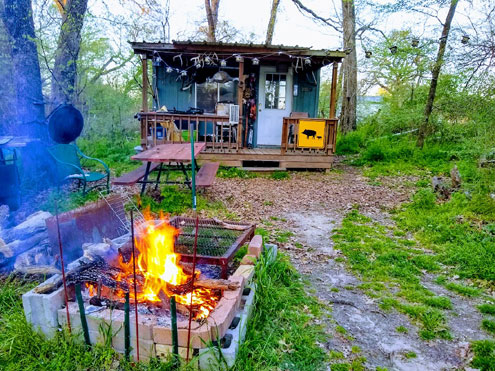
When I was a boy growing up in East Texas, I remember squirrel camps where several guys would pitch tents and camp out over the weekend hunting squirrels. They would have daily contests with cash prizes for the most squirrel harvested and each hunter would do duty on the camp stove preparing his favorite squirrel dish. I visited a couple of these camps as a boy and remember one of the guys making ‘cat head stew’ which was a vegetable stew with carrots, celery, potatoes and onion with a tomato base with, naturally, the heads of several squirrel slowly cooked. The dish sounds a bit bizarre today but I remember enjoying it at one of the camps with camp cornbread cooked over coals in a Dutch oven. I vividly recall the squirrel teeth in the stew and the advice of the cook to “watch out for bones—and teeth! I’ve make many pots of squirrel stew at camps but must admit I use only the prime cuts!
Spending time in the woods in May presents challenges that we don’t have to deal with in the fall, mosquitoes, ticks and chiggers to name a few. A good insect repellant will help a great deal with the insects, but snakes are also active this time of year. When hunting turkey or squirrels, I spend a good bit of time sitting on the ground and usually carry a padded seat that slings over my back. It’s a good idea to walk slowly and keep an eye on the ground where your next foot is landing! Granted, a copperhead is a bit easier to spot in the spring compared to fall when dry leaves are on the ground. Before setting down to hunt, I always use a stick to scratch around the tree I’m leaning against, just in case a copperhead or rattler might be nearby.
I haven’t concentrated much on fishing this week but we all know May is prime time to catch a ‘mess’ of tasty bream which are moving onto their spawning beds in the shallows about now. White bass and stripers have about wrapped up their spawning runs up creeks and rivers and are out in the main body of lakes, feeding heavily on huge schools of spawning shad along the shoreline, sometime in numbers so thick the feeding schools of fish push the hapless baitfish up on the bank in efforts to escape being eaten by the big schools of white bass.
May is truly a great time to be an outdoors person. Here’s hoping you can find time to get out on the water or in the woods. Until next week, I’m wishing you the best the outdoors has to offer.
Listen to Luke’s radio show online at www.catfishradio.org or the podcast “Catfish Radio with Luke Clayton and Friends” just about wherever podcast are found.