The modern-day eastern turkey restocking program that began back in 1979 has been successful in some areas and somewhat of a bust in others. In earlier days, pen raised domestic birds were introduced in the wild without success. Biologists learned that live-trapped wild birds were the key to success and by 2003 about 7,000 birds were released in East Texas; since the initial stockings, super stockings in areas with prime habitat seems to be succeeding.
I killed my first eastern gobbler in Texas back in the late nineties up in Red River County and today the county remains a hotspot for Texas hunters that have been chasing our plentiful Rio Grande birds and wish to kill an eastern gobbler in their home state.
Granted, opportunities to hunt our plentiful Rio Grande birds are far greater than the limited habitat with good Eastern turkey numbers, but each year hunters bag a good number of these wise old “woods birds.” I’ve hunted both species and have found the eastern turkey to be a bit more wary, possibly because of the ‘tight’ cover it often calls home. A Rio Grande gobbler is found in open country where he can often spot a predator coming from a long distance whereas eastern turkey resides in tight quarters making it much easier for a crafty bobcat or coyote to stalk within range.
With these facts in mind, it’s pretty obvious the plentiful Rio Grande gobbler is the go-to bird for the beginner spring turkey hunter. But Bill Carey, who began Striper Express Guide Service up on beautiful Lake Texoma over four decades ago, loves the challenge of hunting and fishing. He and his son, Chris, built the largest guide service on Texoma on the premise that using artificial baits rather than live shad was the most challenging and most fun!
So rather than load up the ole 12 gauge with a heavy dose of #5 shot for his first spring gobbler hunt, Bill opted for the challenge of his double-barrel Stevens .410 loaded with a couple of loads of #9 Tungsten shot. Back when I first began hunting spring gobblers 40 years ago, any veteran turkey hunter would laugh at the thought of using a diminutive little .410 shotgun for turkeys, but with today’s tungsten in number 9 shot, the load closely compares to #5 lead in a 12 gauge and at reasonable ranges, will knock down the biggest boss gobbler in the woods.
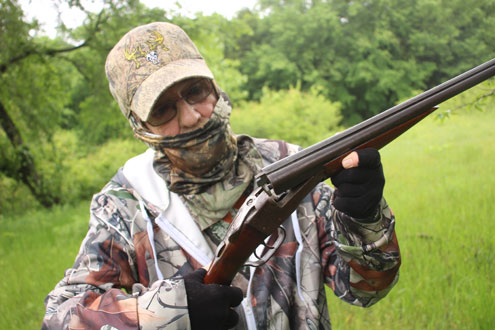
I got very lucky and managed to down a big longbeard during the first hour of legal shooting light and welcomed the opportunity to hunt with Bill and hopefully call him a gobbler withing range of that little .410.
Bill is a self-proclaimed “old school” hunter and has killed several gobblers in the fall, usually while deer hunting with a rifle but this was his first attempt at spring gobbler hunting. Back before he began running Striper Express four decades ago, he had more time to hunt in the fall but as most striper fishermen know, fall is prime time for chasing schooling fish and Bill was and still is kept very busy running his fishing business. Likewise with spring... no time to hunt turkey when the spring spawn is underway.
These days, Bill no longer guides but stays busy managing the business and, as he jokes, he can always sneak away for a short springtime day turkey hunt with his old buddy.
We both enjoy camp cooking and, on this hunt, I brought some turkey breast meat nuggets for a noon meal of seasoned fried turkey and grilled asparagus. We did the cooking on my little wood-fired rocket stove under a giant oak and made plans for him to put that little double-barrel Stevens to work.
The breeding season was well underway and many of the hens were on nests which results in lovesick gobblers on the prowl throughout the day looking for one more romantic encounter before every hen in the woods is setting on a nest. Some hunters favor hunting undisturbed gobblers early in the season but I’ve killed just as many birds later in the season. Gobblers often come in to the call faster when there are fewer available hens. I think the competition is so great that they are anxious to be the first suitor to reach that hen making those enticing yelps!
Before our hunt, Bill and I decided to put that little double-barrel to the test with the tungsten loads. We set up a piece of cardboard at 35 yards and drew a six-inch circle in the middle with a 2-inch red bullseye in the center. The pattern from the full-choke barrel placed far too many pellets in the circle to count and the modified barrel produced almost as many. This little shotgun with the new loads had plenty of power to down the biggest gobbler in the woods. Both Bill and I went into this hunt full of confidence his gun would do the job if my calling would entice a gobbler within range.
Our morning hunt coincided with scattered showers, not enough rain to call the hunt off but wet weather has never been my favorite time to go after spring gobblers. I have had great success after a period of rain when the sun pops out, but, on this day, the skies remained gray all morning with brief periods of sprinkles. Just after first light, Bill and I had Henrietta, my plastic hen decoy setting in a little clearing, 25 yards out from the edge of a heavy wood line. Henrietta has helped me dupe many a gobbler and through the years; I have come to think of the lifelike looking piece of molded plastic almost as a live turkey! There were a couple of big oaks for us to lean against and just enough cover between us and the decoy to help conceal our setup.
I always begin calling with soft hen yelps, just in case a gobbler is nearby. After a couple minutes of soft calls with no response, I decided to hammer down on my trusty old Lynch box call, I hoped to trigger a gobbler back in the woods and then call the bird in close --textbook turkey hunting, you know. The woods remained silent after each series of calls; nothing but water drops dripping on leaves did we hear. I then began calling softly every five minutes or so. Then, just out of sight at very close range, we heard what sounded like two hens talking back to us, answering quietly with the same little clucks and putts that I was making on the call.
We hoped the hens would have a big gobbler following but that was not the case. Both birds spotted Henrietta and one made a beeline for her. I filmed much of the action on video but was unable to catch what occurred without spooking the turkeys. They were as close as 20 feet at one time. The lead hen ran up to Heneretta, faced her eyeball-to-eyeball and tried to stare the decoy down. This was fruitless of course. The decoy remained motionless!
Then the live hen pecked the decoy on the head, hard! Henrietta’s head is fixed so that it bobbles up and down and when her head moved, the live hen nailed her again, repeatedly. It was comical to watch until the hen finally gave up on initiating a fight. She and her buddy moved through the field, slowly feeding on fresh green clover. We were able to get some really good footage for our TV show, “A Sportsmans Life” that Jeff Rice, Larry Weishuhn and I do each week for Carbon TV and YouTube.
Bill and I watched the antics of the two hens for a good fifteen minutes when the sprinkles turned into a downpour. The hens departed for the cover of a dense cedar tree and Bill and I packed up our gear, grabbed Henrietta and headed for the truck. Bill wasn’t able to put his little double-barrel to work on this hunt but we still have time this season to close the deal with a boss gobbler (or a fat Jake, we’re not picky} - we both have an affinity for fried turkey strips!
Catch Luke’s radio show/podcast “Catfish Radio with Luke Clayton and Friends” just about everywhere podcasts are found and watch the action on "A Sportsmans Life!”