Franklin became beloved inventor, patriot
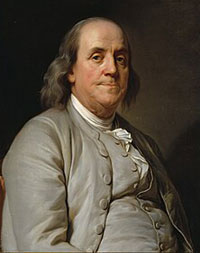
Franklin would be responsible for such a wide array of accomplishments, including the idea of the Gulf Stream in 1770, the first use of the pro and con list in 1772, the lightning rod, bifocals, and even creating schools and hospitals. Of the many inventions and innovations Franklin created that would change the world, the creation of the independent United States with the other Founding Fathers would further cement his place in history.
For over a year, Franklin had already been serving as postmaster general of the colonies, devising what would become the US Post Office. This was after several years of serving as a colonial agent in England, warning Parliament of its disastrous policies. Now as the Continental Congress prepared for independence in Philadelphia in June 1776, Franklin joined Thomas Jefferson, John Adams, Roger Sherman, and Robert R. Livingston in a committee tasked by Congress to make a statement to the world why the colonies were moving for independence.
Though the Declaration of Independence was overwhelmingly the work of Jefferson, Franklin made important suggestions and contributions. Most notably, where Jefferson repeated philosopher John Locke’s assertion that a government’s responsibility is to protect “life, liberty, and property,” Franklin suggested the change to “life, liberty, and the pursuit of happiness,” saying that the new nation was more than just about possessions but was about letting people live their own lives on their own terms under freedom.
Shortly after the Declaration of Independence was approved on July 4, Franklin, now past 70, left for France as the nation’s first ambassador to that nation. France had already been quietly supplying gunpowder to the Continental Army, but Franklin’s job was to secure recognition for American independence and to persuade the French to join the cause. He did the slow, careful work of building relationships that diplomacy requires, working to charm the French public and nobility.
The American victory at the Battle of Saratoga in 1777 convinced France that America was a winning cause. In February 1778, France became the first nation to recognize American independence and signed an alliance, bringing the French army and navy into the fight.
At the end of the fighting in 1781, he led the American delegation for the treaty negotiations. The Treaty of Paris of 1783 secured British recognition of US independence and a border set at the Mississippi River, among other concessions.
In 1785, he returned to the US and was elected to the Supreme Executive Council of Pennsylvania, becoming one of the three governors of the state, serving until 1788. In 1787, he became president of the Pennsylvania Abolition Society.
In 1787, delegates gathered in Philadelphia to devise a new constitution. At 81, Franklin was the oldest delegate. He offered insights and ideas, for he still believed in the importance of imagination, integrity, and fairness in government. Independence Hall, where debate took place, was just a few blocks from his home.
Franklin had built a successful career based on freedom of the press and speaking his mind. He understood the necessity of free thought to preserving a free nation.
“Without freedom of thought there can be no such thing as wisdom; and no such thing as public liberty, without freedom of speech,” he wrote.
After months of negotiations, the Constitution was drafted and sent to the states for ratification. When asked what kind of government the new Constitution created, Franklin is said to have replied, “A republic. If you can keep it.”
The Constitutional Convention would serve as Franklin’s last major public role. He continued to correspond and visit with friends and even sent a petition to Congress calling for the end of slavery. However, his health was declining.
He died in April 1790 at age 84. Almost the entire population of Philadelphia attended the processional at his funeral. Though he was not much of a churchgoer, he openly supported Christian and Jewish congregations throughout Philadelphia. At his funeral, every minister and rabbi in the city led the march in honor of their beloved neighbor. As the years passed, dozens of communities and counties would be named for him as well as many schools and colleges.